




















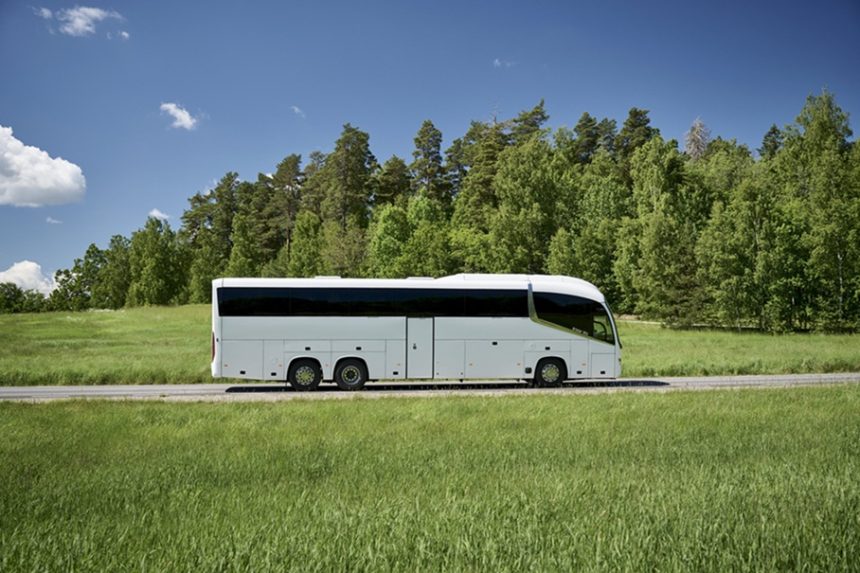
Scania seldom has been a manufacturer that favours a ‘big bang’ approach to product development, but it is now on the cusp of step change to availability of zero-emission in the UK passenger market with two coach models that can deliver that mode of operation and advancement of battery-electric in the bus market.
The zero-emission coach offering is made up of a straight battery-electric model and a plug-in diesel-electric hybrid option to complement the new Super diesel drivetrain based on a 13-litre engine. The hybrid will give up to 80km engine-off operation, which according to the manufacturer’s coach and bus team here makes it well suited to future zero-emission zones.
The hybrid unit, which besides being plug-in will recapture energy during braking, works in parallel with the engine at times of peak power demand. In that application, it will reduce fuel consumption. It will also handle moving away from stationary.
Completing the updated coach range is firm UK news on battery-electric bus. Scania UK Bus, Coach and Power Solutions Sales Director Mark Oliver notes how the low-entry chassis is settled upon and represents version 3.1a of the OEM’s work in that field. A focus is now on identifying body partners for right-hand drive.
He adds that key to successfully delivering change across multiple platforms is Scania’s vertically integrated approach to powertrains and the benefit that brings.
That applies also to compliance with the EU General Safety Regulation. While not yet required in the UK, it will be introduced here later. A fully integrated drivetrain has aided its homologation into passenger-carrying products. Scania has already delivered coaches into the UK that are fully compliant.
Zero-emission e.Levante coach is ‘showstopper’ for Scania
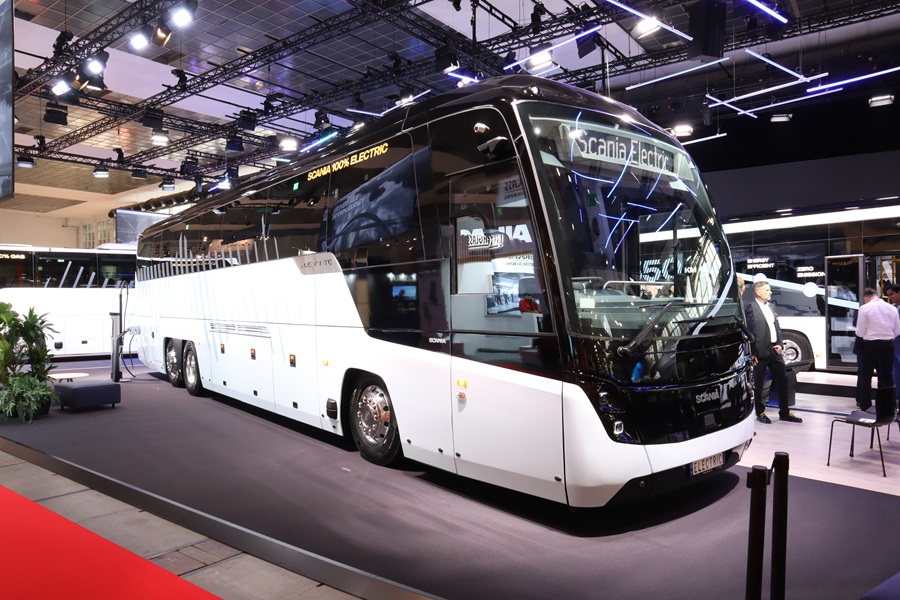
Most prominent among the new products is Scania’s battery-electric coach and high-floor bus platform. Notably, it makes its global coach debut in right-hand drive form with a Caetano e.Levante body. “This is our showstopper,” Mark says. The first appeared at Busworld in early October and will begin a demonstration programme here in 2026.
Choice of Caetano as the opening body manufacturer is deliberate, he continues. “The vehicle must suit scheduled service use, but we are not limiting it to that.” A version for retail buyers – including a centre sunken toilet and a continental door – will follow as Caetano bids to expand its reach in the UK coach market. It has made some minor cosmetic changes to the Levante as part of the overall battery-electric product.
To begin with, the coach will be built in tri-axle form at 14.3m. A 330kW motor is coupled to a four-speed gearbox. That is the latest Scania battery-electric drivetrain, which made its debut in truck earlier in 2025, and it promises excellent efficiency.
534kWh of battery storage is fitted to give a claimed 600km range. Scania sources cells from various suppliers and packs them itself. That allows it to configure the battery layout to suit the coach. For weight balancing purposes they are biased towards the rear bogie, with most on or around the chassis rails. That has a benefit for safety in case of a collision.

Minimising underfloor intrusion is another priority, and Scania says that the battery-electric e.Levante will have the same space there as a comparable diesel. Beyond the tri-axle model, a two-axle chassis will follow, and other bodybuilders will also join the equation. That will likely include the Touring offering along with Irizar products.
Hybrid coach maintains existing usability with engine-off scope
Irizar has already completed the first plug-in diesel-electric hybrid coach from Scania in left-hand drive with its i6S Efficient body. While hybrid in the bus field was seen as a bridge to full zero-emission, that is not the case for coach, says Scania UK Bus and Coach Fleet Sales Manager James Thorley.
“The hybrid approach is to permit zero-emission driving while maintaining ease of operation,” he explains. The Scania Irizar i6S Efficient has its 89kWh battery pack in the luggage bay but that will not necessarily be the case for other models; James adds that bodybuilders “can take a view” of where the energy storage is placed, while adding that adoption of a hybrid coach chassis does not represent a major change for those parties.
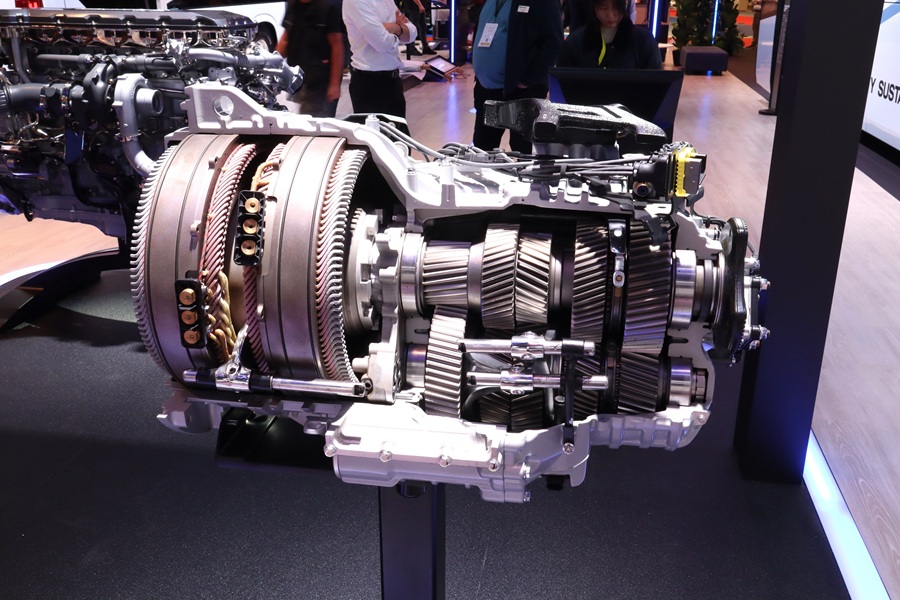
Electric drive is taken from a pair of 145kW motors integrated into the same casing as the Opticruise gearbox. A two-axle option will follow, which promises an 80km engine-off range compared to the tri-axle’s 70km. Scania UK has a tri-axle hybrid chassis in build for bodying by Irizar, with other partners to follow.
Sales Engineer – Bus and Coach Karolina Miiller notes how the hybrid driveline in a coach represents a good opportunity to combine no impact on operating cycles in long-distance operation with significant zero-emission scope. “Key here is the engine-off capability,” she notes.
A weight penalty of around 890kg is expected, along with a price uplift. But Scania recognises that some customers maintain modern fleets and replace coaches when still in early life. That is one factor influencing the payback period for the hybrid package, which is expected to be attractive.
A further benefit of the electric motor comes when otherwise running in diesel mode. As the Opticruise automated manual gearbox changes up, one of the electric motors can provide traction during the ‘pause’, smoothing the ride for passengers.
Super diesel powertrain promises benefits for diesel
When the hybrid system is specified, it will be coupled to the Super diesel drivetrain. Super is also the major development for standard diesel coaches. It uses a new 13-litre engine, but that power unit sits with other components to collectively deliver a claimed 8% reduction in fuel consumption compared to the outgoing 13-litre model.
“Our fuel efficiency is already good, and this platform will be even better,” says Retail Sales Manager Lee Wale. The new engine on its own is expected to reduce diesel use by 5.7%. It will come at 420bhp and 460bhp both in conventional diesel form and with the optional hybrid unit. A 500bhp option will also be offered without the hybrid pack.
While the Super engine is a development of the existing DC-13, it has some major structural changes. Dual overhead camshafts are fitted to enhance valve timing control, while thermal efficiency is improved. Aspiration and combustion are also better. The SCR unit within the exhaust now uses a twin-dosing strategy. That will increase Ad-Blue use to around 11% of diesel and so larger tanks will be fitted.
A further part of the overall fuel economy improvement comes via new 12-speed Opticruise automated manual gearboxes. Those are configured to match the Super engine’s low-speed, high-torque delivery, and hence 11th gear will be direct drive and 12th will be overdrive.
The gearbox contributes a 1% fuel consumption reduction via a claimed 50% fall in internal friction losses, a reduction in unit weight, and a better ratio spread. Now utilised are a variable oil level and half the number of synchromesh units, giving faster shifts. A planetary gearset is used for reverse and to select high or low range. Finally, new drive axles further optimise the Super package.

Battery-electric bus for UK at final stages
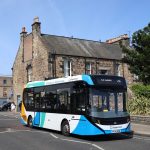
Scania UK has taken time to bring battery-electric bus products, but there is now some clarity on how they will progress. For the version 3.1a chassis that will be deployed here, the Fencer body will be available but products from other partners will complement it.
“It is now a case of selecting bodies that suit the UK market,” Mark notes. The same generation of electric chassis was seen at Busworld with an Irizar i3 body. He does not rule out offering a tri-axle option here if the market dictates, but it remains the case that a double-deck product will not be forthcoming.
“We have customers in the UK asking for a Scania battery-electric bus,” Mark continues. When the chassis arrives, it will come with various driveline options. A 240kW motor will be coupled to a two-speed gearbox while 270kW, 300kW and 330kW options will work with a four-ratio unit. Front or rear charging sockets will be available.
Arrival of battery-electric coach and bus products and a hybrid option for coach will represent a big step for Scania in the UK. For it to lead on the manufacturer’s electric coach platform is a major coup. The priority is to get completed vehicles here and into service, Mark says. But core diesel is not forgotten, and the Super driveline promises a notable evolution. Scania certainly now has a chassis line-up fit for the future.