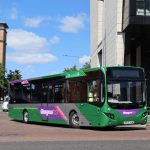





















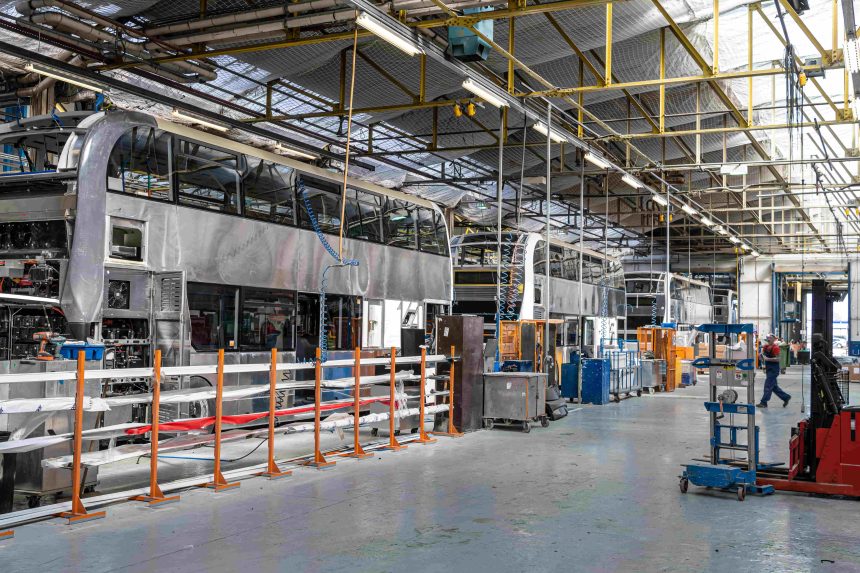
Alexander Dennis has set out new proposals for its Scottish manufacturing operations, saying it is now consulting on a plan to convert its Larbert facility into a chassis manufacturing hub while closing its Falkirk site.
The move would retain around 350 roles in Scotland and safeguard approximately 200 jobs that were previously at risk, although up to 115 positions still face potential redundancy.
Alexander Dennis says the consultation is intended to preserve a core industrial presence at Larbert while leaving open the possibility of reintroducing body manufacturing in the future should market conditions improve. It adds that the revised strategy reflects continued pressure on the UK bus manufacturing sector, where domestic producers have lost ground to overseas competitors despite increased public funding for zero-emission vehicles.
“We are proposing to retain jobs and restart manufacturing at Larbert with a focus on chassis manufacturing. This represents the best possible outcome for our business, employees, customers and supply chain partners in the current climate,” comments Paul Davies, Alexander Dennis President and Managing Director. “This new approach would enable us to better align with the current market while improving our efficiency. It also allows us to continue to adapt to rapidly changing and challenging market dynamics.
“We remain grateful to the Scottish government for the furlough scheme support to secure these jobs, maintaining skills and manufacturing capability in central Scotland. We will continue to work with the Scottish Government, its agencies and the trade unions to support staff during the consultation period. We are absolutely committed to doing the right thing by our team members and our stakeholders to protect jobs, invest in our business and maintain strategically important manufacturing capability in Scotland.”
In making the announcement the company reiterated concerns about procurement policy and funding allocation. It argues that insufficient emphasis is placed on the contribution of domestic production and the higher cost base of UK manufacturing, and is critical of the fact that more than half of zero-emission buses purchased in the UK in 2025 were sourced from outside the country.
“We continue to repeat the same calls to both governments to level the playing field, recognise the cost of manufacturing in the UK and the fact that these higher costs flow through the supply chain,” adds Mr Davies. “Manufacturing in this country needs to be better supported if we are to generate the economic benefit that the country so badly needs.”
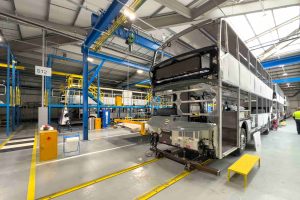
The latest proposal is an evolution from plans announced in June 2025, when the manufacturer outlined intentions to close its Falkirk factory and suspend production at Larbert, consolidating UK bodybuilding activity at its Scarborough site as part of a cost-reduction drive.
At that stage, up to 400 jobs were at risk, with the company citing changing market dynamics and the need to improve efficiency.
Through the summer, efforts were made by the Scottish Government, industry stakeholders and the manufacturer itself to avert the closures by securing additional orders and policy support. The company indicated that a pipeline of 70-100 buses for 2025, and up to 400 for 2026, would be required to sustain Scottish production, while a furlough scheme was explored to bridge gaps in demand.
Those interventions culminated in September with an agreement to keep both Falkirk and Larbert sites open, supported by a 26-week furlough scheme designed to preserve skills and manufacturing capacity while orders were pursued.
routeone understands the further orders and policy support have not materialised to the degree anticipated, hence the proposal now being consulted upon.