



















The recent launch of phase two of the Bus Safety Standard revealed the technology and design changes set to shape London’s bus fleet, as TfL continues its Vision Zero drive
It now seems almost unimaginable that passengers were allowed to hop on and off London buses while they were moving via an open rear platform.
Bus safety – much like road safety in general – has improved substantially since those days.
The number of casualties on UK roads decreased from 7,499 in 1970 to 1,602 in 2024 despite the volume of traffic more than doubling over that period. The technological, engineering, and cultural changes which have led to such safety improvements have been seen in the coach and bus sectors too.
The rate of killed or seriously injured casualties among coach or bus occupants has significantly decreased from 1,699 per billion vehicle miles in 2015 to 1,145 per billion vehicle miles in 2024.
Transport for London (TfL) has a target that by 2030 no one will be killed in or by a London bus. Key to that aim is the Bus Safety Standard, which was launched in 2018.
Work from TRL (formerly Transport Research Laboratory) published this year shows that the reduction in casualties was significantly greater on Bus Safety Standard routes (-40.8%) compared to control routes (-21.5%) when comparing figures from 2016/17 to 2023/24.
TfL data shows the number of deaths involving buses on London roads in 2025 was, at 10, the lowest level since 2021 and that passenger injuries are the lowest on record – apart from the pandemic-affected 2020.
It also claims a 28% reduction in the number of people killed or seriously injured in collisions involving a bus compared to the 2010-2014 baseline.
In terms of passengers and drivers, the reduction is 40%. TRL noted that camera monitoring systems reduced incidents by 47.7% on those routes compared to 20.9% on control routes.
Aside from camera monitoring systems, other features brought in by the Bus Safety Standard have included acoustic vehicle alerting systems providing audible sounds on electric and hybrid buses, intelligent speed assistance, advanced emergency braking (AEB), blind spot detection, pedal error mitigation, and runaway bus prevention.
Bus Safety Standard 2’s aims
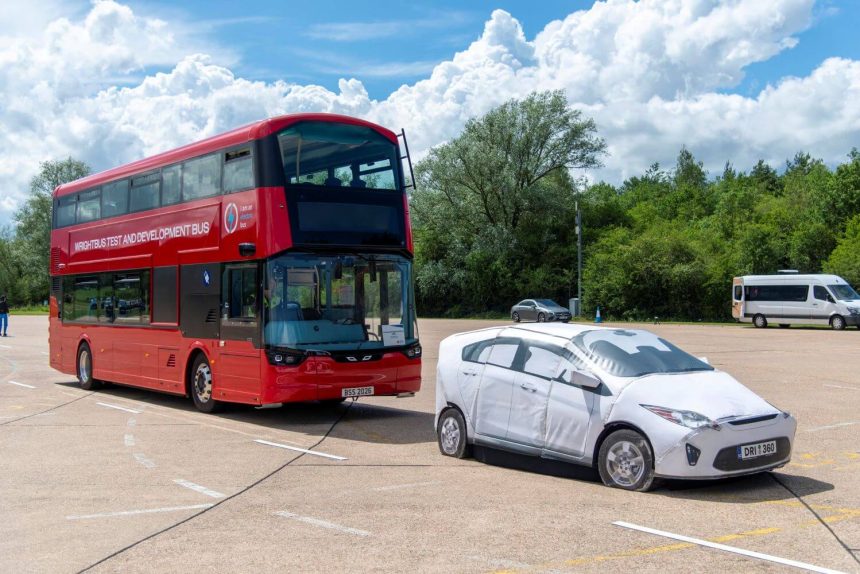
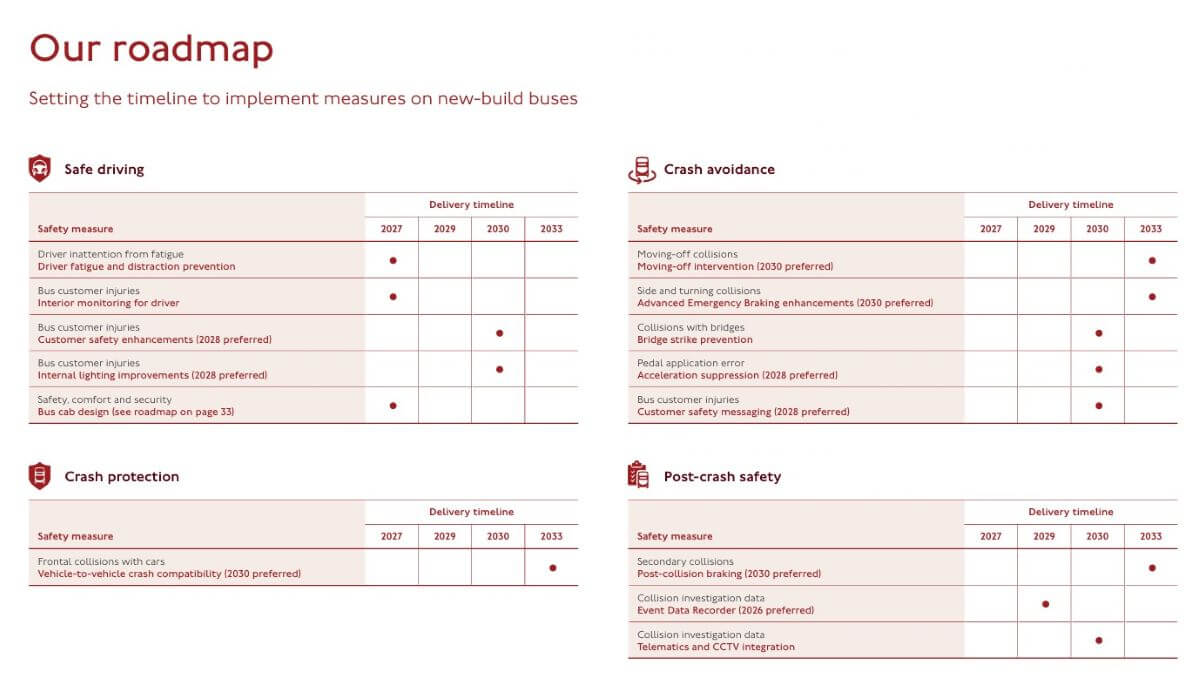
At the launch at UTAC Millbrook in June of phase two of the Bus Safety Standard, the requirements for buses entering service in London in 2027, 2029, 2030 and 2033 respectively were set out.
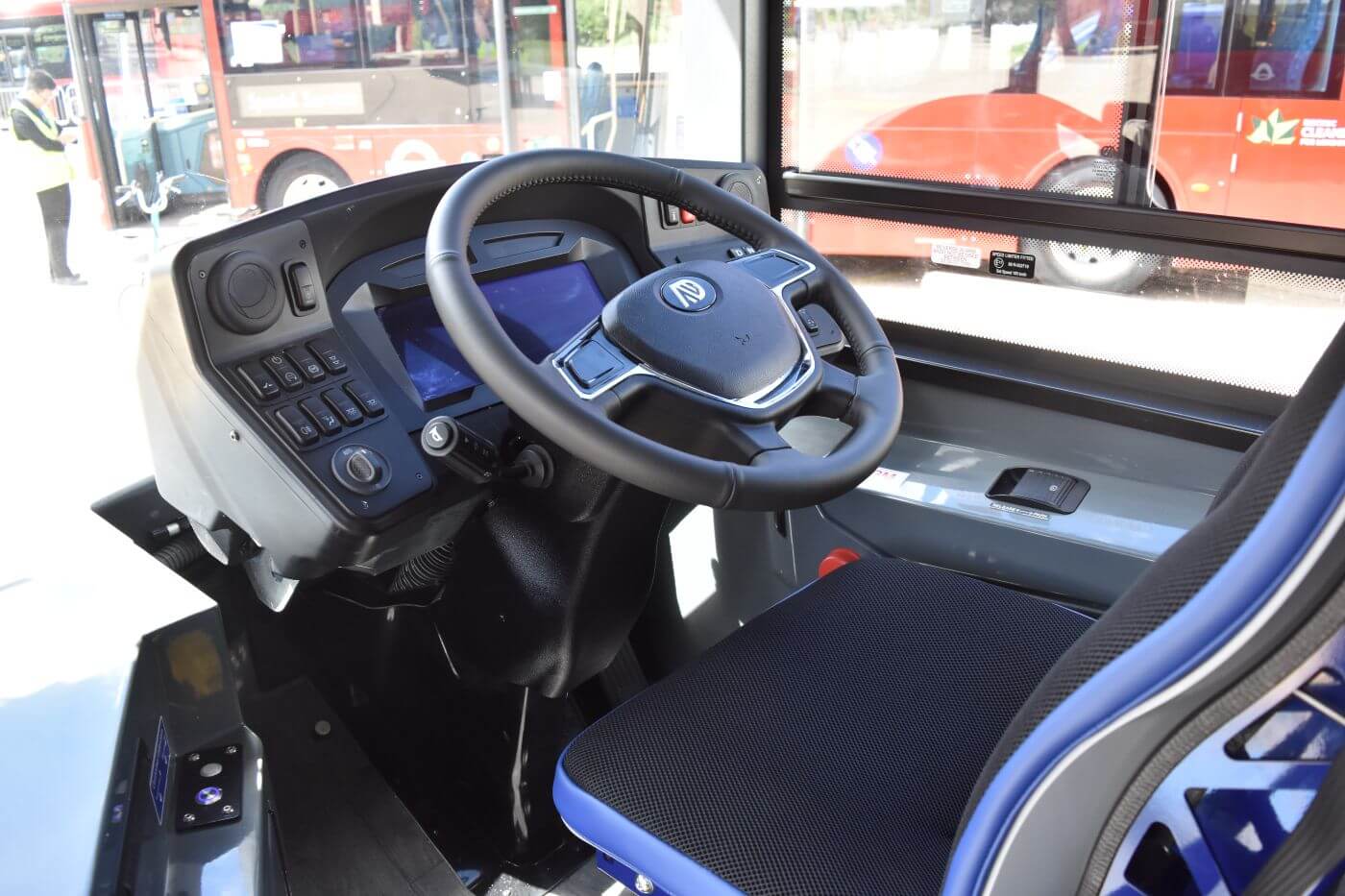
Heavily emphasised were improvements to bus driver cab design to enhance safety, inclusion, and comfort, which will be introduced from 2027.
Driver fatigue and distraction prevention technology will also be standard in new buses entering service next year.
Features of that will include haptic and audible driver alerts, management alerts, and a data dashboard. Trials of this on around 400 buses have been positive, TfL says.
The Bus Safety Standard will standardise how drivers’ interior monitoring systems display CCTV images to minimise cognitive overload while boosting passenger safety.
The introduction of tip seats in priority areas will allow more room for users of wheelchairs, mobility scooters or buggies while improving safety for anyone standing in those areas.
Following research from University College London, new internal lighting requirements around positioning and colour will be stipulated from 2030.
This is aimed at reducing passenger slips, trips, and falls, which are recognised as being the leading causes of safety incidents on buses.
Set to be compulsory from 2033 for new vehicles, a “moving-off intervention” system is designed to detect pedestrians or cyclists in front of a bus and either warn the driver or prevent the vehicle from pulling away.
AEB will be enhanced to include situations where the bus is turning, with the requirement coming into force for new vehicles from 2033.
Another development will be acceleration suppression, which activates when the accelerator pedal is fully and forcefully depressed, which can happen when drivers mistakenly press the accelerator thinking it is the brake pedal.
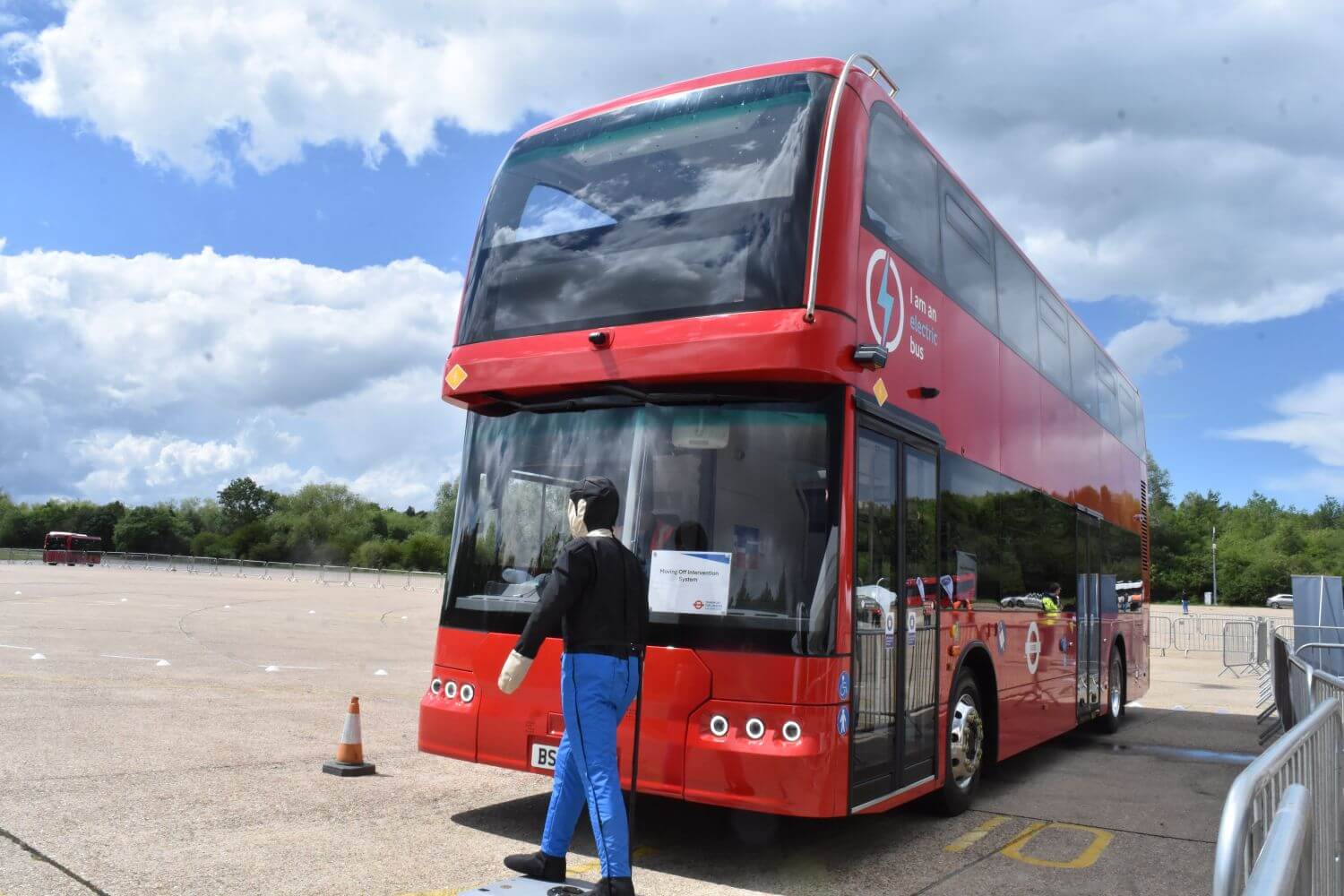
Customer safety messaging to become mandatory from 2033 includes displays showing upper-deck seat availability to help passengers avoid unnecessary stairs, which could reduce the risk of injury.
Bus front end design is already a Bus Safety Standard feature to prioritise pedestrian protection in collisions but, from 2033, compatibility with other vehicles will also have to be considered in new vehicles.
A device at the front of the bus will help absorb greater impact energies and prevent smaller vehicles from going under the bus in a collision.
Also lined up is a system which automatically applies the brakes upon detecting a collision. It will require development before becoming mandatory from 2033.
Event data recorders will be mandatory from 2029 and will provide crucial information about accident causes to inform future safety improvements.
Telematics and CCTV systems will similarly capture data from a broader range of incidents.
Wider geography targeted by Bus Safety Standard
Many measures from the first phase of the Bus Safety Standard have become standard features on vehicles in Manchester, Northern Ireland, Hong Kong and Singapore.
Combined authorities which are progressing down the franchising route have shown interest in adopting aspects of the Bus Safety Standard.
Kerri Cheek, TfL Senior Bus Safety Development Manager, says: “[Authorities] don’t need to do any extra research; it’s all been done. So, all they need to do is ask [manufacturers] for it, and the more people that ask for the standard, the cheaper it becomes, because the cost could be spread more widely.”
The government’s Road Safety Strategy, which was published earlier this year, noted the efforts of the Bus Safety Standard.
Combined and local authorities which are set to take greater control of bus services may choose to stipulate such minimum standards, but there is a case that the responsibility should not be fully devolved.
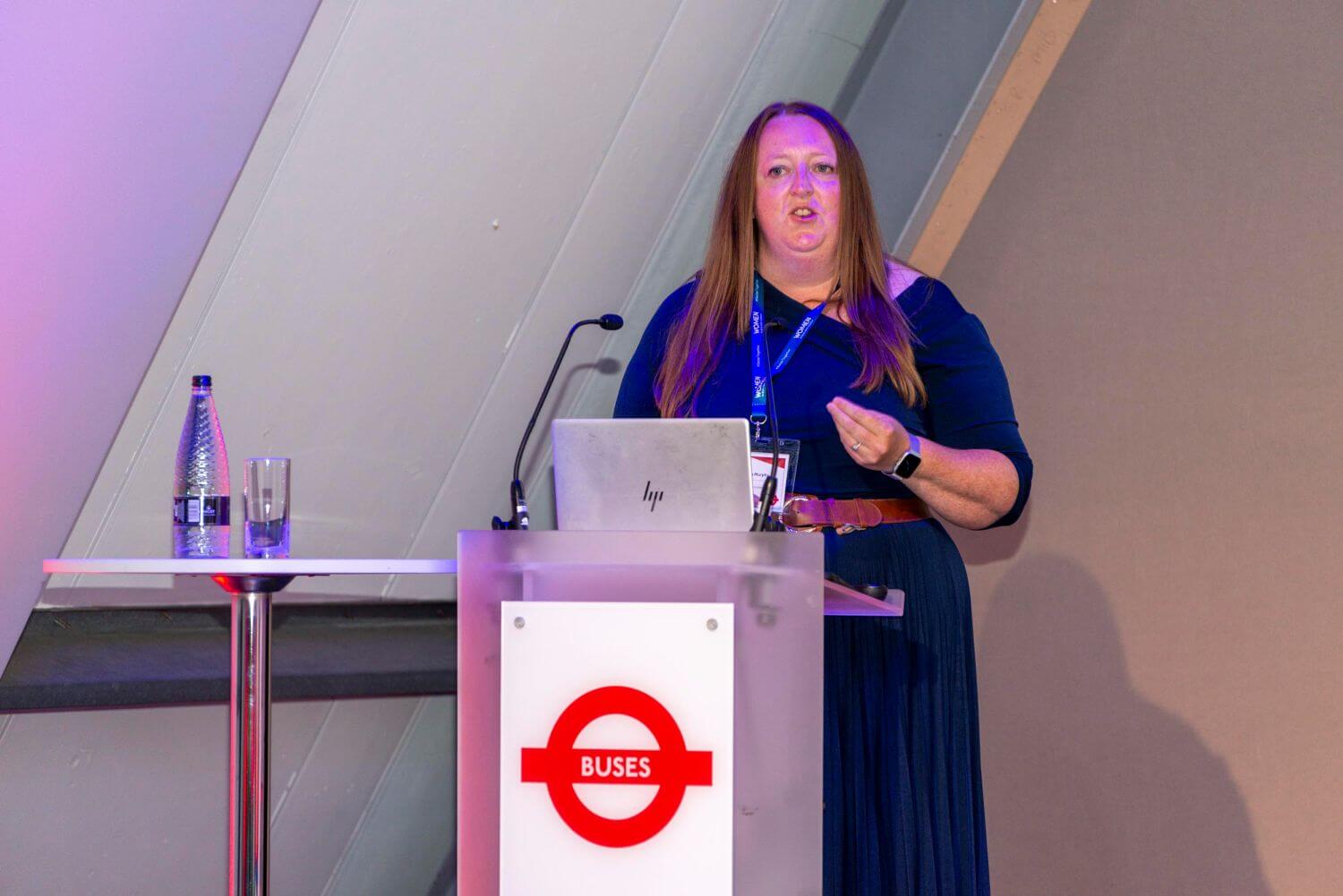
On whether the government should do more on bus safety, TfL Director of Buses Lorna Murphy says: “We’d love to see government really push this forward into legislation and regulation, because we think it’s the right thing to do.”
The Bus Safety Standard could have benefits for the coach sector too, if applied more broadly. Kerri highlights the work around driver cab design, for example.
She says: “It’s a different environment to the bus cab because of just the nature of the job, but there are a lot of similarities between the two.
“And, in some respects, coach [cabs] are slightly more upgraded than bus [cabs], but still below truck.
“What we want to see is that clear thinking that comes through to say, if you’re having this in cars … that should be filtering through to what is someone’s working environment.”
Operator considerations
Paul Lynch, Managing Director of Stagecoach London, highlights that the Bus Safety Standard has several implications for bus operators. As well as the many benefits, the requirements add to costs where margins are tight.
TfL estimates that Bus Safety Standard 1 requirements added on £20,000 to £25,000 per bus, which as a fraction of the cost of an average electric bus is “quite low”, according to Kerri.
Lorna adds: “It’s well worth that cost, because obviously the impact of not doing it is far greater, and it’s more than a financial cost.”
If people believe that buses are safe, they will use them – Paul Lynch
Speaking at the launch, Paul concedes: “There are challenges around fleet investment and modernisation, there are higher investments up-front, more complex specifications and longer lead times for procuring.”
He also refers to considerations around driver training and behavioural change. He points out the standard has accelerated the move away from maintenance being a mechanical discipline to a technical one.
However, he supports it, adding: “It’s provided progress for the industry, not just [in] London, that might not [otherwise] have happened at all.”
Listing some of the benefits, he continues: “Reduced collisions, less severe incidents, fewer claims, perhaps over time lower insurance costs. But it could lead to increased public trust… In a city where scrutiny is high, trust is a valuable asset. If people believe that buses are safe, they will use them.”
Keeping standards achievable
The work of the Bus Safety Standard is about laying down minimum achievable targets for all operators rather than innovating at a pace which is unrealistic for operators and manufacturers.
For example, measures such as low bridge detection technology have been a feature on all Stagecoach double-decker buses in the UK since 2022, but this won’t be required by the Bus Safety Standard on all new buses in London until 2030.
Kerri says: “We want to standardise this across all of the manufacturers, so we need to look at what the OEMs are able to deliver and their timescales and make sure that we’re not introducing something a lot earlier than most of them can achieve, because that then comes back to the commercial issues which really constrain the market: which vehicles that [operators] can choose from, which suppliers, and that then becomes anti-competitive and that can drive up costs.” Operators and manufacturers can, of course, work to faster timelines.
Paul says on this: “The Bus Safety Standard is effectively a partnership: TfL to set the direction, manufacturers to develop the technology and operators to deliver it effectively on the ground. It’s important for TfL not to overspecify that safety standard and thereby exclude some manufacturers or unnecessarily increase … costs.”
Notable by its absence for a strategy which covers up to 2033 was mention of autonomous buses – albeit that many of the standards introduced by the Bus Safety Standard are also features of driverless technology.
After all, Jim Hutchinson, CEO of autonomous vehicle technology leader Fusion Processing, believes the technology will allow buses without on-board safety drivers on the road by the end of 2027, assuming the necessary government legislation is in place by then.
As Paul mentions: “Planning new standards seven years ahead can help bring about that change, but it also risks being outmoded by other developments.”
Kerri points out that London, with its complex infrastructure and busy streets, is likely to be among the last areas to adopt autonomous buses.
“We’re interested in how the technology can support us now rather than what it might look like in 20 or 30 years’ time,” she says.
TfL’s target of eliminating deaths in or by a London bus by 2030 remains ambitious, but the Bus Safety Standard demonstrates how incremental improvements can deliver significant gains. With local authorities set to exercise more control over bus services, London may be laying a template for the rest of the UK to follow.
Imposing such standards inevitably brings challenges for operators, not least in terms of cost.
However, if buses are to keep pace with the improving safety performance seen across other modes of transport, continued investment in safety technology will be essential.
Beyond the obvious human benefits, safer buses can also help strengthen public confidence in the mode, thus supporting patronage growth.