




















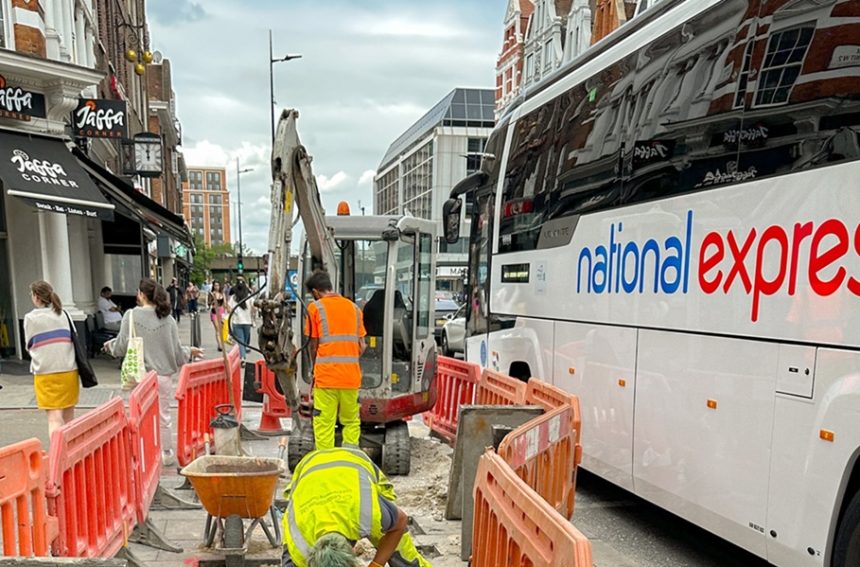
Transport Committee Chair Ruth Cadbury has attacked the government for what she says is unwillingness to stand up for road users in England impacted by “never ending” street works undertaken by utility companies.
On 1 September, the government responded to a report published following the Committee’s Monitoring the impact of street works inquiry. That document, released on 3 July, issued recommendations that it said would reduce the disruption caused by “lengthy and often-repeated street works” by utility companies.
The government response is lukewarm, a position that has drawn the ire of Ms Cadbury. She notes that all major recommendations have been rejected by the Department for Transport (DfT).
That approach risks the government “making itself simply look unwilling to stand up to utility companies on behalf of frustrated road users who have to endure unreasonable and often repeated street works delays,” says Ms Cadbury.
How street works impact coach and bus has repeatedly been highlighted by members of the industry and their representative bodies. The Confederation of Passenger Transport (CPT) previously pointed to an instance in Plymouth where a 350-metre section of road suffered 25 separate sets of street works in 2024.
Among the report’s recommendations was support for more local authorities to establish lane rental schemes to incentivise early completion of street works.
While DfT agrees that lane rental has been effective where already present, it notes that such an approach “is not suitable for every area” and claims that many local authorities “do not experience the levels of congestion necessary to justify the administrative and financial burden of operating such a scheme.”

The government adds that risk of “inconsistent and fragmented” use of lane rental powers across England sits against the tactic solely being a tool to reduce disruption on the busiest roads and not to act as “a revenue generator.”
That has drawn scorn from Ms Cadbury. She says there is “a contradiction” in government opposition to wider adoption of lane rental by way of fear of misuse of by local authorities being at odds with an agenda for devolution and of empowering those bodies.
Highlighted in the report is growing use of emergency permits. During the evidence gathering stage of the street works inquiry, CPT Operations Director Keith McNally told Committee members that it is an increasing problem for coach and bus operators.
The report sought limitations on emergency authorisations. In response, the government acknowledges “concerns raised by some highway authorities about their potential misuse” but says it will continue to monitor usage trends and keep the matter under review.
Also advocated by the Committee was placing a longer-term responsibility on utility companies for durability of their road reinstatements. Presently there is a two-year guarantee period, which the Committee wants to become five years.
The government says it is watching a similar change in Scotland before considering any such move and notes how a performance-based inspection regime introduced in 2023 – the cost of which is covered by utility companies – is already established.
Longer-term planning, creation of a street works commissioner and improving accessibility when works are in place were also among recommendations.
The Committee says that in FY2023/24, there were around 2.2 million instances of street and road works in England. “Road users in constituencies across the country trying to get around and access shops and services deserve better,” says Ms Cadbury. “Our recommendations, if adopted, would help to grip this never-ending nuisance.”