



















As the Bus Services (No.2) Bill in England moves through Parliament, thoughts turn to how it will play out once in law. Royal assent is now likely before the end of 2025. From there, the expectation is that three rollout phases will follow, says Confederation of Passenger Transport (CPT) Director of Policy and External Relations Alison Edwards.
Ms Edwards was speaking on 16 September at the Route Forward conference organised by Backhouse Jones and CPT. She cautions that no concrete timeframe can be defined until the bill becomes law. Backhouse Jones Legal Director James Backhouse adds that there is still scope for change to be made.
Department for Transport (DfT) Director for Buses and Inclusion Stephen Fidler would not be drawn on whether CPT’s timeline predictions are accurate. But he notes that the trade body’s forecast reflects “quite a lot of our emerging thinking.”
Mr Fidler – who urged local transport authorities (LTAs) and operators to explore the full extent of Enhanced Partnership (EP) and franchising scope – adds that DfT will want to take introduction of the legislation “step by step, and put things in place gradually.”
First phase of Bus Services (No.2) Bill to come quickly
The opening phase of implementation is set to start two or three months after royal assent. An update to existing bus franchising guidance is likely then, although Ms Edwards believes that there will be no ‘deep dive’ into complex elements. That will come at a later stage.
“Something else we expect to see in this phase is statutory guidance to LTAs [in England] around how to use their new grant-making powers [for bus],” she continues.
Those bodies will be able to create and administer their own bus grants. That will give much more autonomy on bus spending, including on supporting services. Ms Edwards describes such powers as important, and the guidance will be equally so.
Also predicted for the first phase is guidance to LTAs on floating bus stops. Those pieces of infrastructure are increasingly controversial, particularly where bus passengers board from or alight into space shared with cyclists.
Second phase of deployment will see major work
The second phase of rollout is expected in early to mid-2026. It will see publication of statutory guidance on various other powers within the bill, including how a new local authority-owned bus company may be established. Details of an expanded group of parties that can audit a franchising assessment is also projected for then.
EP guidance is likely to see a refresh at this juncture. That will take account of new powers for LTAs, but Ms Edwards adds that it will also consider outcomes from an ongoing review of EPs. “We are expecting things in [the guidance] around new minimum standards, publication of performance data, and suchlike,” she says.
On EP changes, Mr Backhouse’s assessment is that DfT is seeking to make the mechanism more flexible and give LTAs some additional tools akin to those of a franchising authority. He believes that alongside other measures, such a shift will increase the popularity of EPs.
“The purpose is to allow EPs to have longevity,” he continues. “A risk is perceived that they start with a bright flashing light, but five years later, arrangements are old and vehicles and commitments are ‘past tense’. This is designed to encourage a much longer-term view in an EP.”
Likely to be part of that are socially necessary bus services. CPT expects phase two to be when DfT sets out what is required of LTAs and operators in that field and how such services become protected in an EP.
Mr Backhouse says that LTAs may seek to place obligations on operators such as to consider alternative arrangements if they wish to withdraw socially necessary services. It may well additionally be that LTA grant money comes forth to support routes that would otherwise be lost. “That is a very easy thing to say, but let’s see how it pans out on the ground,” he cautions.
An important expected part of phase two is publication of guidance on direct awards of franchising contracts to incumbent operators. That is described as “contentious” by Mr Backhouse, who notes that CPT has been working with DfT to ensure that the process is fair.
Wrapping up loose ends will be the third phase
Phase three of the rollout process is expected at the end of 2026, the Confederation believes. Ms Edwards predicts that it will see statutory instruments laid to capture the mandatory training for drivers on antisocial behaviour and disability awareness.
Also forecast to be part of phase three is how LTAs in EPs or franchising schemes will be required to provide bus service information to common location and data standards, with CPT working to ensure that commercially sensitive material does not enter the public domain as a result.
Beyond that, from 2027, a statutory instrument will be laid to give LTAs the power to tackle fare evasion, while a date for when new non-zero-emission buses can no longer be used on local services in England is due in the longer-term. The earliest that can be set for is 1 January 2030.
Mr Backhouse observes that while work around the Bus Services (No.2) Bill seeks to give more control to LTAs regardless of whether EP or franchising is adopted, protections for operators will be included. “The devil will be in the detail, and that detail will be within the statutory guidance,” he advises.
Exploring the predicament of SME operators in bus franchising
Separate to considerations of the Bus Services (No.2) Bill, the position of SME operators in bus franchising was close to discussion at Route Forward. Mr Fidler acknowledged that aspiration for their involvement in Greater Manchester “did not work as well as it might have done,” although he caveats that by adding how in a first-mover scenario, there is much to be learned post-occasion.
Backhouse Jones Legal Director Jonathan Backhouse believes that there will be opportunity for SMEs in future franchising schemes, although he notes how in all such shake-ups there are losers as well as winners.
“For small and medium operators working in rural and interurban environments, now is the time to get your voice heard. What can you deliver? How can you do that? There may be models that you are not even thinking about that could be implemented into these [franchising programmes].”
Prominent was talk of how large operators can subcontract franchised services to SMEs. Go South West Managing Director Richard Stevens told the gathering of how that structure works under Enhanced Partnership in Cornwall, where the Go-Ahead subsidiary subcontracts to three such businesses.
Mr Stevens previously explained how that works. He adds that while Go South West won all supported service contracts in Cornwall, the subcontracting approach adopted served to protect SMEs.
He believes that the same could be achieved in franchising but cautions against over-complicating the process. A local transport authority (LTA) should ask at the outset whether a large operator will work with SMEs and seek the same in reverse of those smaller businesses. “Score on that basis, and I believe we could preserve the SME network,” Mr Stevens continues.
Collaborating in such a way may be easy on paper, but two SME operators active in West Yorkshire gave an element of real-world concern about what the future could look like under franchising, subcontracting or not.
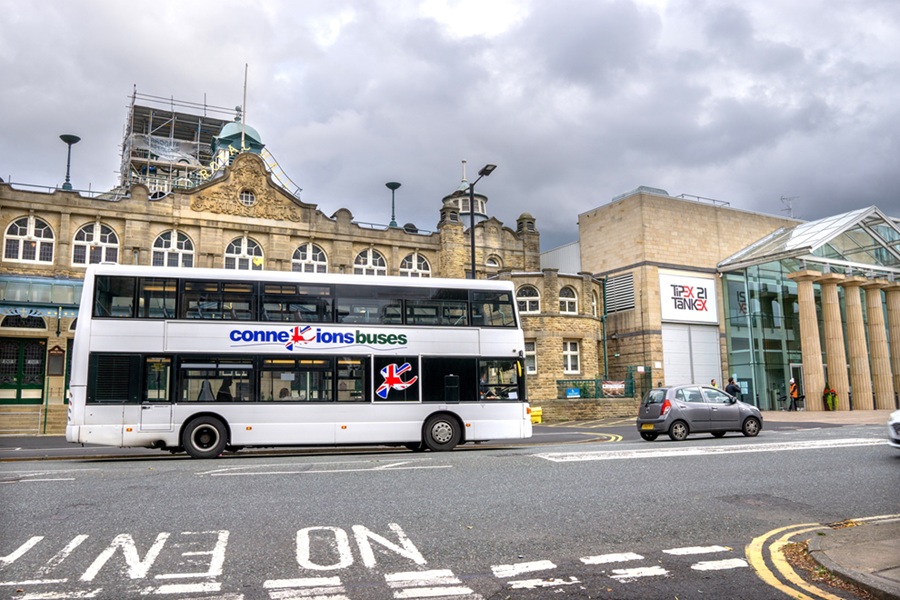
Connexions Buses Managing Director Craig Temple has significant worry about how reregulation will affect SMEs. While accepting a need to look at doing things differently, he contrasts that with exhaustion among some small operators from years of uncertainty. He believes that they now look at franchising as a threat that they no longer have the motivation to tackle.
Meanwhile, Yorkshire Buses Director Steve Carr sought clarity on business confiscation from unsuccessful incumbents via franchising. “Ticket machines, vehicles, equipment – as Stotts of Oldham found, that can all end overnight,” he told the conference.
“Nobody will ask who is going to pay for that. We have already paid for it, because it was demanded of us by the West Yorkshire Combined Authority and its predecessors when we took on contracts.”
Mr Backhouse acknowledges how that point is unanswered. He suggests that there could be a claim under human rights legislation but adds that it would take a brave SME indeed to pursue that.
He additionally cautions that the move to franchising will affect coach operators that carry out home-to-school contracts on behalf of LTAs if those are wrapped into franchise packages.
“The cliff edge moment is not just a commercial cliff edge. It is a personal one. That is the problem with it, as we saw in Manchester,” says the legal expert. While one coach operator in Greater Manchester pivoted its business away from home-to-school, that was a major task.
“If [LTAs] want to keep SME operators involved in franchising, then they need to stop the cliff edge every five or seven years or reduce the risk of it.”