




















The landscape for home-to-college transport is often-changing, with provision procured directly by those establishments evolving as student numbers and local bus networks do the same.
In more rural areas, the challenge to colleges of ensuring that students can get to and from education is significant, but Callywith College – on the outskirts of Bodmin in Cornwall – is doing its utmost to bring in as many of them as possible by bus, having commenced a new contract with Stagecoach South West for 17 such services at the start of this academic year.
All of those are provided on an open-door basis and hence they comply with applicable requirements such as the Bus Open Data Service. Stagecoach took up the work after expiry of the previous contract with another operator, and it is overseen from the educational establishment’s point of view by Callywith, Truro and Penwith Colleges Strategic Transport Manager James Church.
He has a long career in coach and bus that includes time spent with First Bus, Go South West and Roselyn Coaches. That brings strong operational knowledge coupled to a clear understanding of Callywith’s requirements for the services. James is quick to commend Stagecoach South West through its Managing Director Peter Knight and Head of Commercial Simon Ford for their approach to engaging with the college to deliver the network it sought.
Additionally, as a committed public transport proponent, James believes that good bus services for home-to-college travel help to retain young people as users of the mode when they move on in life.
Callywith has a policy of encouraging as many students to travel by bus as possible. That brings with it a degree of training need in some cases, but changes with the new contract are seen as strong ways in which to further grow usage.

Technology drives evolution on home-to-college transport
Callywith College opened in 2017. It then had only four dedicated home-to-college bus services but that grew quickly to peak at 21 across a catchment area of east, mid and north Cornwall. Since 2020 the number has been pared back to the current 17, but those vehicles are largely full. The college sells passes to vehicles’ maximum capacity.
Some students use the public bus network instead, but capacity to move large numbers of additional travellers to it at peak times is limited, James observes. Most bus duties in Cornwall already include education-related movements.
Six bids for the current contract were received by the college. James acknowledges that a 17-vehicle requirement is likely to be easier for larger operators to deliver, although he notes a theoretical position where SMEs could work together around a lead bidder on big contracts. Assistance from travel technology suppliers is also a factor.
In that field, RideTandem works closely with Callywith and Stagecoach on delivery of the current contract. The operator opened a depot in Bodmin on a ‘full service’ basis, with vehicle washing, fuelling, and on-site supervision for the period that buses are on the road. Those added extras “were quite a thing for us,” James says.
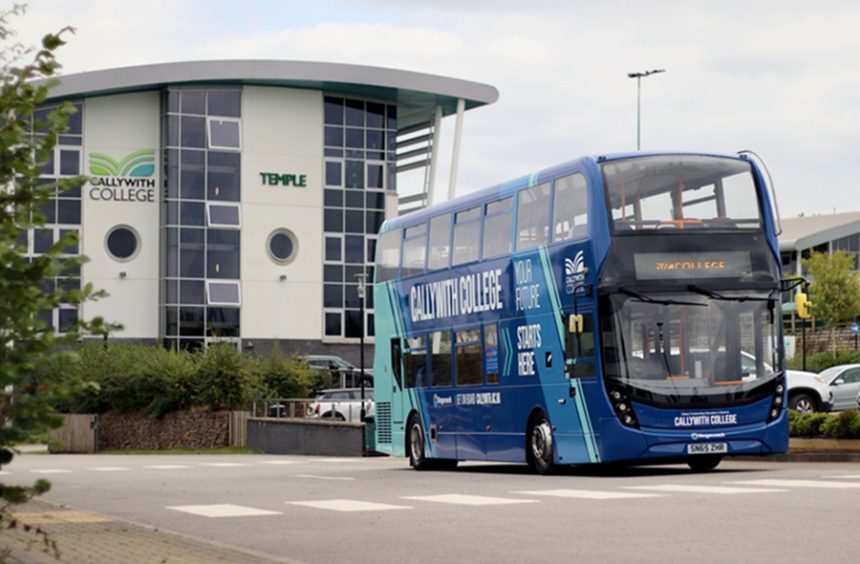
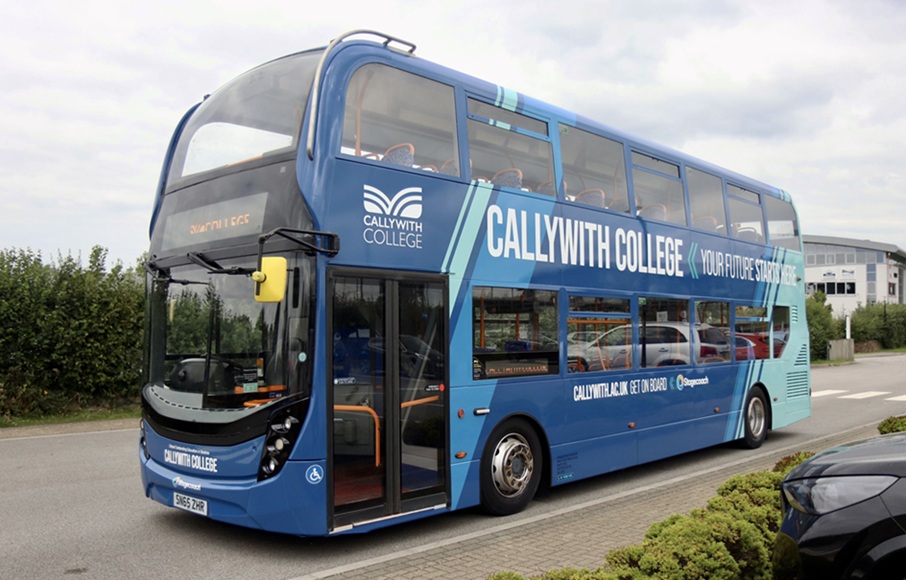
Stagecoach will paint five buses into a striking Callywith College livery. That is a valuable marketing tool for the educational establishment, but the relationship works both ways.
Double-decks operate all but one of the 17 services, but there is flexibility on vehicles when it works for both parties. James points to occasional needs from Stagecoach to deliver event shuttles; if that occurs at quieter times of the academic year, the college is amenable to smaller vehicles being swapped onto its services if they can carry the load.

Transport to and from home key to Callywith College experience
The contract is for five years with a pair of one-year optional extensions. Safeguarding for students is a major consideration in how it is delivered. The RideTandem app allows buses to be tracked and passes to be held. Parents and guardians can also use the app to see where their family members are.
Drivers configure on-board hardware before leaving the depot, and hence James and colleagues – along with students – can see in advance that the bus will start the morning route on time, rather than tracking commencing when it enters service. A separate device on buses is used to validate QR code tickets.
In the afternoon, buses are required to be on site well in advance of departure. Vehicles must be under 15 years old. “When I put the tender package together, someone told me I was asking for too much, and that I would not get it,” James says.
“But why should I not ask for it? I want the Callywith contract to be the best it can be. We are not just an outstanding college in terms of our education delivery; our bus service should also be excellent. The last thing I want is for students to have a good and enjoyable day of learning and then a bad journey home. If that happens, we are not outstanding.”
That is not to say quality trumped all else in tender scoring. Price was still key. “But standards had to be there as well, and thankfully, Stagecoach’s pricing matched its quality,” James continues. “That is why it was awarded the contract.”
Driver safeguarding training important, says establishment
Before the contract began, all drivers were invited to the college and given a tour. They also received Callywith’s in-house safeguarding training. “If there is a problem on the bus they will report it back to Stagecoach, but we need to know about it as well,” James continues.
“We gave the drivers a lot of in-depth safeguarding training. Issues that could affect students, extremism, what they could be dealing with on social media and how that could impact their mood. If a student is happy one day and withdrawn the next, what is going on?”
Drivers are not expected to deal with such matters, but if they notice that something may be wrong, it is helpful for it to be passed to the college. Callywith’s safeguarding lead spent an hour with on-road staff; policy is for the same driver to do the same route as much as possible.
Transition to the new contract saw an overhaul of how student bus passes can be paid for. Previously, payments were taken in one sum for either a full academic year’s travel or individual terms. That also brought access to the wider bus network, something that via a change in operator has been lost as what James accepts is a downside.
Now, instalments are accepted for the college passes. “Previously we would have 10-15% of users buying an annual pass; most would go with the term-by-term approach,” he continues. “But now around 60% have purchased the annual pass because their parents can do so via four instalments.”
Pass revenue does not cover the whole cost of providing the services, but James believes that if travel was more expensive, some students would be unable to attend Callywith. Long-term work on the bus network has delivered in that respect; of 1,600 students, three-quarters travel by bus, and a smaller number of lunchtime journeys run for those who attend for part-days.
Education budget pressures are going nowhere
James engages with other colleges to share learnings on approaches to transport. The pressure on funding and costs of providing services is clear. One of the establishments he is in contact with runs its own fleet via an associated organisation that holds an O-Licence, a tactic viewed as something that could be adopted by Callywith in the future.
It already has an O-Licence, with James as a CPC holder the named Transport Manager. Should the college take on full-size vehicles, he believes that scope to offset the cost of education-based transport could come via commercial work on behalf of selected parties locally. Development of such a business plan is underway.
“This will have to be done incrementally; we are a college, not a transport operator,” James continues. But the strain on budgets is clear and so is the need not to price students out of attending their first-choice college. In a rural county, those elements are furthered by the distance some young people travel for education.
“That is a huge challenge, and at times we almost want to say: ‘let’s go with the Greater Manchester approach and franchise all educational transport with local bus services to get better value’. But I cannot see it. Instead, it is about creating partnerships with Cornwall Council and operators.”