

















Per-vehicle subsidy thresholds for the third round of the Scottish Zero Emission Bus challenge fund (ScotZEB3) have broadly been lowered from those in the scheme’s second iteration, guidance from the Energy Saving Trust has shown.
ScotZEB3 continues the approach of supporting the purchase of zero-emission vehicles and associated infrastructure by operators in Scotland. The ScotZEB2 consortium-based approach is relaxed, and bids may now also be submitted by single operators.
Transport Scotland says that the changes to subsidy levels mirror policy from the scheme’s opening round into ScotZEB2.
With the programme having shown that it can deliver zero-emission buses at scale and with private investment attached, thresholds are amended to reflect that maturity, how costs have evolved, and how focus has moved from proving feasibility to growing uptake, the body notes.
A spokesperson adds that lower per-vehicle subsidies should allow the up to £45 million allocated to be spread further across more vehicles and more operators, accelerating emissions reductions while delivering value for money.
ScotZEB3 seeks to maximise the impact of further zero-emission vehicles “while requiring the smallest possible subsidy per bus and per element of infrastructure,” they continue.
The guidance document notes how ScotZEB3 is a “direct response” to UK law that allows Scottish ministers to end the sale of new non-zero-emission vehicles for registered local routes on a date not before 2030. That is part of the Bus Services Act in England but also applies in Scotland.
In a change to ScotZEB2, which captured zero-emission coaches used on private hire and tour duties, the latest scheme requires vehicles to operate on registered local services. Repower of existing diesel examples is permitted.
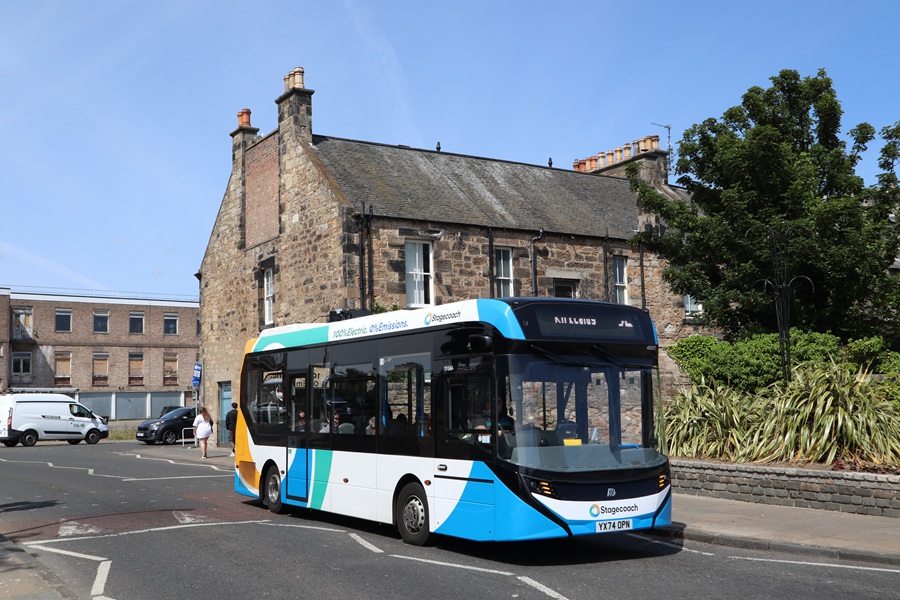
Assessment criteria utilise the same weightings as before. All subsidy must be spent by 31 March 2028, although project delivery may continue beyond then. While the up to 70% of infrastructure costs carries over into ScotZEB3, adjustment of most per-vehicle thresholds is accompanied by some changes to categorisation.
An accessible battery-electric coach or bus with 45 or more seats attracts a maximum subsidy of £122,000. In ScotZEB2, such a vehicle, or a zero-emission example with a total capacity of 60 or more passengers, was eligible for £135,000. The latter category does not appear in the ScotZEB3 guidance.
Under the new definitions cited in that document, a typical battery-electric single-deck bus with under 45 seats but a total capacity of 70 passengers falls into a band for vehicles with at least 32 seats that gives a threshold of £101,000. Previously, it could have gained £135,000 through an ability to carry 60 or more passengers.
The up to £50,000 available for repowered vehicles is constant across both rounds, but at the smallest end of eligibility, an accessible zero-emission vehicle with at least nine seats and one wheelchair user space now attracts up to £57,500 compared to £60,000 for a nine-passenger and one wheelchair users example in ScotZEB2.
For mid-capacity vehicles, the £101,000 on offer for zero-emission examples with at least 32 seats compares to £105,000 available under ScotZEB2 for those with a total capacity of 32 or more passengers, suggesting that some smaller battery-electric buses could see a major fall in the level of subsidy available.