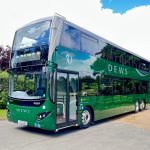




















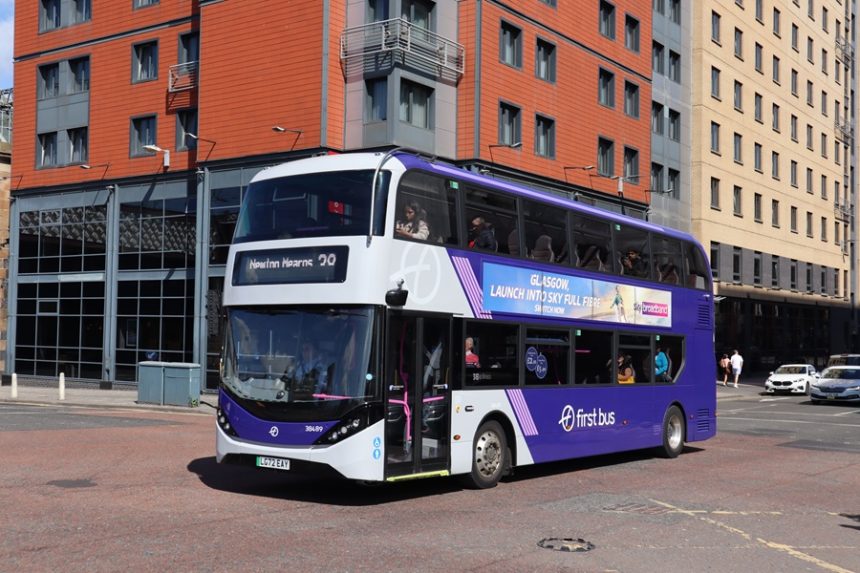
A third round of the Scottish Zero Emission Bus challenge fund (ScotZEB3) worth up to £45 million will open to applications shortly after the Scottish Government revised its approach to funding more such vehicles.
Up to £40 million was previously allocated to a reopened ScotZEB2 but that and more will now go to ScotZEB3.
Creating a third round of ScotZEB and increasing the overall total follows what Transport Scotland says was “careful consideration” and recognition of a need for “collaborative and innovative approaches to decarbonise the heavy-duty vehicle sector.”
Ministers thus concluded that running a competitive ScotZEB3 “is the fastest and most certain route to support new zero-emission bus orders.”
In announcing the now-shelved reopening of ScotZEB2, the Scottish Government had said that a previously unsuccessful consortium bid to the initial phase would be revisited and that if successful against the original criteria, be considered for further funding. Up to 300 additional zero-emission buses could have been facilitated.
ScotZEB3 will directly build on ScotZEB2 but focus on what Transport Scotland calls “public service routes.” The prior scheme included coaches that are used on private hire and tourism-related work.
Award of ScotZEB3 money to successful bidders is expected in spring 2026. The Scottish Government says it will be the final round of support under the ScotZEB programme.
In a letter to Economy, Net Zero and Transport Committee Convener Edward Mountain on 14 November, Cabinet Secretary for Transport Fiona Hyslop noted how ScotZEB3 guidance was being finalised with applications expected to open in early December via a 12-week window.
“The new scheme will extend the benefits of ScotZEB2 by continuing to reduce emissions, improve air quality, lower noise pollution, and support green jobs and skills across the supply chain – contributing to a sustainable, green economy,” adds Ms Hyslop.
Reopening of ScotZEB2 came soon after Alexander Dennis proposed an end to bus building at sites in Scotland with the loss of 400 jobs. That has since been averted through a 26-week furlough scheme agreed by the Scottish Government, the manufacturer, and unions.
In a statement to the Scottish Parliament on 18 November, Deputy First Minister Kate Forbes told MSPs that while she could not detail any orders received by Alexander Dennis since the furlough scheme was agreed, the builder had assured her that it “has been working hard to secure orders in national and international markets.”
She noted how Alexander Dennis has met the UK government recently to push for change to procurement and subsidy control rules. However, work via the UK Bus Manufacturing Expert Panel to develop a demand pipeline for zero-emission buses has not yet worked as predicted and such demand “is not coming to market as quickly as expected.”
Continues the Deputy First Minister: “It is essential that the UK government is wholly engaged in this matter and does all that it can to support domestic bus manufacturing. I urge the Westminster government to accelerate progress in this area towards immediate publication of the Expert Panel’s demand pipeline for electric buses.”