


















Messaging at the British Tourism & Travel Show (BTTS) this year indicates the group travel market is evolving, requiring operators to rethink how they design, price and market their products.
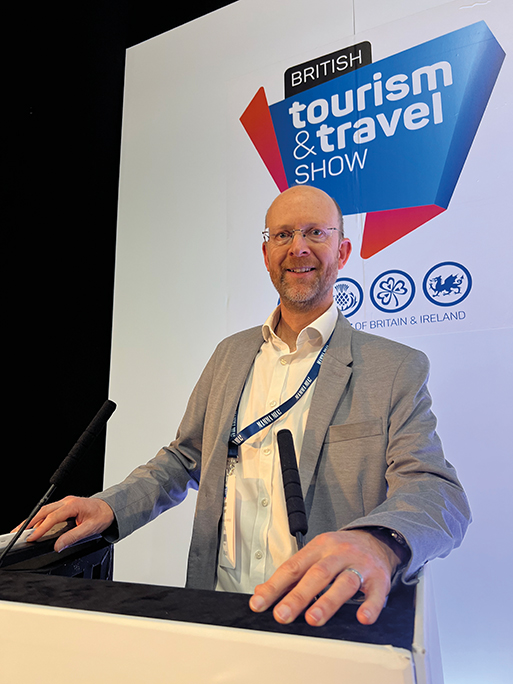
In a presentation on travel trends, Oliver Rowe, Global Managing Partner at independent research agency GSIQ (pictured, right), drew attention to current global headwinds and their impact on the travel industry.
“Cost of living is the number one issue in the UK, Europe, and the USA,” he notes. That translates to a reduction in budgets – but not necessarily a reduction in quality.
“In terms of spend, we’re seeing a paradox between wiser wallets and premiumisation,” Oliver says. “Wiser wallets mean customers are careful about every penny counting. But premiumisation is the desire for exclusivity and high-end branding. We have a core group of people saying they buy extra luxuries, a trend that is higher among younger people — affordable luxury.”
Oliver believes price sensitivity and premiumisation can coexist. “It is about an entry-level value proposition and keeping it sharp.”
Among other concerns, the EU Entry/Exit System has the potential to cause disruption, alongside tourism taxes, and overtourism concerns. Value and how it is audited is changing, and motives for travelling are diversifying. Older generations favour localised travel options , while younger travellers value curated trips. “Age shows a huge difference in the data,” Oliver says. “For younger people, it has to tap into specifics. A more curated option might be the secret to unlock that demand.”
Group travel organisers should also be wary of shorter planning cycles. GSIQ reports an average now of three months. Travellers are also changing the time of year in which they
travel – to “shoulder seasons” driven by a search for milder weather and better value. “We see climate comfort in decision making. Thermal migration away from July and August. September and June are becoming prime targets, along with cooler locations, such as Scandinavia, the Alps, and the Scottish Highlands,” James adds.