


















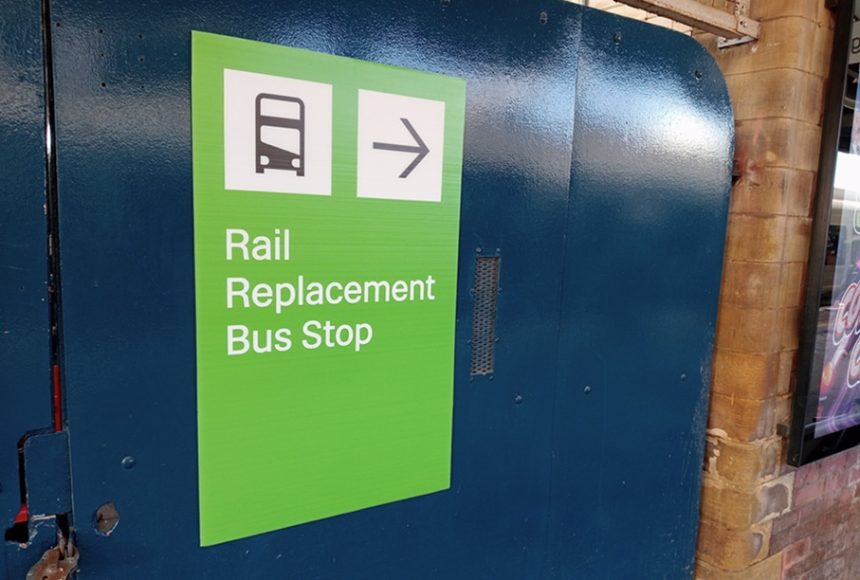
A shortage of technicians to fit next-stop announcement equipment to coaches so they comply with the PSV Accessible Information Regulations (PSVAIR) 2023 when used on in-scope rail replacement work poses a risk to service continuity after current temporary exemptions expire on 31 July, a supplier of such products has warned.
IT9 director Ka Chun Li has written to ministers including Secretary of State for Transport Heidi Alexander and Roads and Buses portfolio holder Simon Lightwood calling for a good faith temporary transitional arrangement after that date for coach operators that can prove they have taken steps towards complying with PSVAIR on rail replacement.
Under his proposal, operators that have ordered equipment, reserved installation slots or begun preparatory work “should be distinguished from those that have taken no meaningful steps towards compliance” and given a period of grace.
Exemptions for coaches on rail replacement aside, vehicles first used since October 2014 are already subject to PSVAIR when on in-scope work. Older examples will be captured from 1 October.
On 19 January, Mr Lightwood and Rail Minister Lord Hendy told members of the coach and rail sectors that no further leeway on PSVAIR would be given beyond 31 July. More recently, Mr Lightwood confirmed that the same is the case for the separate PSV Accessibility Regulations on rail replacement from that date.
Speaking to routeone, Mr Li says that the January clarification by the two ministers helped to make coach operators aware of the reality for PSVAIR on rail replacement, but that it was late March when interest in sourcing solutions began to build.
He attributes that to closure of the Accessible Information Grant scheme, which in its later stages was focused on coach operators undertaking rail replacement.
Further support for transferrable next-stop announcement equipment in coaches has been announced more recently with up to 75% of the cost potentially available, capped at £2,000 per vehicle. Applications will open at the end of June, giving scant time to secure funding and source and fit equipment before exemptions expire.
IT9 offers a suitable platform that can be moved between coaches with a controller dismounted by undoing a small number of screws and unplugging cables. Existing monitors and speakers are utilised. It has a ‘rail mode’ that allows what the supplier says is every train journey in Britain to be configured.
Mr Li notes in his letter to ministers that while availability of suitable equipment is partly limiting compliance levels, installation by technicians competent to work on coaches is “a major constraint.” That position has been arrived at by engagement with the market.
The work “cannot always be completed safely or responsibly as a rapid, standardised fitment,” he continues. “This issue extends beyond individual operators or any one supplier. It reflects a wider industry capacity challenge affecting operators, installers, commissioners, and the practical delivery of accessibility objectives.”
What he calls a carefully managed transitional approach may deliver better accessibility outcomes than a hard 31 July deadline. The latter “unintentionally incentivises rushed work or forces operators into unsuitable installation arrangements,” Mr Li claims.

If rail replacement providers that have committed to satisfying PSVAIR are otherwise penalised, accessibility will not necessarily be advanced, he believes. Instead, uncertainty could result, leading to reduced rail replacement capacity from 1 August.
IT9’s proposed temporary transitional principle would capture operators that can show they have taken “genuine, funded and verifiable steps towards compliance before the deadline,” its letter to ministers outlines.
Proof from a supplier or installer of the appropriate equipment would be part of that, with Mr Li suggesting that a certificate issued by one of those parties demonstrating a legitimate commercial relationship being required to qualify. He believes that ministers should also consider vehicles where installation has commenced but is incomplete.
“This is not a request for an open-ended exemption. It is a request for a practical, temporary and evidence-based approach that supports compliance while recognising real-world delivery constraints,” he adds.
IT9 is willing to provide evidence to the government from a supplier and installer perspective of lead times, technician capacity constraints, order volumes, and delivery timescales.
Mr Li believes that his suggested transitional approach “is a proportionate way to encourage compliance while enabling suppliers to catch up with [a] sudden surge of demand, and allowing us to maintain the quality of our product and installation work.”