





















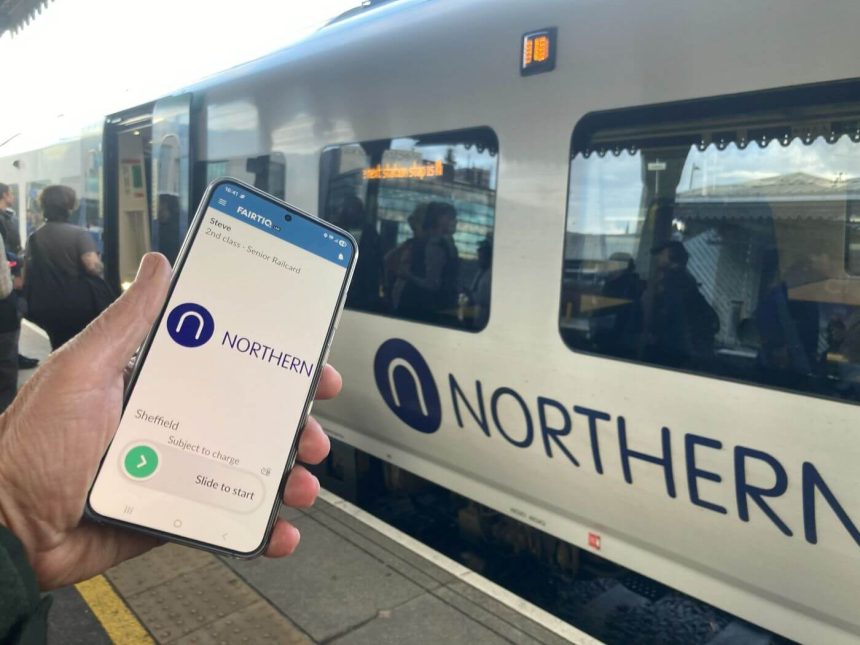
Fairtiq – already established in 13 countries – is coming to the UK with what it believes could be revolutionary for multi-operator and multi-modal travel
The bus ticket could be set for one of the biggest shake-ups in its history.
For more than a century, public transport revolved around choosing and buying tickets before travelling. Capped fares and account-based ticketing changed that. However, digital pay-as-you-go (DPAYG) turns the idea completely on its head.
Using a smartphone’s GPS, the system works out which services the passenger has used, calculates the cheapest fare for that journey and then charges them automatically.
It is set to be particularly useful for multi-operator and multi-modal journeys, and within franchised bus areas.
DPAYG is now being trialled on some rail services in the North and Midlands, and Fairtiq is the supplier for one of three such government-supported pilot schemes.
The Switzerland-based company is new to the UK but operates in 13 countries across Europe, racking up 131 million journeys last year.
It powers the national public transport ticket systems in Denmark, Switzerland, Austria, and Liechtenstein.
How Fairtiq works
Starting a journey with Fairtiq involves simply swiping a bar to the right on your phone.
When you have finished your journey, you swipe left.
The system then uses data such as Bus Open Data Service and the operators’ fare rules to calculate the cheapest fare, taking into account capping or multi-operator offers, and allocates payment to the provider or providers in question.
The big advantage for passengers is overcoming the dilemmas and complexities of knowing where you will travel that day and what the best ticket option is.

Fairtiq is in discussions with stakeholders here. UK and Ireland Lead Steve Broadley says: “We’re talking to lots of combined authorities. It’s probably ones that are more towards franchising.
“Having said that, we’ve had lots of discussions with bus operators. The larger operators want to get more sophisticated and want to think about different commercial scenarios, and different revenue sharing. And we’ve been talking to smaller operators who can’t afford to develop an app.”
Linked to that, one advantage of DPAYG is the lack of infrastructure needed. The traveller effectively provides the hardware in the shape of their smartphone.
The operator requires only a device such as a tablet or phone to scan a QR code to check the passenger has a “promise to pay”.
Some operators abroad have opted for the system as an alternative to upgrading existing ticket machines.
Steve adds regarding flexibility: “Operators don’t want to be tied. If an operator decides, ‘I don’t want to continue working with Fairtiq, I want to move to XYZ company,’ it’s just some software changes and can be done relatively quickly and easily.
“It’s a software-as-a-service contract, so they’re paying monthly, subject to minimum terms.”
Another potential benefit for operators and authorities is the insight into passenger travel patterns provided by the data.
Eliminating the worry of TOTO
One of the biggest concerns around tap-on, tap-off (TOTO) is passengers forgetting to tap out, which can result in either a higher fare for the passenger or rectifying work for passenger and operator, as well as often general mistrust and fear from the traveller’s perspective.
Fairtiq’s system can eliminate the issue by detecting when the journey has ended and either sending a reminder or automatically closing down the trip.
Passengers don’t need to worry either about jumping into a car after disembarking a bus and being charged more because the system will be able to detect that the profile of that journey no longer resembles that of a public transport trip.
The return of the ticket inspector?
For the UK, it is envisioned that – in the short-term at least – most operators will still require the passenger to show the QR code when boarding that indicates the user has swiped right.
That is less common elsewhere due to greater use of all-door boarding and ticket inspectors.
Steve says: “In Europe, they make more use of all doors. And this works ideally on an all-door system.
“One of the major benefits of all-door boarding is it significantly reduces dwell times.”
The number of doors aside, the model may work hand-in-hand with any move toward autonomous buses operating without a safety driver, as that could free up staff for a more “continental” role.
Steve points out that, elsewhere in Europe: “The ticket inspectors don’t just inspect tickets. They’re more a customer-service person on and around the transport network who also check tickets.”
He adds that fraud evasion under Fairtiq is “certainly no worse than existing systems and, in a lot of cases, less common.”
He adds: “We check every journey in the back office. We use AI machine learning and pattern recognition to look at how people are travelling and identify patterns that are potentially suspicious fraud events.
“Our fraud team can then analyse it and can offer warnings or training and, if the problem persists, the ultimate sanction is they can block them from the system.”
Fraud prevention mechanisms also include requiring the passenger to swipe right before the journey begins, while the technology can also flag where the passenger has swiped left before the end of the journey – should that make a difference to the fare.
Passenger challenges
One of the biggest challenges for the adoption of DPAYG could be how passengers respond.
Steve says: “The majority of people love it, because you don’t have to worry about getting the right ticket. You just get on and travel, and the system will work it out for you.“
The majority of people love it, because you don’t have to worry about getting the right ticket – Steve Broadley
However, inclusion may be seen as an issue, particularly when it comes to those who do not have a smartphone or are technophobic.
But Steve says: “The feedback we get is older people like it because they tend to be frightened of buying the wrong ticket, and Fairtiq makes sure they’ve always got the right ticket.
“And it’s dead easy. They don’t have to use a complex app and consider, ‘Where am I starting? Where am I going? What time of day am I going? What passes have I got? What discounts have I got? When am I coming back?’”
He points out that Denmark’s research before implementation found 10% of the population potentially couldn’t or wouldn’t use the system.
For that section of the population, a card-based system was introduced, but, as Steve points out, because it’s only 10%, the amount of infrastructure needed is very little.
Mindset change for operators
However, it is also the operators and authorities that may have to be won over. Steve says the biggest potential challenge is that “it is so different to everything that’s happened in the UK before”.
But he adds that Fairtiq has invited operators to see how it works in other countries, and the system can also be used in the UK “offline” so they can build up trust in the method.
It is so different to everything that’s happened in the UK before
He adds: “As that trust and confidence builds, and they start seeing the customer experience benefits and the savings in equipment costs, cleaning costs, maintenance costs, and upgrade costs, they start realising it’s worthwhile.”
Through paper receipts, card payments, contactless, and account-based approaches, the bus ticket has undergone a rapid evolution in recent decades.
If DPAYG is adopted where appropriate, it could be transformational – making travel cheaper and more convenient for passengers, while improving data insights and potentially speeding up boarding for operators.