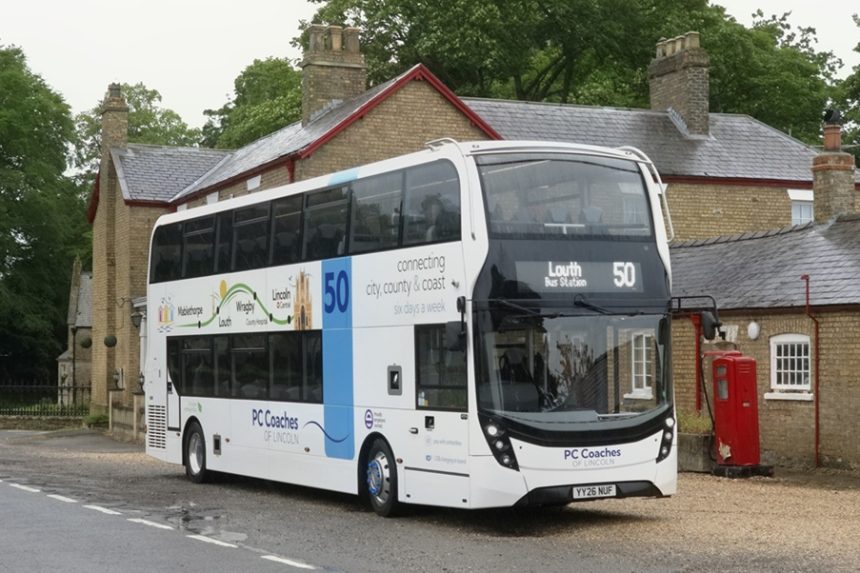
PC Coaches has highlighted the role played by SME operators in delivery of rural public transport after it invested £600,000 in two new Alexander Dennis Enviro400 double-decks for a service taken up by the Lincoln business three years ago.
Those vehicles work route 50 between the city, the Lincolnshire Wolds and Mablethorpe on the coast. They took up employment on 5 June, exactly three years after PC Coaches stepped in to continue route 50 after its previous operator exited.
Since then, the employee-owned business has worked with Lincolnshire County Council and other stakeholders to enhance the service, introducing improved journey opportunities and maintaining essential connectivity across a large geographical area.
Further uplifts are planned from July following the award of additional Bus Service Improvement Plan Plus funding, supporting earlier and later journeys. PC Coaches has previously advocated the benefits of Enhanced Partnership in Lincolnshire.
The two new buses are branded for service 50 and its nature connecting city, county and coast. Each seats 85. Their purchase “underlines the company’s long-term commitment to the route and the communities it services,” PC Coaches says.
Continues Managing Director Stephen Bryce: “When we took over service 50 in June 2023, our priority was ensuring that local communities retained an important transport link.
“Three years later, we are incredibly proud of what service 50 has become. The route now forms one of Lincolnshire’s key transport corridors, connecting the city of Lincoln with the market towns and villages of the county before continuing to the coast.
“The arrival of these new Enviro400s demonstrates our confidence in the future of the route, and our commitment to delivering high-quality public transport for the communities we serve.”
Mr Bryce notes the success of route 50 under PC Coaches’ stewardship as indicating the importance of SMEs to bus services in rural areas.
“While larger urban networks often attract the headlines, it is frequently independent operators that provide the flexibility, local knowledge and long-term commitment needed to sustain vital transport links between rural communities, market towns and coastal areas,” he says.
“Routes such as service 50 require investment, determination, and a belief that public transport can be a force for good. Independent operators remain at the heart of many rural transport networks, connecting people with employment, education, healthcare and leisure opportunities that might otherwise be inaccessible.”