



















Adoption of bus franchising in north east England would see the first services start in September 2029 under a three-phase approach to deployment that is detailed in a franchising assessment among documents published by the North East Mayoral Strategic Authority (NEMSA).
Its release on 6 July sits alongside the opening of a statutory consultation on the proposed scheme. That will run to 28 September. Mayor of the North East Kim McGuinness has long advocated the franchising of bus services in the region, with an Angel Network brand slated.
The second and third phases would start in September 2030 and September 2031, respectively, under the provisional plan. Each of the three rounds will be built around medium and small contracts, with five of the former and 85 of the latter across the full process. Small contracts will account for around 20% of the overall network.
Implementation remains subject to “further testing,” according to the assessment, but it finds bus franchising in the north east to be “affordable, feasible and deliverable.”
Ms McGuinness is thus recommended to opt for it as the avenue of reform, with Tyne and Wear, County Durham and Northumberland each fully within scope of such a scheme. She is expected to decide in early 2027.
Scope for grouped bids and subcontracting within proposed approach
Under current plans, the first phase will see one medium contract awarded. It will capture the Gateshead Riverside and Washington depots that are currently part of Go North East for an overall PVR of circa 150. Seven small contracts, each with a PVR of no more than three, will also be awarded at that stage.
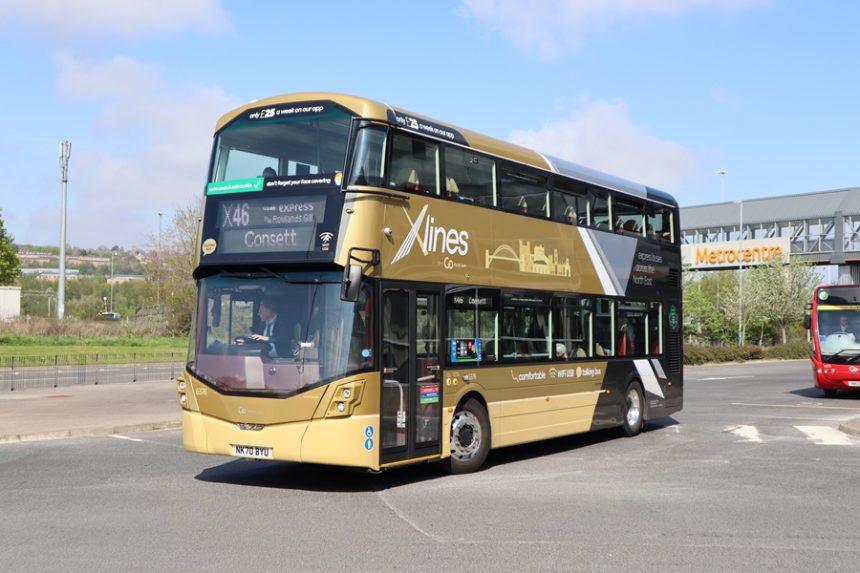
For the second phase, the Go North East base in Deptford along with Stagecoach depots in South Shields and Sunderland will form one medium contract with a PVR of around 190. That part of the second phase will also have 12 small contracts, each with a PVR of up to three.
A further medium contract within the second phase will capture the Arriva depot in Durham and the Go North East base in Consett for a PVR of circa 110, alongside 35 small contracts each with a maximum PVR of 11.
Phase three will have a medium contract for the Arriva depots in Ashington and Blyth and the Go North East centre in Percy Main for a PVR of 160, alongside 17 small contracts with a maximum PVR of five. The other part of phase three will involve the current Stagecoach depots at Slatyford and Walkergate with a circa 170 PVR within a medium contract, alongside 14 small awards with PVRs of up to 13.
All awards are expected to last a maximum of seven to eight years, including discretionary extensions. Small contracts will be to the same duration, which the assessment says will encourage SME operator interest.
Under the proposed model, small contracts can be combined into “group bids.” In addition, it notes how SMEs will “have opportunities to participate in tendering for bigger contracts, either independently or “through potential consortia bids and as a subcontractor for the contracted operator.”
NEMSA will provide depots for medium contracts. It will buy those from incumbents, with compulsory purchase potentially used should voluntary negotiations fail, although building new premises is not ruled out. Winning bidders for small contracts will resource their own depots.
Fleet provision questions for north east bus franchising
The assessment says that a market testing exercise involving incumbents and potential new entrants to the north east bus market saw the commercial model for franchising “generally well received” and that a range of parties expressed appetite to bid.
That aside, reservations were expressed about three aspects of the commercial model: fleet provision, timetable provision, and ownership of ticket machines. Those “have been considered and are subject to further analysis,” the document continues.
It adds that NEMSA’s initial position on fleet ownership under franchising was to retain operator responsibility for providing vehicles. That was to harness the “significant commercial expertise” that they hold in that field, and would avoid complexities for the Strategic Authority in assuring that buses were suitably maintained.
However, the exercise also recognised risks associated with operator-sourced fleets under franchising and the potential advantage it would give to incumbents.
Those parties “generally stated that they are content with the proposed model,” but potential new entrants expressed a preference that the franchising body provides vehicles, with advocacy of a residual value mechanism highlighted.
“Additional work is required to consider the options fully, and the benefit of time will allow the MSA to gain a clearer picture on the market,” the assessment states. An existing target of a fully decarbonised fleet in the north east by 2035 remains in place.
On home-to-school services, such registered local routes that run commercially and serve a school en route, or those that only operate for part of the day, run commercially or are subsidised, and are eligible for BSOG, are within the franchising scheme.
Registered school services that take payment from ‘unentitled’ pupils will be outside franchising, as will closed-door provision.