





















Please note that this column was written before the resumption of hostilities between Iran and the United States in early July.
Brent crude oil prices fell by 24% in June, as ceasefire agreements and US-Iran negotiations improved the outlook for supply flows through the Strait of Hormuz.
At the beginning of the month, markets reacted to Tehran suspending talks with Washington, while Israel continued its deepest military operation in Lebanon in over 25 years.
Although US President Trump claimed that negotiations with Iran were ongoing, Tehran vowed to “completely” block the Strait of Hormuz while also warning of disruptions to shipping through the Bab el-Mandeb Strait, highlighting escalating tensions.
An assessment by the International Energy Agency (IEA) added to bullish market sentiment, warning that global oil inventories could hit critical levels ahead of peak summer demand if stock draws continue at the current pace, as robust consumption outpaces supply growth. Additionally, an official noted that it could take between six to eight months in a best-case scenario to fully reopen the Strait of Hormuz following an agreement.
Oil prices then fell after Israel and Lebanon reached a ceasefire agreement on 4 June, easing concerns over potential supply disruptions and raising hopes that negotiations between Iran and the US could progress.
On 12 June, Iran’s Mehr News Agency reported that a 14-point draft agreement included the lifting of oil sanctions and a commitment by Tehran to reopen the Strait of Hormuz within 30 days. In return, the US would reportedly suspend key sanctions, unfreeze Iranian assets, restore Iran’s access to the international financial system, and facilitate trade and investment.
The deal was not agreed, and both sides said further negotiations were required. However, on 17 June, a memorandum of understanding was signed and in effect, establishing a temporary framework to halt hostilities and open a 60-day window for negotiations toward a comprehensive agreement. Although promising, the arrangement was interim and conditional, and did not constitute a final peace settlement.
While some measures began, including preparations to reopen the strait and resume International Atomic Energy Agency inspections of Iran’s nuclear activities, renewed exchanges of fire and disputes over compliance threatened the agreement, and negotiations continued under Qatari mediation.
The agreement caused oil prices to fall to three-month lows of US$77 per barrel due to improving market sentiment around supply flows. According to Kpler, the reopening could release approximately 93 million barrels of stranded crude. Additionally, IEA raised its 2026 global supply forecasts by 200,000 barrels per day to 102.4 million.
Towards the end of the month, investors continued to closely monitor shipping activity, although concerns intensified after a commercial vessel was struck in an attack off the coast of Oman.
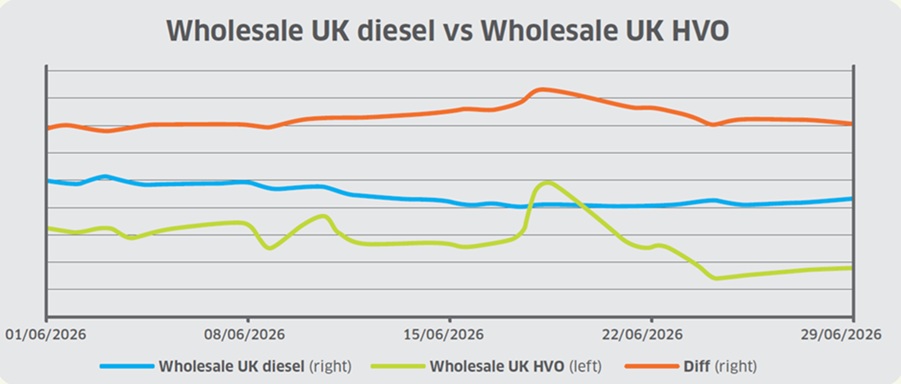
Overall, oil prices retracted to levels close to those seen before the conflict. Diesel prices fell but not at the same pace, with wholesale UK diesel prices declining from 69.89ppl excluding duty to 60.41ppl, as record-high diesel crack spreads (the margin between diesel and crude oil prices) continue to reflect persistent supply tightness for the product.
Wholesale UK diesel prices have also been supported by a depreciating pound in June, as oil and refined products are traded in USD. GBP weakened from US$1.344 to US$1.327, equating to an increase of almost 1ppl in wholesale UK diesel costs, based on prices on 30 June.
The pound struggled against a stronger US dollar, weak UK economic data and lingering political uncertainty in June. Early in the month, stronger-than-expected US payroll data reinforced expectations of tighter Federal Reserve monetary policy.
In the UK, the first Bank of England rate-hike is expected around September, with a 50% chance of a second by year-end, according to analysts. Central bank policymakers face the dual challenge of addressing stubborn inflation while managing a labour market that is showing early signs of weakening.
Unemployment is projected to rise to around 5.5% (c.2.2 million), as Middle East conflict and higher energy costs weaken business investment and hiring. Meanwhile, inflationary data revealed that the Consumer Prices Index unexpectedly held at 2.8% in May, causing investors to reduce interest rate hike expectations.
Furthermore, the Organisation for Economic Co-operation and Development forecasted UK GDP growth of 0.9% this year, higher than previously expected, but has cut its 2027 outlook due to the economic risks posed by the ongoing Iran conflict.
In the central bank’s June meeting, the Monetary Policy Committee reinforced its cautious approach by keeping interest rates unchanged at 3.75% for the fourth consecutive time, largely due to uncertainty over the impact of high energy prices.
In the US, investors priced in higher likelihood of an interest rate hike due to mounting inflation concerns and strong economic growth, helping the USD index to strengthen to a one-year high. The Federal Reserve later decided to maintain the target range for the federal funds rate at 3.50-3.75%, although governors were split on whether to increase rates in a bid to tame inflation.
Finally, political uncertainty in the UK intensified after Keir Starmer announced his resignation as prime minister and leader of the Labour Party. Sterling has come under additional pressure as markets anticipate higher public spending under Andy Burnham.
Wholesale UK renewable diesel (HVO) prices (in reference to the HVO UCO Barges FOB ARA benchmark) also declined across the month, from 166.40ppl to 159.30ppl (excluding duty and Renewable Transport Fuel Certificate (RTFC) benefit). Note: this is a wholesale settlement price comparison only, and does not reflect broader end-user pricing dynamics.
Notably, the differential between HVO and diesel prices rose from 96.51ppl to 98.89ppl, reaching highs of c.116ppl, as diesel declined more sharply than HVO across the month.
Following the partial reopening of the Strait of Hormuz, oil prices have declined significantly; however, biofuels are not expected to track this fall proportionally, according to market analysts.
Any downward pressure from weaker crude is likely to be limited and delayed in the biofuels market, as pricing is driven not only by fossil fuel benchmarks but also by feedstock costs, supply/demand fundamentals, and policy support.
European HVO markets remain increasingly constrained by limited availability of sustainable feedstocks, particularly used cooking oil, even as renewable fuel mandates continue to underpin demand. Upcoming policy changes are expected to further intensify competition for compliant feedstocks.
This dynamic is already evident in key markets. For example, in Sweden, diesel biofuel demand reached its highest level in 28 months in April due to stronger renewable diesel blending, highlighting how policy-driven consumption continues to increase demand for scarce feedstocks.
In the US, the Energy Information Administration expects renewable diesel capacity to remain above historic levels, although growth is projected to slow due to feedstock constraints, weaker economics, and project delays.
Its latest outlook also slightly raises 2026 renewable diesel and biodiesel production forecasts while lowering renewable diesel inventory expectations, reflecting stronger output alongside tightening supply conditions.
Furthermore, the American Fuel and Petrochemical Manufacturers has reportedly sued the US Environmental Protection Agency over its record-high 2026-27 biofuel blending mandates, arguing they will significantly increase compliance costs and fuel prices, and exceed domestic biofuel production capacity.
The spot cost of blending biodiesel to the UK B7 specification returned to pre-conflict levels in June, rising from 4.8ppl to 5.5ppl and increasing the cost of meeting the Renewable Transport Fuel Obligation, as wholesale diesel prices (fossil component) fell more sharply than FAME-10 (bio-product).
Finally, RTFCs rose from c.19 pence per certificate (ppc) to 24.5ppc across June, increasing the benefit that HVO consumers receive (assuming that 100% of RTFC benefit is passed on to the end-user). Certificate prices rose as biodiesel premiums moved higher amid falling gasoil prices in response to the US and Iran reaching terms for a settlement to end the war and potentially re-open the Strait of Hormuz.