



















Significant progress has been made in the UK bus sector to introduce vehicles that are zero-emission at the tailpipe. Today, around 4,000 zero-emission buses are operating across the country, equivalent to around 10% of the total parc.
By 2027/28, this proportion is expected to rise to 20%, according to Zemo Partnership analysis of funding that has already been allocated and vehicles ordered.
Despite this progress, diesel buses continue to be purchased, and the tens of thousands of legacy vehicles already on the roads will remain in service for many years to come. The lack of funding clarity and certainty on the date by which the sale of new diesel buses will be banned is likely to extend the prevalence of diesel buses in the UK.
With a long-term role for diesel powertrains in the bus sector, actions to decarbonise those legacy vehicles today should be considered. This is something even more pertinent for coach, where adoption of zero-emission is an even bigger challenge.
Perhaps the most obvious and attainable solution is use of so-called drop-in fuels like hydrotreated vegetable oil (HVO) that have the potential to deliver an immediate CO2 saving compared to fossil diesel without the need for significant vehicle or infrastructure alterations.
To support their adoption, Zemo Partnership operates the Renewable Fuels Assurance Scheme. It provides operators with independent verification of low-carbon fuel supply chains in terms of greenhouse gas emission (GHG) performance, renewable blend composition, and feedstock sustainability.
The scheme enables fleet operators to understand credible GHG savings figures that can help to inform decision-making processes around fleet decarbonisation by demonstrating the merits of sustainable low-carbon fuels.
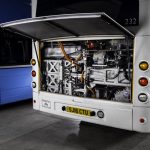
Repowering existing vehicles to zero-emission is another option to fleet users. The recently launched Zero Emission Vehicle Repower Accreditation Scheme (ZEVRAS), operated by the Energy Saving Trust, supports the market by ensuring that repowered vehicles meet a range of technical requirements and by enabling bus operators in England to access the 22p per km BSOG incentive for such vehicles.
Repowering to zero-emission not only presents the opportunity for an immediate emissions reduction, but also enables operators to extend the lives of their existing assets.
Some operators are starting to see the potential of such a solution – so much so that multiple repower suppliers are going through ZEVRAS approval.
Of course, any alternative solution comes at extra cost to fleet suppliers, which will inevitably be a challenge given the tight margins most contend with. Government policy has long focused on new vehicles entering the market across all sectors of road transport, with limited interventions to tackle emissions from legacy vehicles.
If we are to meet carbon reduction targets, that action must start today. Government and industry need to look at a multi-pronged approach to decarbonisation – introducing new zero-emission buses in line with fleet replacement cycles and available funding in tandem with focused action to tackle emissions from diesel fleets already on the road.
Immediate emissions savings from diesel vehicles is a crucial mission, until a point where zero-emission buses are seen as business as usual from a cost and operational perspective. To that end, government needs to support the adoption of those solutions and associated emissions savings. Otherwise, they are unlikely to ever be realised to a large extent.