The European Union Entry/Exit System finally had its delayed launch this month. routeone visited Dover and Folkestone to see preparations, and gained early feedback on its implementation
Introduction of the new European Union Entry/Exit System (EES) at the Port of Dover and Eurotunnel terminal at Folkestone finally took place on 12 October, with infrastructure at both looking ready. However, the coach sector nervously awaits busier travel periods to learn the true impact of the new digital border management system.
The process, which involves taking passengers’ biometric data at ports of entry to the Schengen area, was due for launch last November.
However, after several member states indicated they were not ready, it is now being phased in over a six-month period.
Under that rollout approach, freight staff and coach drivers and passengers will be the first to be required to submit a facial image, fingerprint scans and other information on first entering the Schengen area in order to create a digital record of all third-country nationals. Subsequent visits will require only a passport and biometric verification.
There’s potential for huge delays and drivers run the risk of falling short of their destinations – Stephen Spendley
EES will mean more stringent application of the 90-in-180-day limit, the EU rule that could impede the work of coach drivers who work extensively overseas. However, the other concern for the industry is whether the new system will exacerbate the delays seen in recent years at Dover.
The Port has asked coach drivers to allow extra time but not to turn up more than two hours before travel – as is the current stipulation.
New lane for Entry/Exit System administration
routeone visited both the Port of Dover and the Eurotunnel terminal six days before EES went live and found both appeared to be ready to go.
In the case of the Port of Dover, a new road has been built in the Western Docks from The Viaduct to accommodate EES. A building to administer EES for coach passengers can deal with up to two coach loads at a time.
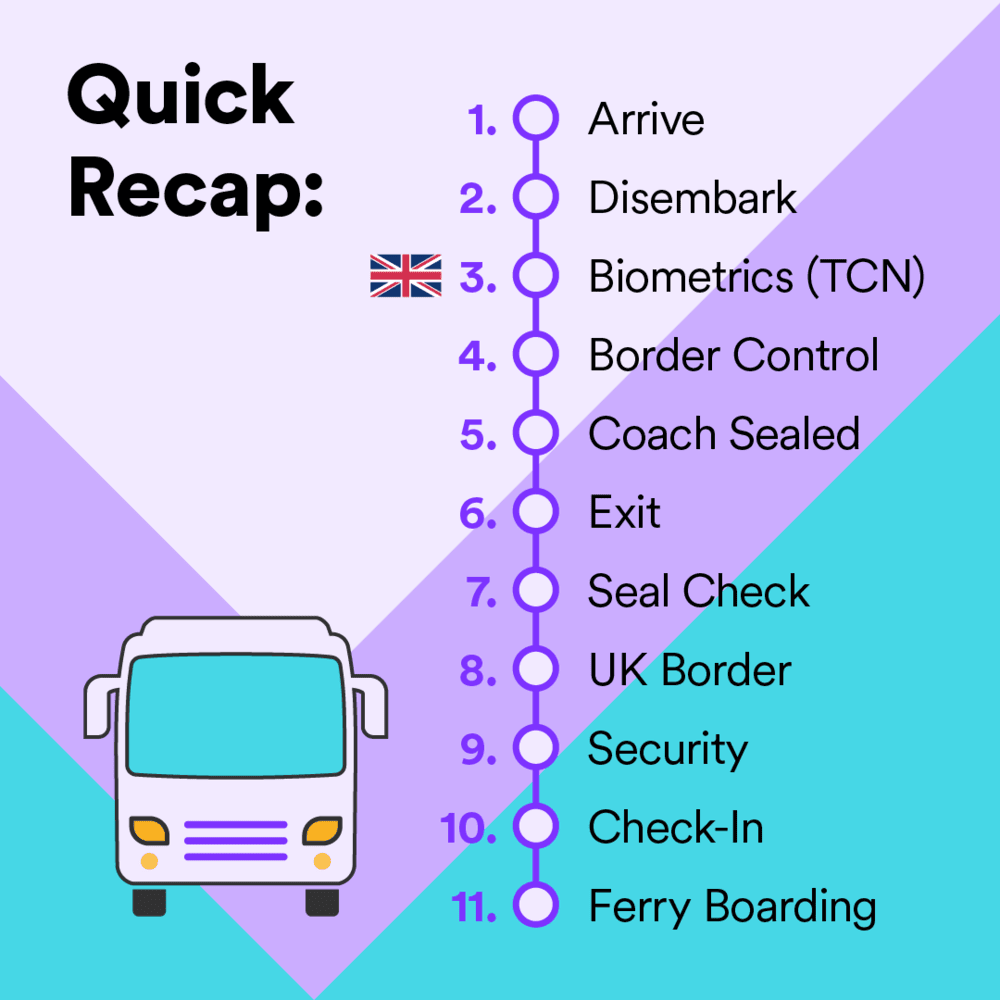
The coaches stop either side of it and all passengers and coach staff will have to disembark and enter an airport-style queuing system for one of 12 self-service scanning machines.
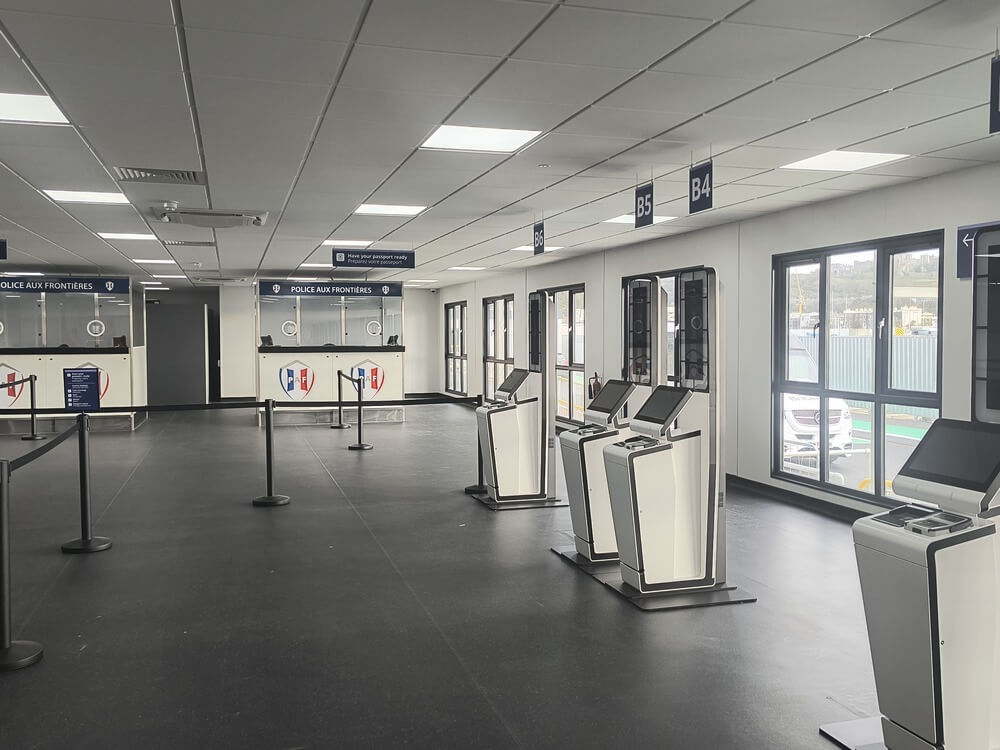
The self-scan process is said to take an average of 76 seconds per passenger and the Port of Dover says its modelling shows capacity for up to around 20 coach loads per hour. Port staff will be on hand to help with the self-service element.
Passengers then have to pass through Police aux Frontières (PAF) desks for French border control. Once all passengers and staff are back on board, the coach will be “sealed” with a sticker to ensure no other individuals can board when it rejoins the A20 on the way to the ferry terminal. If the seal is broken before PAF’s check just before the UK border, the coach will be required to return to the EES building to go through the whole process again.
Processing of cars for EES is expected to begin next month, using 72 self-service kiosks slightly further down the same road in Western Docks.
Potential challenges ahead for Entry/Exit System administration
The Port stresses that the phasing-in process will be used as a learning process and is open to tweaking procedures as necessary.
It also has short-term concerns over the technology. Doug Bannister, Chief Executive of the Port of Dover, says: “Along with our counterparts who are also implementing EES, there are still some outstanding technology challenges that we are navigating with the French provider and border authorities.”
In addition, a mobile app which would allow passengers to register some details in advance has been talked about by the EU, but the Port says it has not been given a timeline for its implementation.
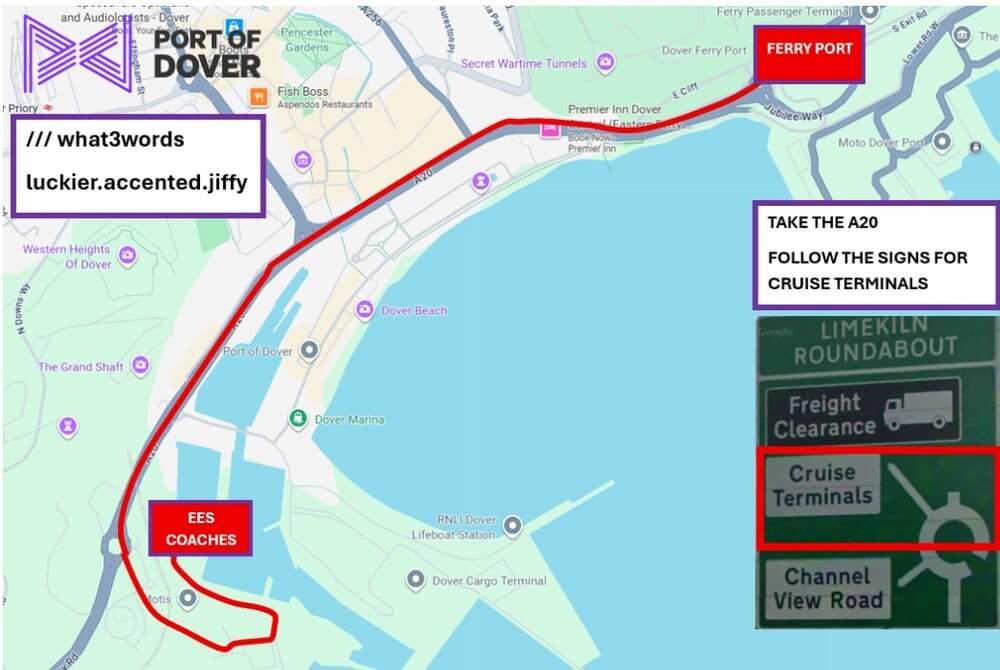
However, the Port concedes that its main challenge in the longer term will be how the road network will cope around busier times of the year.
The main concern will traffic backing up on The Viaduct trying to enter the EES lane.
Another possible bottleneck exists where both coaches and cars, on exit from this area, need to turn right out of Union Street on to the A20.
However, the Port says it is working with Kent County Council to help combat potential issues and, if necessary, will have access to increased police presence and be able to adjust traffic light timings.
Industry reaction
Speaking before the launch of EES, Andy Warrender, RHA Operations Manager ‑ Coach Sector, says: “Overall, it looks fit for purpose. I think it was probably the best solution overall. To try and do all of the checks necessary on the Eastern Docks site was going to be a real challenge.
“It’s coming in at a time when traffic is relatively light.
There will be a bit of a test at October half-term, so they’ll gain some experience then and they’ll know where the pinch points are. They’re able to dynamically manage traffic on site and tweak the process as it develops, so the whole thing will build up over time.” However, he adds that February 2026 half-term will be the first big challenge.
Stephen Spendley, UK Coach Operators Association Director of Operations, also saw the preparations first-hand and says: “The biggest issue for the coach industry, as far as these new facilities are concerned, is driver handovers.
“It’s not only the flow of traffic between the Western and the Eastern Docks, it’s the flow of traffic from the nearest driver handover point, which realistically is going to be [M20] stop 24 services… There’s potential for huge delays and drivers run the risk of falling short of their destinations when they are on the continent because they’re out of hours.”
Gavin Miller, Confederation of Passenger Transport (CPT) National Operations Manager, says: “The Port has had a long time to prepare for this change, and a lot of meticulous work has been done. So we’re hopeful that this will go smoothly. It’s being introduced at a relatively quiet time – after the summer holidays, but before things get busy for the ski season and Christmas shopping.”
Eurotunnel: Entry/Exit System impact ‘minimal’
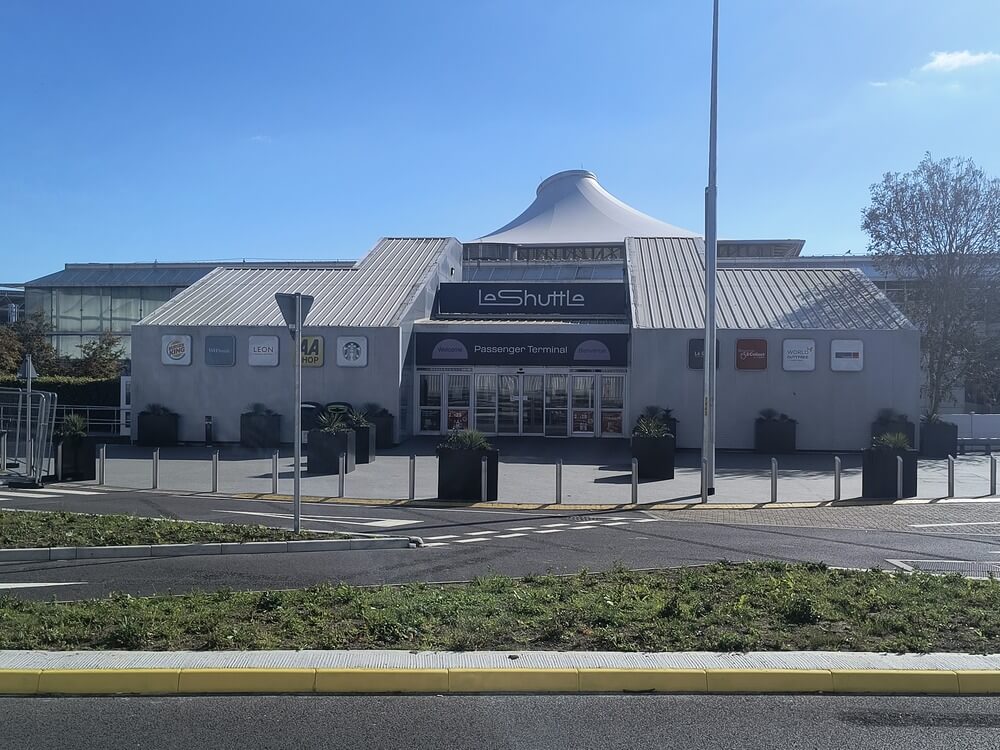
The direct impact for coach groups entering the EU via Eurotunnel is likely to be “minimal”, according to carrier LeShuttle. The volume of coaches using it is around 20% of that going via the Port at about 12,000 per year.
In addition, the EES processing for coaches will all be handled at the existing French border building and via PAF officials rather than self-service kiosks. Car travellers will eventually use one of the 224 EES kiosks located across both the Folkestone and Calais terminals.
A LeShuttle spokesperson says: “As this is an EU initiative, our role is to educate, and reassure travellers, before and during their journey so they can move smoothly and quickly onto the shuttle and continue their trip with minimal disruption. We’re confident that the extensive work undertaken by Eurotunnel will result in a process that is efficient, but it will also be a learning curve for travellers. Our goal is to maintain the expected customer journey, with clear guidance and support.”
Regarding Folkestone, Andy adds: “I don’t see any major concerns. The volumes are obviously nowhere near the sort of volumes that are going through Dover at peak periods.”
The journey for coach travellers at Eurotunnel has been improved by the newly opened UK coach exit check hall inside the main terminal, which gives them access which had been temporarily lacking to the shops, restaurants and other facilities.
The new facilities increase LeShuttle’s capacity from two to up to six coaches per hour, and the dedicated parking and drop-off points are also aimed to streamline the operation.
Early feedback
As routeone went to press on 14 October – two days into the launch of EES – early indications were that its introduction was not leading to delays. However, those aforementioned technical problems led to the scanning machines being switched off.
In those cases, coach passengers, who disembarked at the coach building, were simply directed straight to the passport control desks without biometric data being taken.
Leger Shearings confirms via Operations Director Chris Plummer that was the case with its first coach to go through the Port, which did not experience hold-up.
Our operations team has been well prepared for the new EES process changes, with coaches arriving in advance of crossing, and we have completed all departures on time with no complications for passengers so far – FlixBus UK
Scott Rattle, Transport and Operations Manager at Passenger Plus, says his coach went through Folkestone without any problems.
Both CPT and RHA added they had not heard of any delays.
Andreas Schorling, Senior Managing Director of FlixBus UK, which took coaches through Dover and Folkestone the day after launch, says: “Our operations team has been well prepared for the new EES process changes, with coaches arriving in advance of crossing, and we have completed all departures on time with no complications for passengers so far.”

EU regulations state that no biometric data needs to be taken during the first 60 days of the progressive operation.
With traffic at Dover and Folkestone relatively quiet, too, it is no surprise coaches weren’t delayed straight after launch. However, the real test will come during peak travel periods.
Operators and port authorities recognise that a period of adjustment is inevitable, but the end-result could eventually mean a smoother journey for passengers.