



















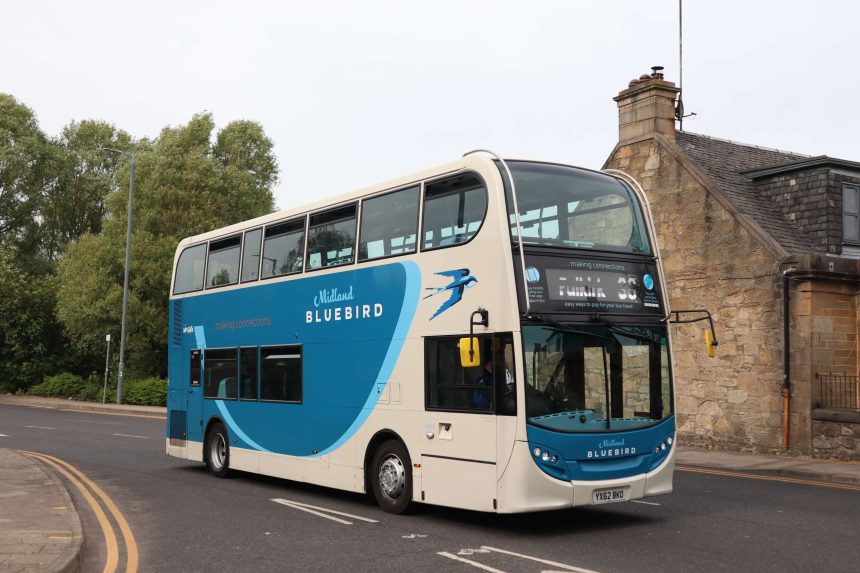
Midland Bluebird, together with McGill’s Scotland East, have been ordered to pay a penalty of £29,000 and been issued with a final warning after Traffic Commissioner (TC) Richard Turfitt made it clear that they could no longer use the poor state of vehicles as an excuse for failing to meet published timetables.
TC Turfitt found the repute of each entity to be severely tarnished by the finding of maintenance issues identified at the hearing, and subsequently by the DVSA intervention on 11 December 2024. Any further such reports were likely to result in consideration of more extensive intervention.
The TC took account of the previous reports of poor punctuality, in saying that deterrent action was required in order to achieve the aims of the statute and to ensure that levels of service matched the expectations of the travelling public in Scotland. Putting aside the growth duty and other obligations on regulators outside the tribunal room, the duty to promote the success of the company for the benefit of its members was not his concern.
That was one of the statutory obligations of the directors. The TC rejected the suggestion that the operators might use funds instead of paying a penalty. That would be to reward shareholders, including the group, when the schoolchildren and public paid the price.
McGill’s Scotland East holds an O-Licence authorising 170 vehicles based at Livingston. It was known as First Scotland East from 5 September 2008 to 27 September 2022. Financial penalties of £57,500, £23,000 and £30,000 were imposed at hearings in November 2007, April 2010, and February 2016, respectively.
Midland Bluebird holds an O-Licence authorising 297 vehicles with operating centres at Balfron, Stirling, and Larbert. Financial penalties of £74,250, £14,850 and £15,000 were imposed under previous ownership in November 2007, October 2009, and January 2013, respectively. Both entities became part of the McGill’s Group following acquisition in September 2022.
It was sought to argue that the reliability figures should be averaged at 86.55%, but that penalties should be reduced further by reference to several mitigating factors, including the recent acquisition of the business, extensive roadworks, and ongoing engagement with councils and passengers.
Reference was made to the trajectory of improvement and further planned timetable and resource changes. It was requested that any penalty be proportionate, reduced to reflect the small proportion of affected services, and resolved without a resumed hearing.
The TC said that the acquisition of the relevant business was in 2022. The latest reliability reports on the X10/X10A services showed 89.29% and 83.91% reliability and he had taken account of some mitigation arising from ongoing and extensive roadworks, supported by Bus Users Scotland. That was reflected in his decision to accept the representations that the correct penalty was in the bracket of £100 per vehicle.
An operator was expected to engage proactively with local highways authorities to try and plan for these events and to alter the timetable accordingly when the impact was long-term. TC Turfitt had also limited that impact to the Midland Bluebird O-Licence, under which the X10 and X10A were now operated. Again, credit was reflected in the decision not to apply it more widely across the two O-Licences.
He rejected the suggestion that the penalty be further reduced because of the state of the vehicles. That was in part reflected in the time allowed for extra monitoring.
TC Turfitt was told that, on the acquisition of the businesses, it was found that a number of vehicles were in poor condition. Staff morale was said to be low, and there had been little or no investment in the facilities or people. All locations were running with 50% of the skilled labour provided through external contractors. It quickly became apparent that the group needed to escalate fleet replacement and change local management.
90% of the engineering management team had been replaced. Only one in 13 team members remained from the date of acquisition. The structure had been remodelled and improvements across its key performance indicators were evident. Both operators were said to suffer from a
lack of in-house staffing. Reference was made to the recruitment of 21 skilled engineering staff across both operations since the acquisitions, equating to 50% of all skilled staff. To attract those skills, the group has increased remuneration and introduced a signing bonus.
Challenges manifested themselves at the Bannockburn depot. Of the 294 vehicles acquired as part of the purchase, 106 were found to be in an unfit state for operation. Reference was made to fitters gone rogue, and a management culture that had permitted that to happen. The management team had been changed on four occasions since acquisition.
A very telling insight into the culture of the depot was the description of shifts being run to suit the individual staff, rather than the needs of the business and to deliver effective risk management.
The TC was entitled to infer that due diligence was exercised during the purchase of these entities. At its most basic, due diligence was the exercise of care that a reasonable business was expected to take before entering into an agreement or contract of sale. The state of vehicles would have been reflected in the cost of the sale, or the management should have been aware.
The statutory responsibilities on directors included a duty to exercise independent judgement and a duty to exercise reasonable care, skill and diligence. TC Turfitt expressed his considerable concern that another large operator might have allowed vehicles to deteriorate to the state described.
There then followed the two bus fires that placed members of the public at risk. That should properly attract the attention of the enforcement authorities. Operators must understand that standards apply to them regardless of their size or status.
He noted the findings of improvements in systems across the group, and he accepted the state of both these operations at the point of acquisition.
Finally, the TC said that the delay in the production of a final written decision was in large part attributable to the considerable pressures placed on this jurisdiction not least through the unavailability of experienced TCs. The delay in reappointing an acting TC for the Scottish area had contributed unnecessarily to those pressures.