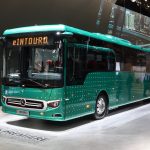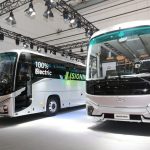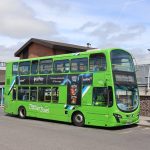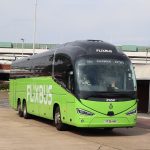





















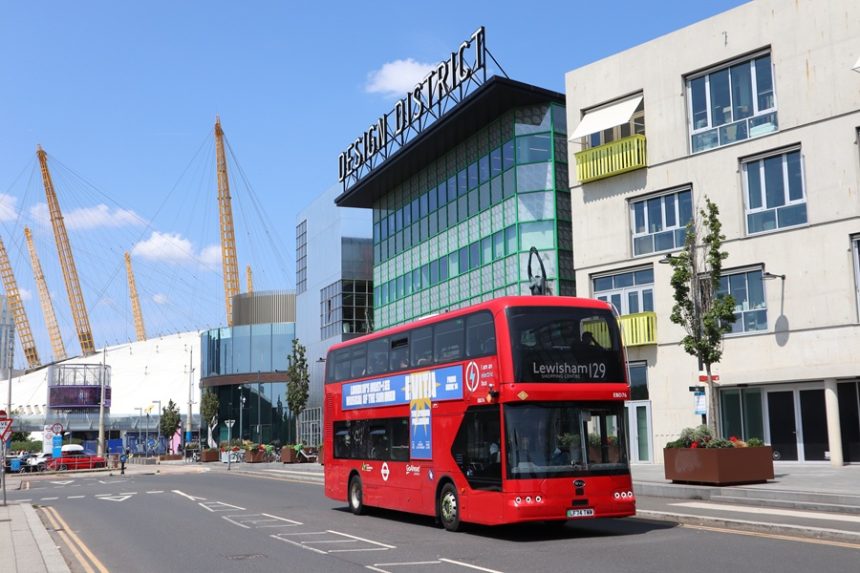
BYD has opened its first dedicated European battery service centre in the UK ahead of the establishment of further such facilities in other nations.
It will repair batteries to maximise lifespan, with the Chinese manufacturer using Busworld to highlight how that work sits against a background of over 5,000 of its battery-electric buses now being in service in Europe.
In underlining the strength of its bus business in the UK, the builder harked back to the 2015 Busworld in Kortrijk, when it displayed a first-generation battery-electric double-decker as one of five built for London. The OEM now supplies its latest BD11 successor alongside the B12 single-deck.
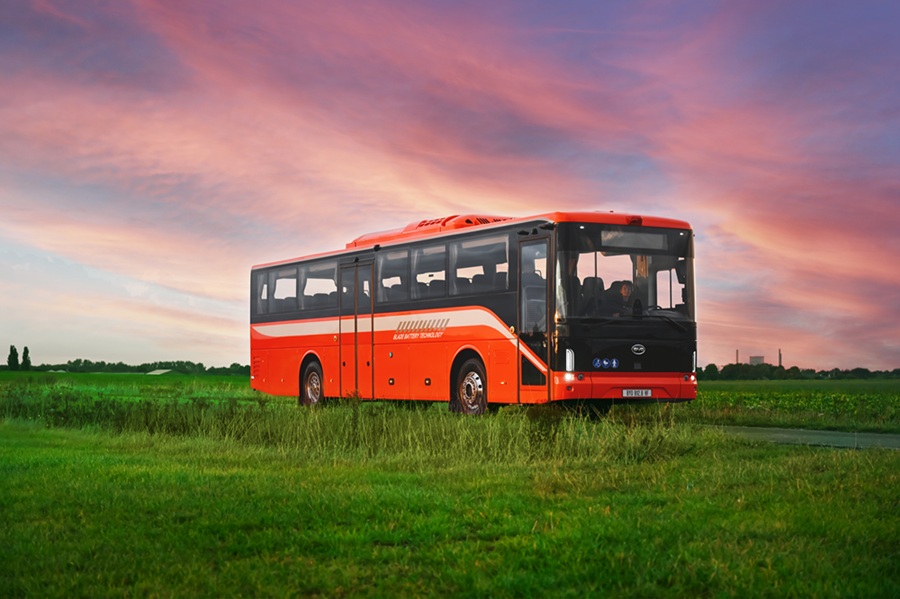
News of the battery service centre came alongside launch of three new models in left-hand drive form. They use BYD eBus Platform 3.0 technology and are made up of the B12.b LE low-entry and B18.b articulated buses and the B12.b HF low-height coach.
Each utilises what BYD calls “breakthrough” technologies including the positioning of Blade batteries within the chassis, hairpin hub motors, and advanced driver assistance systems.
BYD Europe Vice-President – Sales Javier Contijoch says that key to Platform 3.0 is “battery to chassis technology.” That sees replacement of elements of the chassis with energy storage packs, which reduces weight. Other elements including the drive axle, the thermal management system and a six-in-one controller contribute to efficiency gains.
A modular chassis is used in the new products’ combined five variants. Mr Contijoch says that the thermal management system is a major step, with a potential 50% reduction in its energy consumption compared to previous versions.
The B12.b HF has 5.7 cubic metres of underfloor space and a customisable interior to seat a maximum of 57 passengers. It is equipped with up to 495kWh of batteries and delivers a claimed maximum range of 650km. BYD notes that its potential use cases include home-to-school services, scheduled duties and some tourism-centred applications.
Charging is via either CCS2 plug-in or inverted pantograph. In the former case, dual connections allow replenishment at up to 520kW. Twin 150kW hub motors are standard, but for demanding applications, that rating can increase to 340kW, giving a maximum power of 680kW for the two-axle vehicle.
On bus manufacturing in Europe, BYD says that its factory in Hungary will expand to a position where 1,000 units per year can be built. Thus far the plant has assembled that number in total.