



















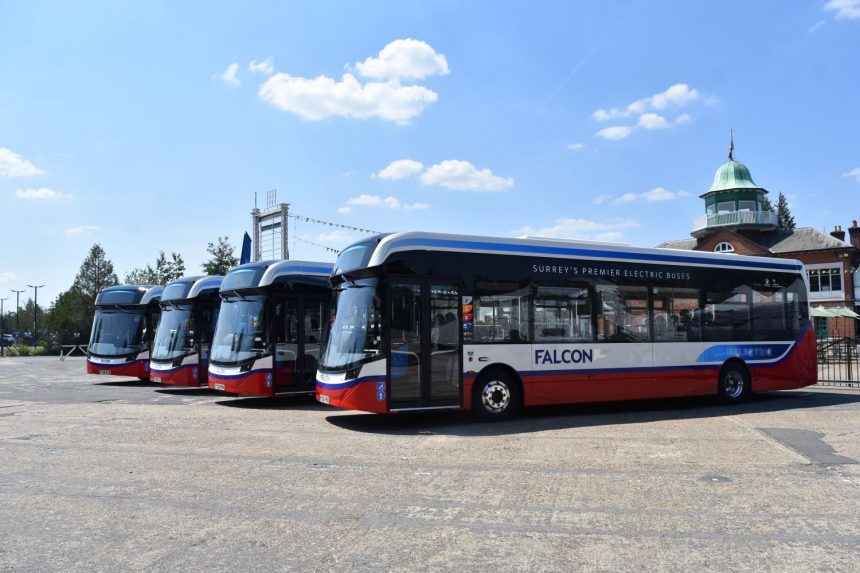
An early adopter of the next-generation Alexander Dennis Enviro200EV, Falcon Buses is proving independents can make the switch to zero-emissions – but not without obstacles
Falcon Buses’ launch last week of 13 new Alexander Dennis Enviro200EV buses highlights the growing role of SMEs in the transition to zero-emission fleets.
As the first independent to take delivery of the latest member of the Larbert manufacturer’s battery-electric range, the Surrey operator has shown the way forward for SMEs in the decarbonisation process.
However, its experiences have shown the complexities involved in the move, particularly for smaller operators.
The first four of the 10.9m-long single-deckers were officially unveiled on 9 July at Brooklands Museum, where the latest in zero-emission technology was juxtaposed with vintage relics from the world of buses, cars, aviation and motorcycles.
They will begin operation this month on the Surrey operator’s routes 436 between Weybridge and Woking, serving the museum, and 461 linking Kingston, Weybridge, Addlestone and St Peter’s Hospital.
While they are Falcon Buses’ first battery-electric buses, it is set to put another 18 into service by March 2027, by when 46% of its bus fleet will be zero-emission.
Supported by the government’s Zero Emission Bus Regional Areas (ZEBRA 2) scheme and in partnership with Surrey County Council, the latest deliveries from Alexander Dennis follow the introduction into service of four Enviro200EV by Go North East in April.
The latest version, which builds on the Enviro200EV first launched in 2016 and initially co-built with Chinese manufacturer BYD, is built in-house and sits alongside the shorter Enviro100EV and double-decker Enviro400EV.
Falcon Buses’ examples are equipped with two wheelchair and buggy spaces, USB charging points at every seat, part-leather seating, wood-effect flooring and colour-coordinated handrails.
The full air-conditioning for passengers and drivers was particularly appreciated by guests at the launch, which took place just a couple of miles from where the UK’s highest temperature of 35C was recorded that day.
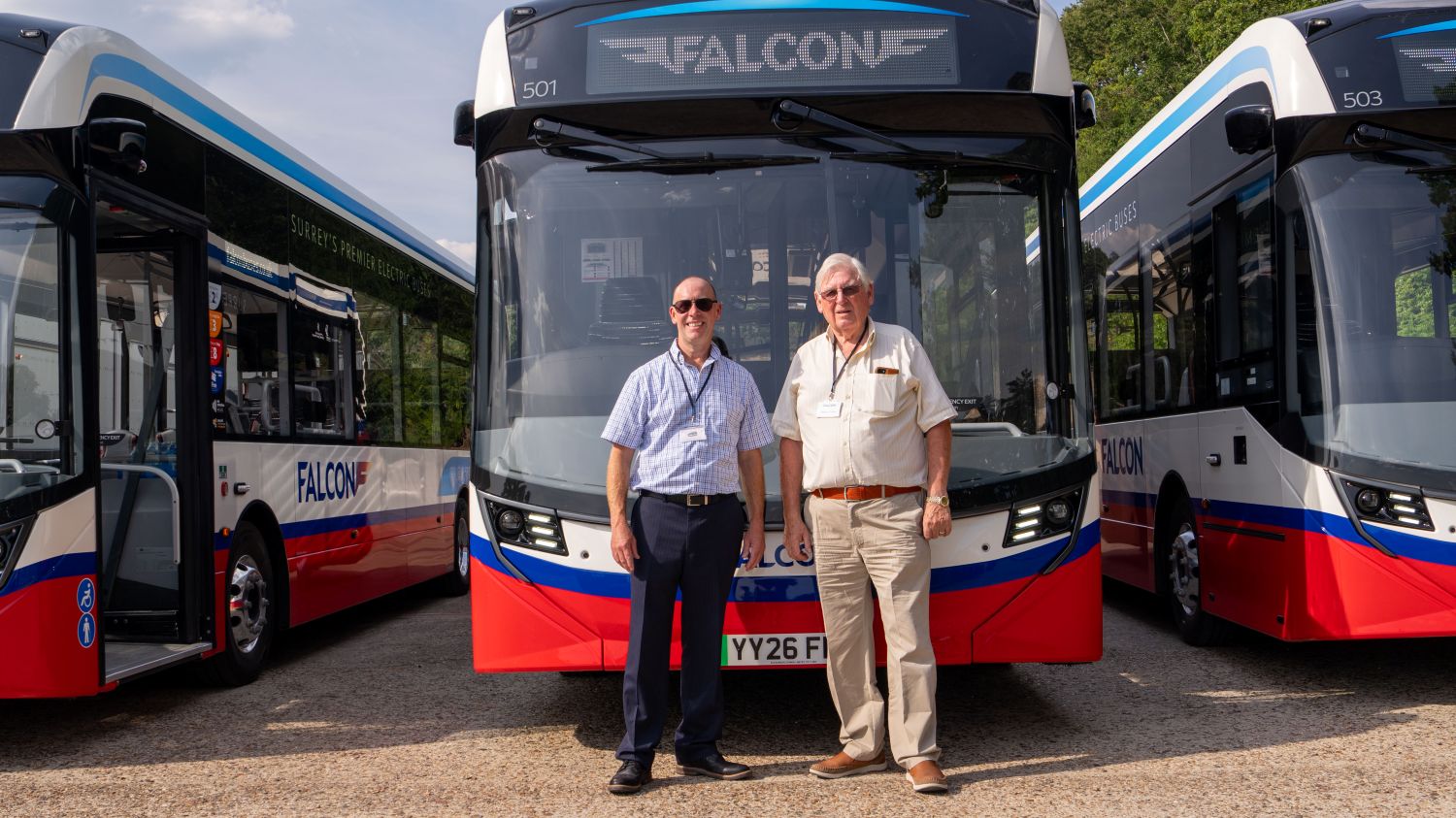
During an onboard tour to the depot to show off the infrastructure, Richard Telling, Managing Director of Falcon Buses, elaborates on the particular appeal of the Enviro200EV: “It just looks futuristic and more than just a square box with windows and wheels, which I think makes people more likely to want to get out of their cars and travel on a bus.”
The 436 and 461 were served by 8.9m- and 10.8m-long Enviro200MMC Euro VI diesels, so Falcon chose the 10.9m version of the new buses to ensure seat capacity wasn’t sacrificed, given the extra space needed for the battery and optimism surrounding future patronage on its two biggest commercial routes.
It just looks futuristic and more than just a square box with windows and wheels – Richard Telling
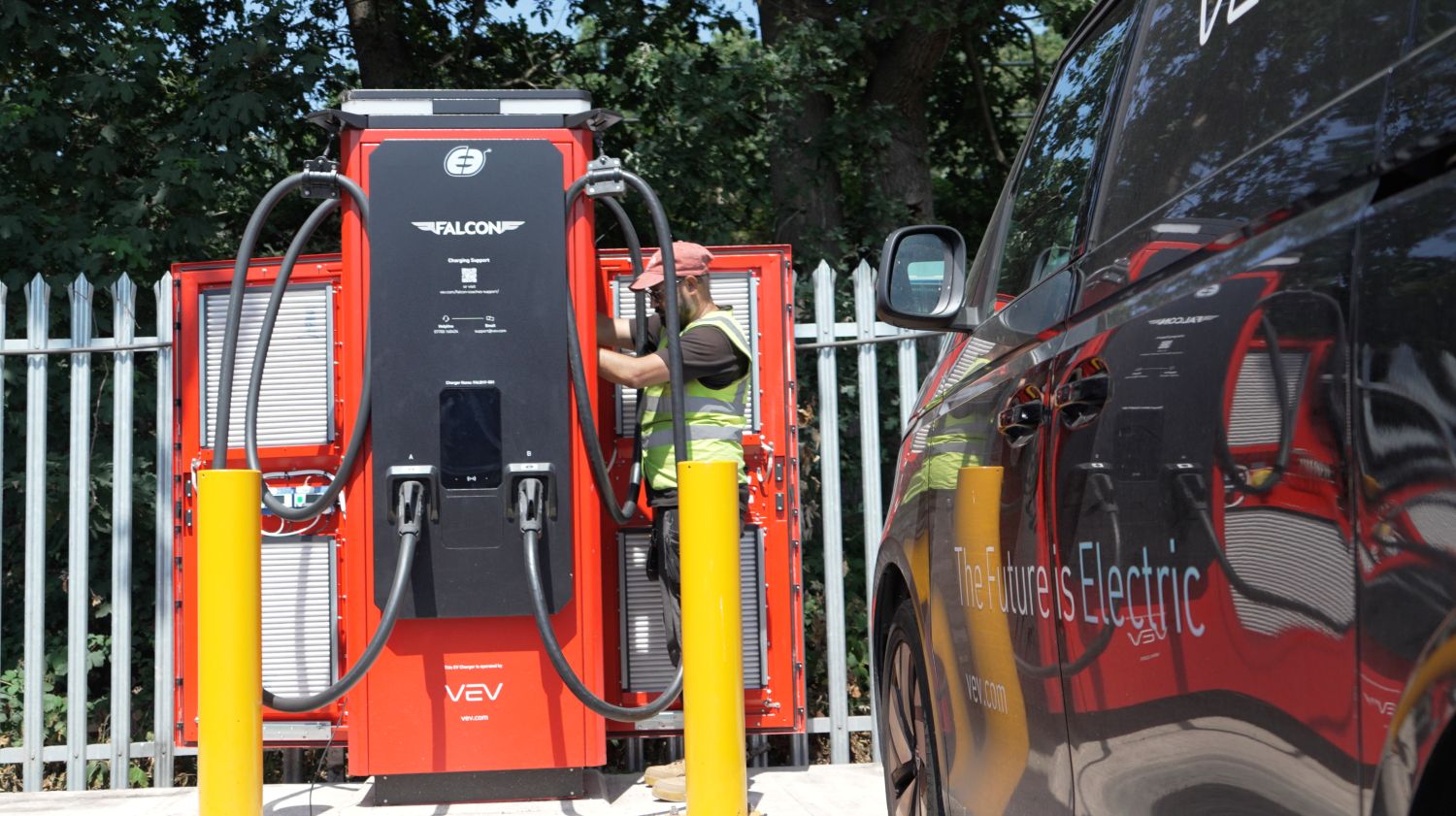
Future-proofing was also a strong consideration for Richard when it came to charging infrastructure. Its small depot in Weybridge is now served by a dedicated 1,500kVA power supply, six 60kW chargers and three 120kW chargers.
“VEV worked with us to make the plan work and make it so that it was expandable as the business grew its zero-emission footprint,” says Mr Telling, who explains the substation carries enough power to charge 40 buses.
A workshop at the small depot will eventually be taken down to allow more room, with engineering moved entirely to a nearby site it already owns. VEV is set to increase charging capacity later this year to five 120kW chargers, five 60kW chargers and two 50kW chargers.
Obstacles overcome
However, the installation further showed that the purchasing of the vehicles and securing the funding for infrastructure can be described as the easy part of the process when compared to the complexities of ensuring the buses can be powered, especially for smaller operators.
Early discussions had involved removing space for 10 buses, which Richard says would have been impossible in one of the most expensive places for land in the UK.
He says VEV’s “flexible” approach enabled the business to make the most of the space. However, a half-mile excavation to connect to the national grid was another of the complications.
That said, it was fortunate to secure the last available slot for that as, if it were unsuccessful, it would have meant a six-mile cable being needed instead, which would have been prohibitively expensive and ended the project.
During the installation process, Falcon Buses lost use of half the yard for six months and of its bus wash for nine months, and had to rent more space.
There have been some learning curves that I think it would be really helpful to share with the wider industry – Richard Telling
Various other complications meant it experienced a significant overspend and Mr Telling wishes there was more guidance from the government on such matters.
“It’s been a challenge,” he says. “There have been some learning curves that I think it would be really helpful to share with the wider industry because there’s more SMEs that need to get involved.
“People need to know where they’ve got to go. I think the Department for Transport could be a lot more helpful, especially with things like yard space.”
He also feels that governments or local authorities could help with opportunity charging at bus stations and elsewhere, partly to allow for expansion of services beyond the range of existing buses in the fleet.
Driver efficiency
Driver efficiency will now become a key focus for Falcon Buses, thanks to telematics from Alexander Dennis and VEV.
“I think the big point that’s coming now is we’ve got to really monitor the efficiency of the drivers,” says Mr Telling, who adds that training will be provided where weaknesses are noted in this regard.
Buying British
Falcon Buses’ entire bus fleet of 55 was Alexander Dennis Enviro200 MMC and Mr Telling is keeping faith with the manufacturer, partly due to reliability on after-service.
“We kind of stayed on 200 MMC from an engineering, parts, and driver familiarisation point of view,” he says.
The urge to “buy British” was a factor in the choice of purchase, although he recognises price needs to be borne in mind and says there was “little in it” when comparing with potentially cheaper products from abroad.
That said, among those 18 soon-to-be arriving battery-electrics are three E10 and two E9 from Yutong via UK distributor Pelican Bus and Coach.
Range was a consideration in that choice, given it is for the newly retained 715 route tender, which covers greater daily mileage.
Falcon Buses has also ordered eight new Alexander Dennis Enviro400EV. Three of those will be for a newly won Transport for London (TfL) contract for the 467 from Hinchley Wood-Epsom Hospital. It is a rare recent example of a new operator entering the TfL market.
The other five will be for a newly awarded Kingston University bus service tender, which also begins in September.
Coach decarbonisation
Falcon Buses also operates eight full-size Euro VI coaches. Mr Telling says the work they undertake could conceivably be completed with the range of a battery-electric, but says the problem is a lack of availability of different models on the market.
“The current offering of a zero-emission coach doesn’t fit the profile of what we need to meet our customer demands,” he says.
On the path to zero-emissions in the coach sector, he adds: “It’s going to need a lot of help. I think that’s probably the biggest problem and there’s no real support from government for coaches.”