


















Could a ‘Mini-Switzerland’ transport network in the Hope Valley lead to a better strategy for rural bus transport?
That better integration of different modes of transport would be beneficial to the economy and society seems to be universally agreed. Turning that consensus into reality is another challenge altogether.
The report “Mini-Switzerland in the Peak District”, which was published last month, focuses chiefly on a plan for better integration of rural transport in the Hope Valley area of the UK’s oldest national park. It is produced by Roger Clarke, Anne Robinson, Thomas Ableman, Matt Harrison, John Bickerton, Anshel Cohen and Nigel Hutton on behalf of Hope Valley Climate Action. Using a model applied in Switzerland, it is aimed at being a “national demonstrator” for how rural public transport can be reliable, integrated and easy to use.
The 50-page document lists the stated support from dozens of organisations and respected individuals in the bus industry, including East Midlands Combined County Authority (EMCCA), which is identified as being the ideal potential delivery body.
At the moment, we’re spending money moving empty buses around that no one uses, whereas we could be spending money moving full buses around that lots of people use – Thomas Ableman
Among the main principles of it are at least hourly bus services at the same time every hour, seamless connections between buses and trains, a single ticket covering all local services in the area, a PlusBus ticket for the whole of the valley, clear information, effective marketing, infrastructure improvements and more economical services due to higher ridership.
The Hope Valley is the ideal test-bed for such a demonstrator, the report argues. The rural area between Sheffield and Manchester is “not well connected to either [city] in a coherent way”. It was picked for having a clear east-west corridor, a rail line with an hourly service and multiple existing bus routes that can be reorganised into a network.
Synching timetables
Rail timetables would not need significant change, says the report, but bus timetables would be redesigned around train schedules.
The report’s main author, Thomas Ableman, admits: “Optimisation depends on the bus journeys … being de-optimised because they literally stop and wait for each other. So, if you’re an accountant looking at the bus network, you say, ‘We need more buses than we would have done, the timetable’s slow, we’re spending more on drivers, this is ridiculous.’ If you’re an accountant, you think exactly the same thing. Put them together, however, and suddenly, with all these optimised customer journeys, you get far more revenue.”
Funding is next step
Delivery of the plan is dependent on funding, the securing of which is the next step. The report says around £1 million of capital expenditure would be required at the outset. The first full operating year would require about £4 million per year of revenue spending, which would fall to £2m for each of the remaining four years. Mr Ableman says it would need to come from various sources but adds he has already had positive discussions, including with EMCCA, and is confident it is feasible. If funding is secured, the bulk of the changes could be implemented between next autumn and spring 2027.
He is aiming to prove that a model which works in Switzerland and parts of northern Europe can work in the UK. “At the moment, we’re spending money moving empty buses around that no one uses, whereas we could be spending money moving full buses around that lots of people use,” he says. He points out that Switzerland’s high GDP per head is not entirely down to banking and is seen throughout the country rather than just in the financial centres. “You ask the Swiss and they credit that to public transport integration,” he says.
National change
Speaking of why he believes this project could work where previous attempts at integration have not come to fruition or been effective, he adds: “What we have tended to do is say, ‘Okay, well, we’ll do an integrated ticketing project here, we’ll put a rail-link bus over there.’ It’s all very small and incremental… [Mini-Switzerland] is looking at what the Swiss do really well, and trying to do that in one place as opposed to coming up with incremental solutions built on where we are now.”
Rather than expecting a sea change across the country, he is hoping for a pipeline of “mini-Switzerlands”, if it can be proven to work. “I’m not asking for or expecting government to suddenly say we’re rolling this out nationwide…” he says. “But what I am hoping is that it can be a demonstrator that regions can learn from and we can then gradually get to a point where this does become possible.”
The report states that five years is the minimum length of time needed for such a project. Mr Ableman, who operates the transport consultancy Freewheeling, admits it will not gain a five-year funding package but adds: “What I am saying is we need to commit to this for five years because we’re talking about large-scale behavioural change here.”
Operator support
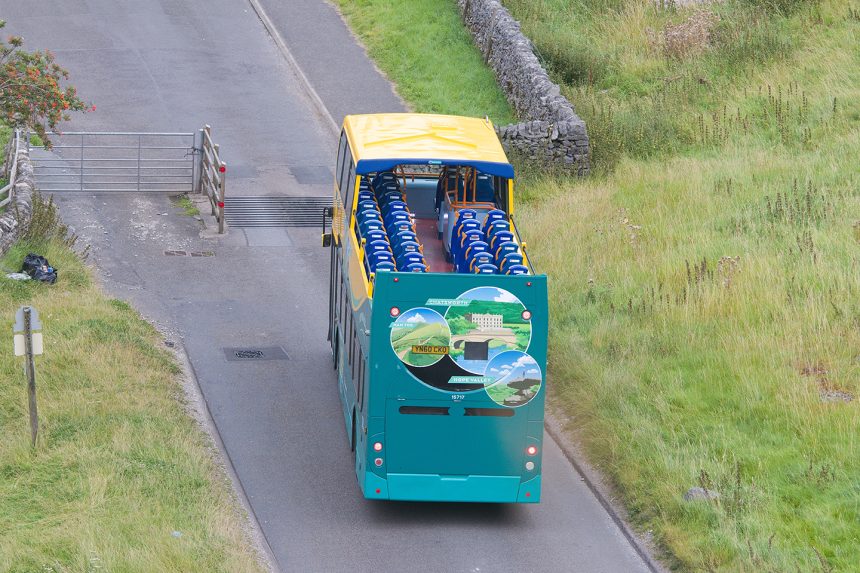
Among the supporters of the idea is Matthew Kitchin, Managing Director of Stagecoach Yorkshire, which operates the local seasonal Peak Sightseer, plus other services just outside the Hope Valley corridor.
Mr Kitchin says: “I think what’s great about this plan is it explains how to do it by taking real world examples of somewhere that does it well… It’s taking what’s already there, an hourly rail service, where you’ve got railway stations all through the valley that have fairly basic infrastructure that could be adapted fairly quickly to act as an interchange by improving the wayfinding from the station platform to the bus stop and maybe you need a little bit of investment in the bus-stop infrastructure.
I think one of the exciting parts of this proposal is rail and bus operators are on board for this – Matthew Kitchin
“But you’ve got the fundamentals there of it, and then it’s creating simple timetables. Whilst it isn’t going to be the most efficient timetable, in that the bus might be standing for 15 minutes out of every hour, it’s going to be a timetable that people can rely on to connect.”
Both Mr Ableman and Mr Kitchin agree this is the right time for the project, given the new powers that combined authorities have, the development of the Integrated National Transport Strategy for England and rural connectivity being pushed up the political agenda.
“EMCCA is a very new authority, but it gives a great opportunity to actually try something new and innovative,” says Mr Kitchin. “And I think one of the exciting parts of this proposal is rail and bus operators are on board for this. We want this to happen, we think it’s a good idea, and we’re prepared to bring our expertise in terms of network planning and data insights to refine this proposal, to bring it to life and to make sure it is a viable proposition.”