



















Moray Council-operated bus services should not participate in the Transport Scotland regional bus fare cap pilot because of concerns around reimbursement, a report to go in front of the local authority for a decision on 25 February has recommended.
The £2 cap pilot began in Shetland on 30 January and will follow across the Highlands and Islands after the HiTrans and ZetTrans Regional Transport Partnerships (RTPs) were selected to deliver it. The scheme is supported by £10 million from the Transport Scotland to support fares and £3 million to manage and establish it. Taking part for operators is optional.
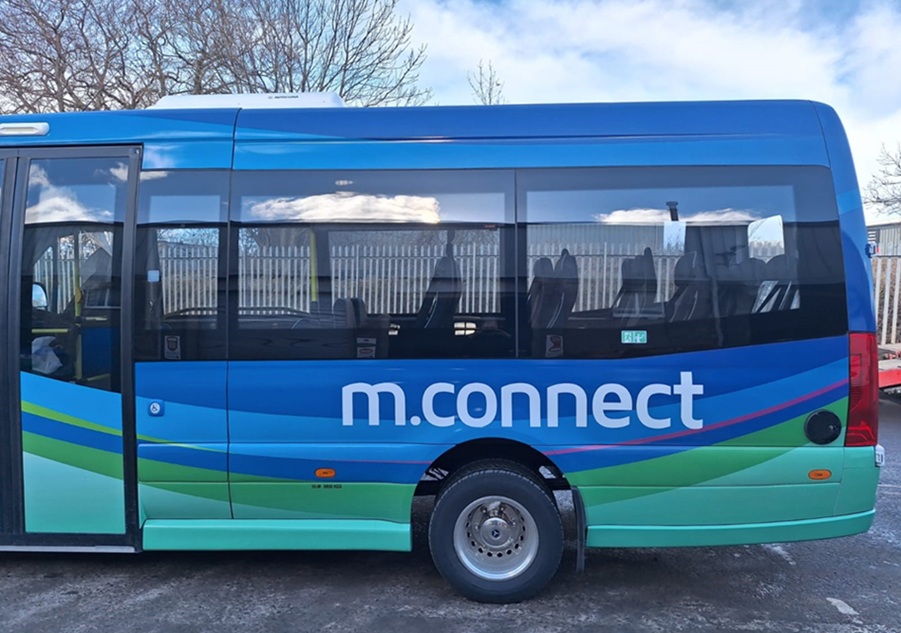
In recommending to Moray Council members that participation is rejected, a report from Public Transport Manager Donald MacRae – prepared in consultation with senior officers – notes how expected reimbursement for the local authority’s m.connect demand responsive and fixed-route services has generated multiple areas of concern.
Among those is no indication of the rate being offered. Mandatory National Entitlement Card (NEC) schemes deliver reimbursement of between 47.9p and 72.4p in the pound to Moray Council but “do not meet operational costs for the m.connect network,” Mr MacRae adds. “Consequently, the council is effectively subsidising [them].”
Not joining the 12-month fare cap pilot would impact only a small portion of m.connect users. Around 5-6% pay a fare and the remainder travel free with an NEC.
The report adds that at the time of writing, Transport Scotland had not set out a proposed rate for the fare cap “other than to state it will not be full reimbursement, nor would it cover additional staffing overheads for the increased administrative costs.”
Also noted is a proposal that fare cap payments will be made in arrears subject to a monthly grant claim being submitted. NEC transfers are generally paid at 90% immediately with the remaining 10% subject to a month-to-month adjustment.
“This creates a situation where [the] council is being asked to sign up to a scheme with no knowledge or guarantee on reimbursement and with a delayed and possibly time-consuming reimbursement process,” the papers continue.
A 100% reimbursement rate for non-commercial services should be provided, the document says. Any lack of participation by Moray Council will have no bearing on other operators’ positions.
Concern over reimbursement for the bus fare cap pilot in Scotland is not new. It was aired in a report to the SWestrans Regional Transport Partnership on 4 December 2025 exploring the suitability of Dumfries and Galloway to host the pilot.
Those papers noted how bus operators in Dumfries and Galloway had made clear that while they support the idea, they could not commit to participating “primarily due to the lack of confirmation on the reimbursement rate, as well as timescales.”
That document adds how operators in the South West of Scotland told SWestrans that “there is too much financial and operational risk to expect them to opt in when it could result in the loss of revenue to their business.”
In announcing the bus fare cap pilot, Transport Scotland aired a hope that it would make services easier to use, more appealing and more resilient in addition to aiding affordability.