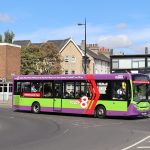






















Transport for London (TfL) has unveiled a five-year plan to cut overall congestion in the capital and speed up bus services.
The “London on the move” report outlines aims to roll out new technology, bus priority measures and lane rental schemes in a bid to improve traffic flow in London, which is one of the most congested cities in Europe.
If TfL is successful, the bus sector would be a big beneficiary with the average bus speed in the city being just 9.17mph in 2024/25.
Among the measures due is expanding TfL’s lane rental scheme from “red routes”, which are managed by the transport authority, to borough roads. Under this, utility companies and others are charged a fee to dig up the busiest roads at peak times.
This scheme, which is designed to encourage more efficient and collaborative street works planning, “has been proven to reduce congestion”, says TfL.
An expansion of the use of BusSense, a partnership with boroughs that reduces the impact of high-impact street works on bus routes through better coordination, is also on the cards. Early results using this system showed a 3.5% improvement in bus journey times.
Further, TfL’s report claims changes to the FUSION traffic control system could reduce delays by up to 14% through greater use of AI and data.
Also planned is an expansion of bus priority at traffic lights. The technology is presently installed at 2,080 traffic signals but the goal is to roll this out to all 3,500 by 2030.
TfL also plans, for the first time, to carry out signal timing reviews of entire bus routes instead of specific areas.
Graham Vidler, Confederation for Passenger Transport Chief Executive, says: “Buses account for five million journeys a day in the capital and are essential to the everyday lives of Londoners. However, London bus speeds have been falling steadily and are below 8mph across much of the city centre during the morning rush hour.
“Bus operators welcome TfL’s strategy to tackle traffic congestion over the next five years. We will be fully behind efforts to improve co-ordination of roadworks and broader traffic light priority.
“However, these steps are overdue. Passengers and operators alike need to see improvement now, rather than in 2031, to give them confidence that a bus can get them to their destination on time. We need urgent action to tackle disruption caused by poorly designed traffic schemes and by increasingly congested road space to get buses back on track.”
Mayor of London, Sadiq Khan, adds: “I’m committed to making London’s transport network as safe, efficient, and sustainable as possible. Congestion is annoying for everyone, and it costs our economy millions of pounds a year. This innovative new strategy will tackle the causes of congestion head on.
“This bold new approach to managing the capital’s streets will ensure they work for everyone: harnessing cutting-edge technology and infrastructure to reduce congestion, keep Londoners safe, and speed up journey times on London’s bus network.
“These improvements are vital to achieving my ambition for 80% of journeys to be made by walking, cycling or public transport, as we continue building a greener and better London for everyone.”
Carl Eddleston, TfL’s Director of Streets and Network Operations, says: “We’re determined to ensure London’s road network is amongst the best in the world and the new London on the move plan marks a major step forward in how we manage London’s streets.
“By harnessing data, technology and the benefits of new infrastructure, our 2030 vision will see a better, safer street network that is better suited to the needs of Londoners today and tomorrow.
“We’ll continue to work with London’s boroughs and our other partners as we work to deliver this plan over the next five years.”