




















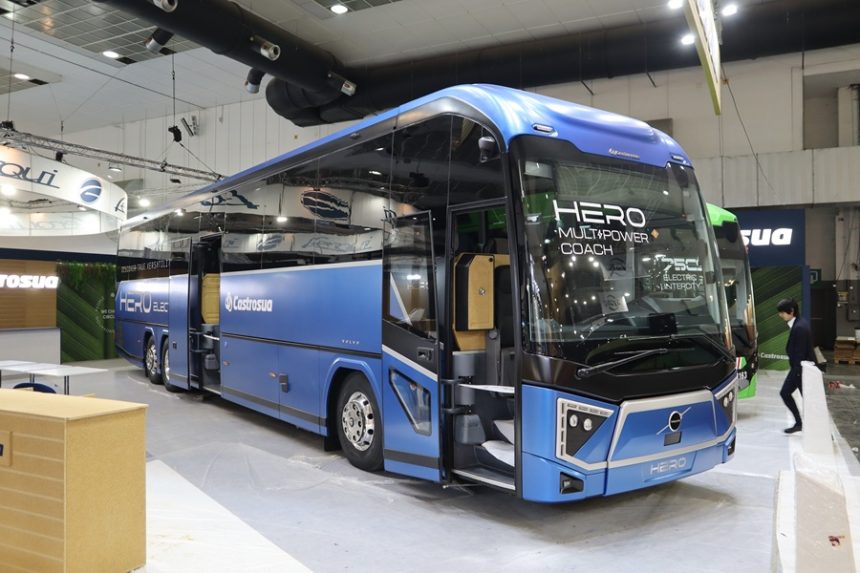
The Volvo BZR battery-electric high-floor coach and low-entry bus chassis has made its Busworld debut carrying a Castrosua Hero coach body. Its appearance is understood to place Castrosua as the first European bodybuilder to complete a BZR coach following that chassis range’s introduction in 2024.
Volvo Buses notes how the BZR used with the Hero is the mid-floor option. It differs from the BZR coach chassis recently launched directly by the Swedish manufacturer for battery-electric operation that will initially be bodied by Carrus Delta. The Hero is 3.68m high.
The initial Hero seats 62 on three axles, but the Spanish builder says that the configuration can go to 71 seats. Lengths are 13m or 15m in tri-axle format, although Castrosua expects to also mount the Hero on two-axle BZR chassis. A camera monitoring system is fitted to the prototype vehicle.
There is no suggestion that the Hero will be built in right-hand drive, but the seed vehicle gives an idea of what is possible on the BZR underframe. As presented, it has 540kWh of battery capacity via six energy storage packs but that can be increased as far as 720kWh.
Charging is at up to 250kW via CCS2 plug-in, with opportunity-based inverted pantograph replenishment also possible. The Hero will also be built on the diesel B13R chassis from Volvo.
Castrosua Sales Manager Ramón Senlle adds how BZR chassis availability has been relatively rapid. The bodybuilder says that the Hero has been created “with the aim of becoming a benchmark in passenger transport, responding to the present and future needs of medium- and long-distance operators, and school and interurban transport.”
He observes that while school and scheduled services are likely to be prominent in use cases for the Hero in battery-electric form, it is also expected to appeal to tourism-based applications. “It is the for the European market, not just Spain,” Mr Senlle continues, adding that there may also be scope to sell it outside Europe.