




















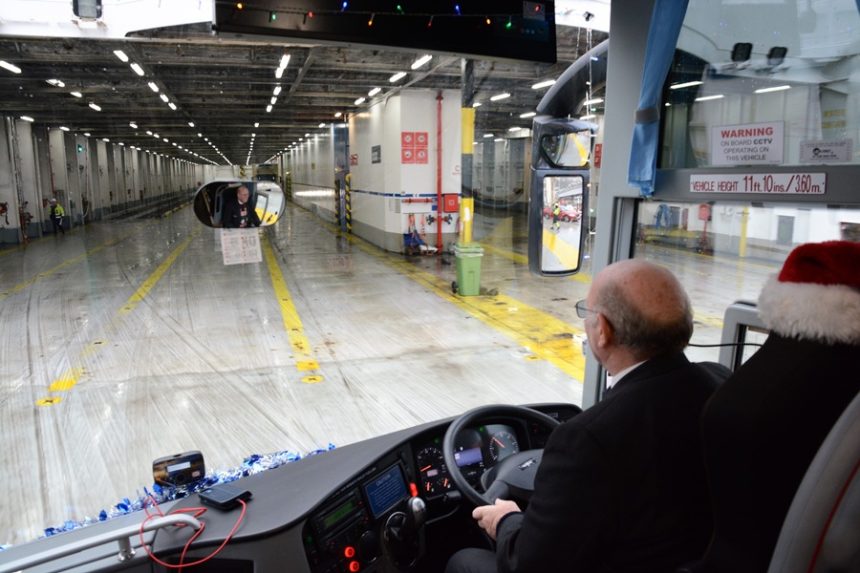
A coach carrying a military brass band to France is transporting more than just passengers. It is carrying a rolling state occasion. I say that with some confidence. My neighbour is in a military band and, as I write, is returning from France by coach with uniforms and instruments safely stowed.
The journey out was less efficient. The Entry/Exit System (EES) was not designed with British military precision in mind. Her driver was required to perform the familiar manoeuvre: leaning forward slightly, as if posture may influence international bureaucracy, followed by the second classic – the sigh.
Not just any sigh, but a declaration of that ancient coach driving unofficial motto: yes, this again.
At the border, the logic of EES is clear. It is modern, biometric, and precise. In effect, it is a computer saying “I would like to meet each of you personally”. Charming in theory, but less so when a coach arrives carrying 50 people.
A system that works well for cars suddenly faces what is in effect a travelling platoon. EES is designed to bring border control into the digital age, recording each third country traveller’s entry and exit electronically, linked to biometrics.
On paper, this should make borders fairer and more secure. But coaches run on tarmac, not paper. For operators, the key is not whether EES is a good idea, but how it works when moving large groups through a system primarily designed for cars and HGVs.
EES introduces three key changes. First-time travellers must register biometrics, which takes longer than a passport stamp. Everyone is processed individually. Small issues, such as scanning difficulties or mismatched details, can cause delays.
For a coach, that creates a major challenge. The group can only move as quickly as its slowest member. A car may have one or two travellers; a coach has dozens. An extra minute per passenger can translate into significant delays. That is why coaches are disproportionately affected.
EES is not just a digital system. It has physical implications. Passengers need to leave the coach and use machines. At ports like Dover, where space is already limited, a coach arrival becomes less like a vehicle passing and more like a small event.
Coach travel depends on precise timing, coordinated around drivers’ hours, hotel accommodation, and crossings. The difficulty with EES is not only extended processing times, but unpredictability.
Most passengers may pass through smoothly, but complications can delay the entire group. That creates good days and bad days, which are far harder to manage than consistent delays.
EES places greater responsibility on travellers themselves. Passengers must understand the process, present correct documentation, and complete biometric checks effectively. The latter can be challenging for certain groups.
As a result, the success of a journey increasingly depends on preparation and clear communication. The UK Coach Operators Association (UKCOA) is playing an important role in supporting operators with guidance and best practice.
If coach travel becomes slower or less reliable, there will be broader consequences. Operators face rising costs, trips become more cautious in planning, and prices increase. Some travellers might choose alternative modes such as air, which will not mitigate climate change.
Over time, this could reduce demand for group coach travel, particularly for shorter trips.
Operators can mitigate some challenges through better preparation of passengers. While these measures will not eliminate delays, they could prevent minor issues becoming major disruptions.
EES is, in principle, a sensible and modern system that enhances border security. However, something designed for individuals risks undermining one of the most efficient collective modes of transport.
With the right infrastructure, planning and support – much of which UKCOA is already addressing – these challenges can be managed, ensuring that even a travelling military band remains, reassuringly, on the road.