



















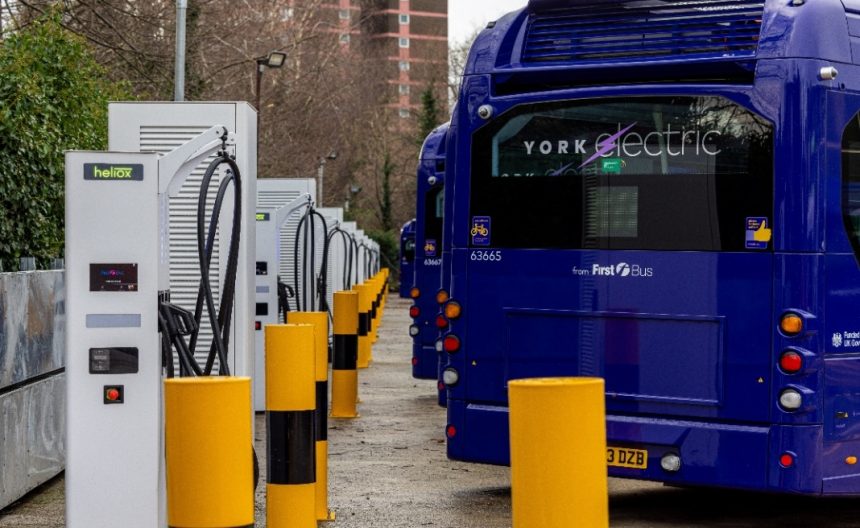
routeone speaks to EV charging specialist Envevo about the challenges around infrastructure and what lies ahead in the coach and bus decarbonisation process
On the journey towards decarbonisation of coach and bus, the installation of electric charging infrastructure is one of the most important and yet complex issues facing the industry.
It is one thing having the battery-electric vehicles, but making sure you have all you need to adequately power them presents a whole series of challenges.
Infrastructure costs, grid connection challenges, land permissions, uncertainty over investment due to franchising possibilities, conversion of live diesel depots to electric, and space considerations are just some of the obstacles which operators need to overcome.
One supplier which is well aware of all those challenges and which is helping operators get around them is Envevo.
The Midlothian-based charge point installer provides turnkey solutions covering design, construction, and maintenance. It works across all sectors – from coach and bus to motorway and forecourt, and from residential to workplace charging.

It has completed more than 3,000 projects of various sizes in the last six years. Among these is the First Bus Caledonia Depot in Glasgow, which involved 80 dual-headed rapid DC chargers capable of powering more than 150 electric buses.
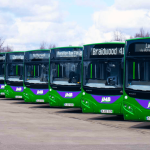
Another was First Bus’s depot in Bramley, Leeds, where it installed two 1.5kV substations to power 57 electric buses.
According to Envevo Chief Executive Michael Kennedy, what sets the business apart is its ability to cater for all aspects of the depot electrification process from concept to completion and beyond.
That includes the consultation at the outset, design, architectural planning consents, electrical works and building. It does not stop at handover as repair and maintenance, as well as software, are part of the service too.
The complexity of the projects varies greatly, with the biggest challenges often involving installing electric charging infrastructure on depots built to house petrol or diesel buses, particularly as the site is likely to be in normal operation at the time.
Having to take power from the grid to the site, potentially requiring the permissions of other landowners, is another often lengthy issue with which to deal.
Envevo’s clients also differ greatly in terms of the amount of assistance required, with the likes of Go-Ahead and First Bus more experienced but smaller operators needing more “hand-holding”.
Michael discusses the factors likely to affect the decarbonisation of coach and bus – both positively and negatively.
Electric is cost-effective, says Envevo CEO
Although saying government investment has been, and will continue to be, important for both the purchase of zero-emission vehicles and installation of infrastructure up to now, he notes that operators such as First Bus and Go-Ahead are now self-funding projects.
This is because there is the realisation that battery-electric buses are cheaper to run, says Michael. As well as low maintenance costs, he adds that a change in the expectation of battery degradation levels is contributing.
“Whereas the expectation was the battery would have to be swapped out at year seven and eight,” he says, “what they’re actually finding out is that the battery might last 10 or 11 years.
“If you’re looking at the life cost of that battery, it’s reducing all the time.”
He adds that decarbonisation is far from the only benefit of the move towards electrification but that operators are making the transition “because it makes economic sense”. He adds: “Battery-electric wouldn’t be rolling out on such scale if the numbers didn’t tie up.”
Changing costs
When it comes to how those costs might go up or down in real terms in future, it is a mixed bag, in Michael’s view. The cost of bringing power to sites will likely rise as the grid becomes more constrained, he thinks.
He adds: “We are seeing the cost of the charging hardware coming down as new entrants are coming into the market from Europe, the Middle East and Asia.”
He says: “Where the biggest cost needs to come down is in the battery itself, and we’ve seen that, even in the past five years, the cost of the batteries has come down significantly.
“You’ll see the cost continue to come down but the performance increase and that will be where you’ll see adoption really kicking in because it does bring down the cost of the car or the cost of the vehicle significantly.”
Grid concerns
When it comes to that lack of capacity available from the power network at certain sites, the UK government will need to solve the problem if the phase out of non-zero-emission coaches and buses is not to be held back, the CEO of Envevo thinks.
“If we don’t find solutions to the grid issues in the next few years, it will absolutely slow down the uptake of electric coaches and buses,” he says.
Michael is of the view that the advancement of battery storage is set to be one of the most significant changes in technology for coach and bus operators, particularly when it comes to overcoming the grid constraint issues.
The only thing that kills investment is uncertainty. For me, it doesn’t matter when the deadline is – as long as there’s a line in the sand and it doesn’t change – Michael Kennedy
He says: “Battery storage hasn’t been a huge part of the mix until now because the battery has been so expensive in relation to the performance but, as the performance has increased and the cost has come down, it really is a solution.”
Where battery storage is in place, power can be stored when demand is low and utilised at peak times, which can also reduce the cost of the electricity.
Uncertainty is an issue
Michael stresses the need for the government to set a deadline for the sale of new non-zero-emission coaches and buses.
He says: “Humans are creatures of habit. If they’ve always bought a diesel bus from a specific manufacturer, they’ll continue to do that.
“The only thing that kills investment is uncertainty. For me, it doesn’t matter when the deadline is – as long as there’s a line in the sand and it doesn’t change.”
The range of the batteries is getting better every year, every model that comes out – Michael Kennedy
Another issue in which uncertainty is harming the industry is the potential for bus franchising or municipalisation, he believes.
“Private operators don’t want to spend millions of pounds in investment in a depot and on a route that actually may be taken back under public ownership,” he says.
“It’s not 100% clear how it will play out and it’s definitely having an impact.”
While operators of long-distance coaches, in particular, may be thinking the phasing out of new diesel vehicles available to them is some way off, Michael says it is probably closer than many consider.
“The range of the batteries is getting better every year, every model that comes out,” he says.
“If you’re talking about coach operators that run from, say, Glasgow and Edinburgh to London, yes, it may be a couple of years away, but it’s coming. And I think it’s coming quicker than probably some of them realise as well.”
The shift to zero-emission vehicles is gathering pace, and with expertise from firms such as Envevo, the infrastructure to support it is rapidly catching up.
The challenges will evolve over time, but battery-electric is undoubtedly becoming a realistic prospect for more and more operators.