





















Transaid is a UK-based international development charity that works to improve road safety and access to healthcare in low- and middle-income countries, primarily in sub-Saharan Africa.
Improving road safety is achieved via a focus on professional driver training and safety programmes. But in many regions where Transaid is active, a gap exists between those behind the wheel, and the training ability of those teaching them.
Project Manager Thelma Ayisi is working to address that training gap. She is heading a professional driver training project begun in the Republic of Ghana in 2021.
Thelma reveals there was no specific training standard or curriculum for the training of drivers of heavy goods vehicle in Ghana at the outset of the project, alongside a lack of training standards, and a shortage of training schools; a discovery from a transport impact assessment conducted prior to the expansion of the Tema Port, one of the largest deep water ports in West Africa.
Leveraging UK expertise
Driver training in Ghana is undertaken through an informal apprenticeship process, with a dependence on older, more experienced driving “chiefs” passing on their knowledge. There is no limit to how long such apprenticeships could last, with Thelma warning that they can last for over two to five years.
“The Driver and Vehicle Licensing Authority (DVLA) in Ghana was also not equipped with enough technical capacity to test HGV licence applicants due to a shortage of examiners with F-class licences and driving ability as the examiners do not have sufficient HGV driving experience,” she explains.
The situation has begun to improve. Over the last three years, 12 trainers have been prepared as well as a curriculum and an instructor’s manual which have provided a level of standardisation to the driver training process. Out of those 12 trainers, four have gone on to become master trainers and therefore able to train more trainers as and when the demand requires it. With government buy-in and to strengthen sustainability, Transaid is currently working with the DVLA to establish a training school for existing and aspiring driving instructors as demand for training grows in Ghana.
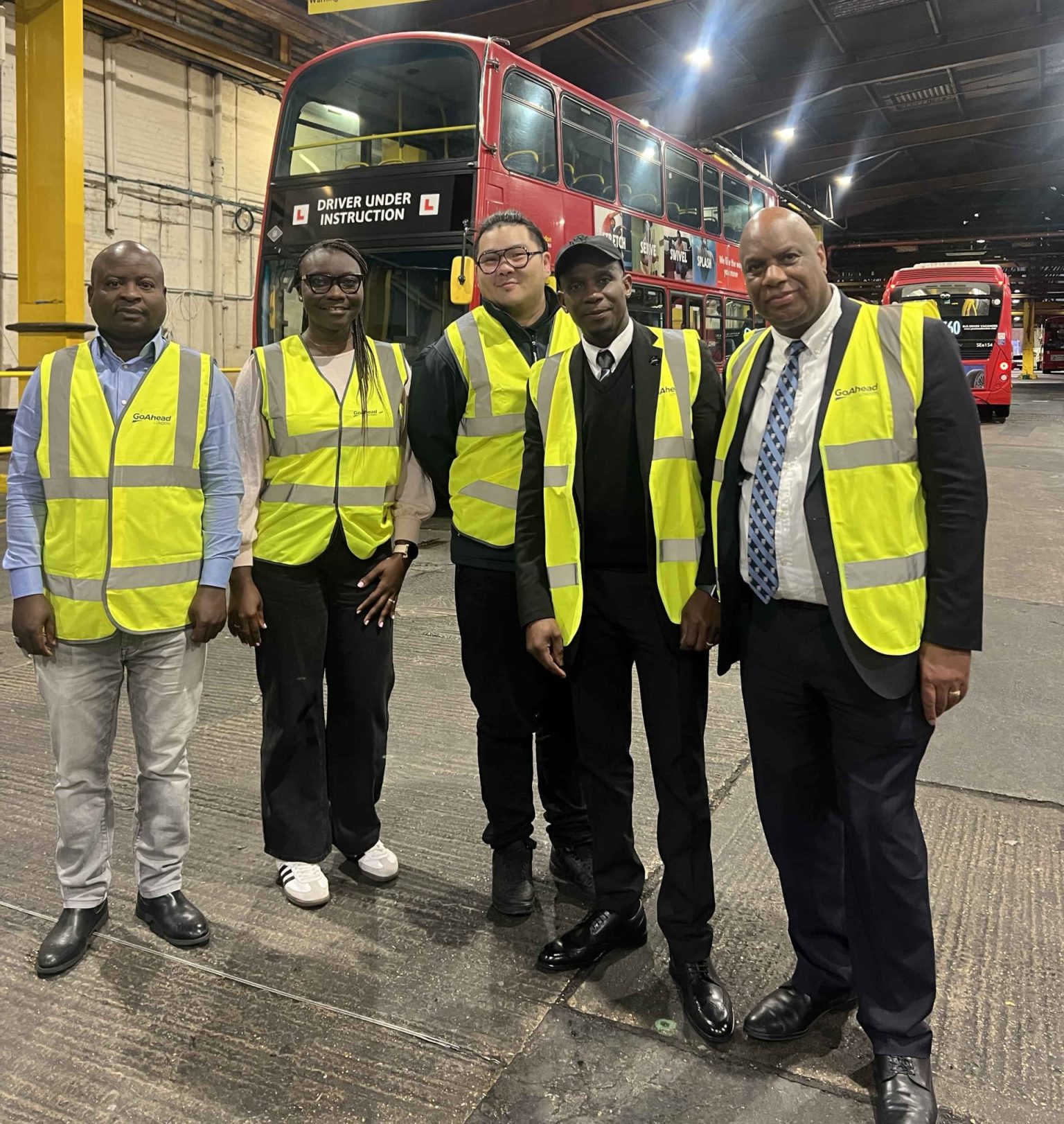
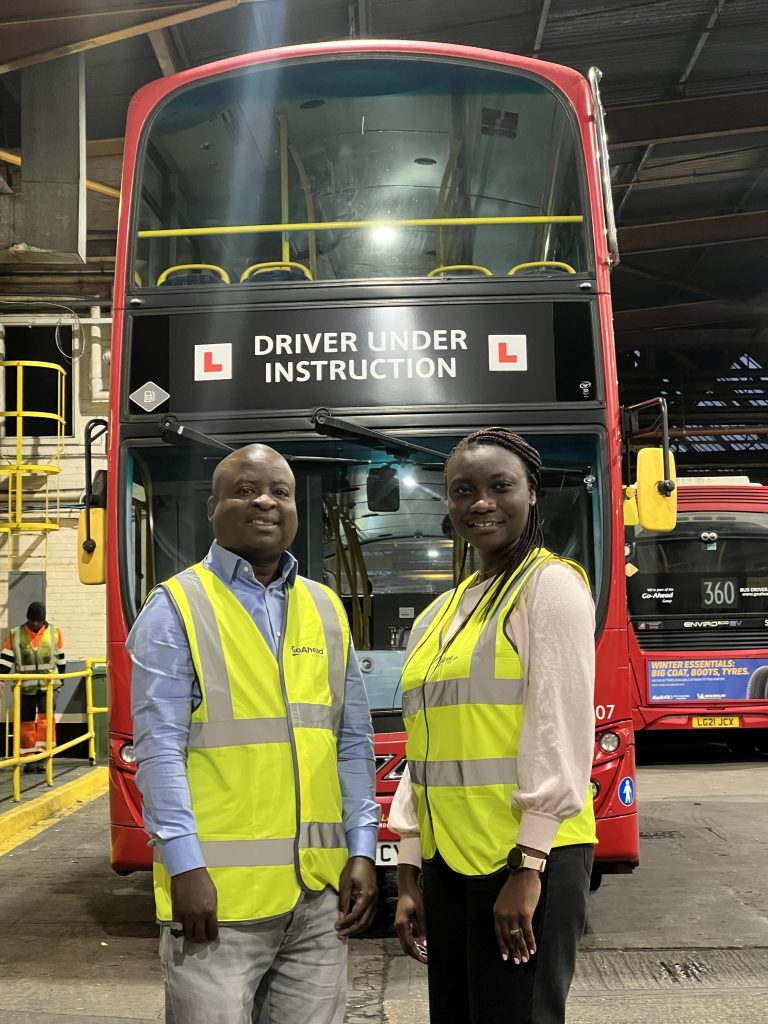
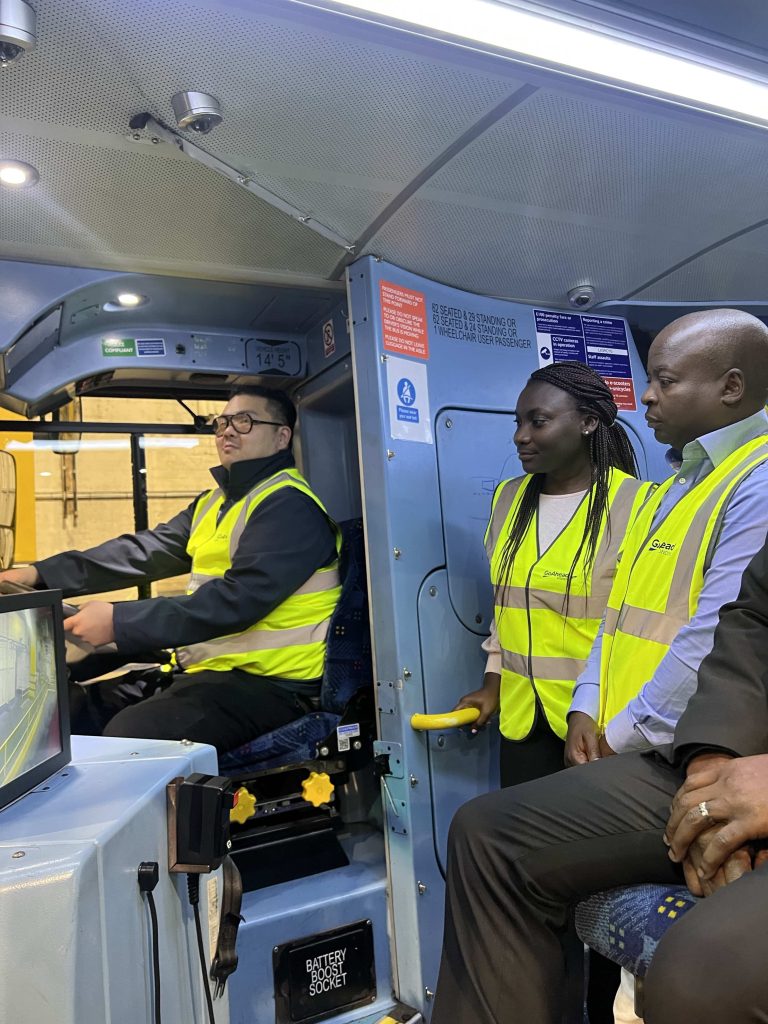
But challenges remain, and Thelma notes that in Ghana, there is a shortage of role models from which new trainers can learn. That has brought her, alongside Dennis Simuyuni, Project Manager in Zambia, to Go-Ahead London’s Camberwell bus depot, highly regarded in the UK as a training academy. The meeting, which has seen Thelma and Dennis observing both driver training on the road and classroom training over a total period of three days, is being facilitated by Transaid’s existing relationship with The Go-Ahead Group.
Thelma is grateful for the opportunity and excited to gain as much knowledge as possible to apply back in Ghana. “As Project Manager I need to have a vision in mind,” she says. “I want to see this project get far, and many of the things we learn cannot be found in a book. We have to see it in person, see how a trainer communicates with a driver. On the first day we have seen the value of communication, and giving assurance to make drivers comfortable — such as helping them feel like they are not taking a test.
“This opportunity gives us something to look forward to and something to learn from that we do not have in Ghana.”
A respected institution
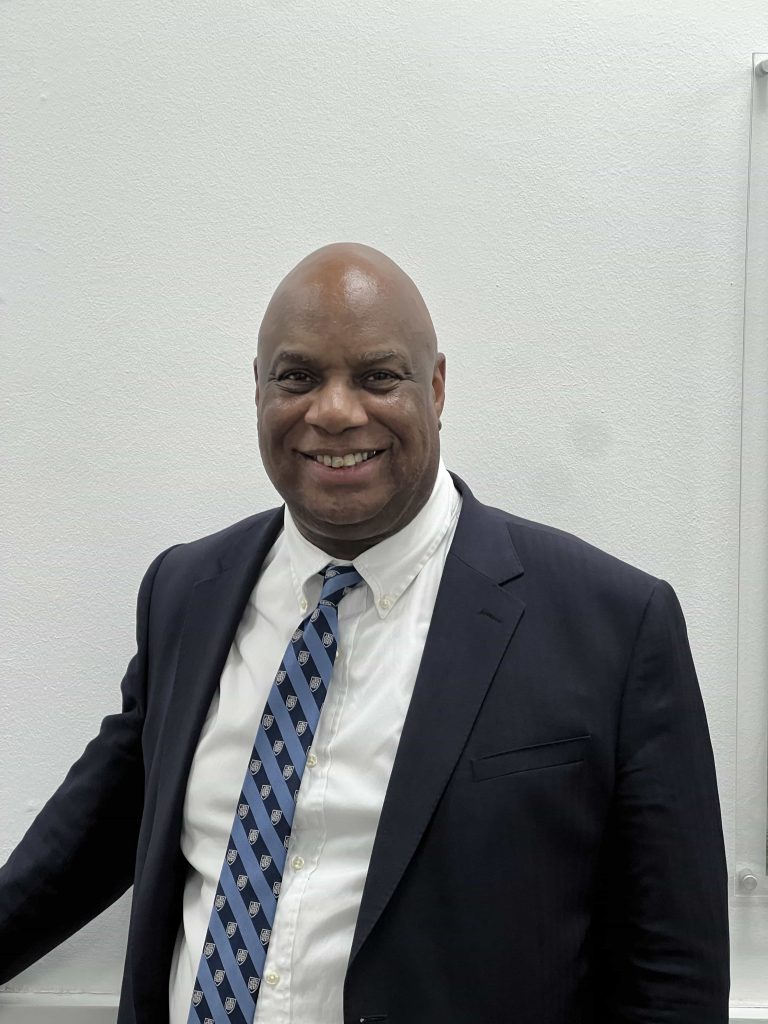
Academy Manager Eric Dale (pictured, left) oversees a professional institution that now boasts 42 driving instructors and eight classroom trainers. He says Camberwell is one of the finest PCV training establishments in the
UK, and he has been instrumental in developing that during his over 40 years spent with the company. The academy has three of its own delegated examiners, meaning there is no queuing system for DVSA testing. Practical driver training takes place over 15 days, and six years ago, Go-Ahead London also began bus driver apprenticeships as an employer provider.
A long history accompanies the Academy. It moved into its present building circa 2001, when two previous training companies, one under London Central and one under London General, were finally merged into a united school under Go-Ahead London in the present building, next to the Camberwell bus garage.
His long association with the training schools, having established one while working for London Central in 1993, means Eric knows all the challenges of establishing a training regimen. One of them is that instructors are not easy to find.
“They need a driving standard higher than the average bus driver. An instructor has to have the ability to teach three different people that all require three different approaches, and administer that approach to the individual how they require it. Some instructors only have one approach, which may not work for one person, but works for another. An instructor needs to adjust their training delivery. Some people need motivating, some need pushing, some need nurturing. The key is knowing when to take the right approach.”
75% of Go-Ahead London’s instructors are trained in house, with the rest coming externally from those experienced with London bus companies that have similar ways of working. A bit of polish steers them into the Go-Ahead London way of thinking.
“The ideal would be to have 100% our own trainers, yes, but the reality is we sometimes need to source more instructors very quickly. As I speak, we are looking for four more,” Eric explains.
When drivers leave the academy, they spend a week with a mentor, a fellow driver upskilled in how to ensure the new drivers meet the standard.
Theory and practice
One of the messages Eric emphasises is that many do not realise all the responsibilities that go with the job — from evacuation procedures to appreciating the restrictions.
“You can see when you deliver training that their minds boggle as some come to realise this is not what they thought it was going to be. That helps some get even more motivated. Bus driving is not a mundane job. It’s a prestigious job that requires a lot of responsibility and a high degree of skill and ability.”
For Thelma, it’s an ideal message, and one which will help inform how the training process will be delivered in Ghana. But a problem remains. The main concern now is that new instructors being sourced in Ghana are not drivers. Despite going through theory training, practical training, and learning how to drive, on a day-to-day basis, they are not drivers themselves. There is also a lack of curriculum for examiners, despite the development of a training process for drivers.
That creates an obvious knowledge gap. In the UK, Go-Ahead London has an expectation of one-year full time employment in addition to three years’ driving experience required by DVSA before they are qualified to train. In order to get that practical experience in Ghana, an ideal solution would be for a delay, during which time the trainers could have a period of driving with a professional company. But there are costs involved, and there is no equivalent to Go-Ahead in Ghana that a training school could lean upon.
“A key problem we have is that few of us can afford to put an HGV in a training school, which will also make the cost of training high,” explains Thelma. “That means our trainers are struggling to implement what they have learned in theory into practice. Instead of them being trained first as instructors, we have to train instructors as drivers first. The biggest challenge is giving new instructors the opportunity for practical experience.”
But a direct line to a highly respected operator now presents the opportunity for standard sharing and a technical exchange. What remains obvious is that in Ghana, it will be a long time before a clear pathway to becoming a qualified trainer becomes available — but the journey has begun, thanks to the collaboration between Transaid and Go-Ahead.
Thelma hopes someday to establish that line of progression. But conversations with DVSA, the only body that licences and certifies examiners, can only help on a government-to-government basis. That makes timebound projects like this one difficult.
“Go-ahead now becomes my teacher. The value of this relationship is the value of technical exchange and having somewhere to go that is at the very highest in terms of ability and standards,” says Thelma. “I’m so proud that this is where we get to learn from, to take that knowledge back home, and manage a project that is trying to set up the first training school of its kind.”