



















How technology is applied to bus services and their passenger proposition is moving quickly. That is broadly driven by the combination of rising customer expectations, and political agenda-setting; franchising is a factor, but so are efforts on integration and data sharing. Developments also benefit the operator and/or contracting body in terms of service oversight and availability of data for performance reporting.
Ridango is a Swedish business with what it terms a “transit gateway” that works across much of that field. How the product can apply in the UK is bolstered by uTrack, the Dublin-based supplier working in a similar field that came under common ownership with Ridango in 2025.
Consolidation brought with it uTrack co-founder Eamonn Hughes. Self-described as “a technologist,” he has extensive experience in mobility across the UK, Ireland and other markets, with many notable client wins for uTrack.
Ridango and uTrack products work well together, says Ridango Sales Director UK and Ireland Argo Verk. Ridango owes its founding to adoption of account-based ticketing in Estonia.
As a group, it now has customers in over 28 markets, a headcount of 220, and belief that it can play a part in ongoing change to public transport here. The uTrack brand will transition into Ridango over the medium-term.
Account-based ticketing on bus flourishes for Ridango
“Since the beginning, Ridango has been about ticketing,” Argo explains. Quickly following were automatic vehicle location (AVL) and real-time information solutions, developed after customer requests. Ridango is strong in the Baltics and Scandinavia. Authorities there push passenger-beneficial technology hard, as is reflected by the supplier’s development trajectory.
The account-based ticketing platform sits alongside in-house readers, arrival of further payment units to suit the UK, and compatibility with other suppliers’ hardware. “This captures the ticketing affair management together with contactless payments all that comes with it,” Argo continues.
A central hub on the vehicle sits above those. While the overall offering is wide, it is also modular. “If a customer has a need for an AVL system, we can supply it. If it wants to replace a new ticketing system, or just provide new validators, or an account-based system to sit ‘on top’ of its legacy product, we can do that, too,” he continues.
Multimodal functionality is part of the account-based platform in recognition of political and operational realities around integration. Significant thought goes into how fare caps are applied. Argo points to work in another market, where a nine-and-a-half-page products list was consolidated into the account-based system as an example of how well-versed that is.
uTrack consolidation brings leverage for bus-centred products
Ridango previously explored the UK, but did not reach the stage where it was ready to invest. Acquisition of uTrack changed that. uTrack brought its own AVL product, but Eamonn notes how the pair of location solutions differ in application. Ridango’s is an operational tool; that from uTrack majors on data analytics.
Combination of the two businesses also brings uTrack’s driver app. It allows staff to self-serve many administrative tasks such as rostering, leave requests, payslip access, signing on, and much else. Live messaging from operator to driver is a further attraction.
Work on ticketing, oversight and management for home-to-school services by uTrack is also developing further towards what Eamonn says will be “a whole solution” for that field. uTrack counts a huge school transport operator in North America as a client and is leveraging experience there for the UK and Ireland.
While the Ridango approach looks largely to deployment at scale, Eamon observes the wider agenda of local authorities taking greater interest in and control of transport services. He points to Ireland, where Bus Éireann manages home-to-school provision, as a learning point. There is scope for similar on a county basis in the UK, he believes.
Public control will provide influence on approaches
That the Ridango platform suits authorities and operators is reflective of work in other markets and what is currently happening in the UK as bus franchising rolls out, Argo explains. Its versatility will also benefit operators that through franchise contracts may have on-board hardware that differs to products used in deregulated areas.
Coupled to natural development in the technology field, he suggests that a risk exists of such a burden becoming difficult to manage. Argo points to the contrast between technology in Scandinavia and in the UK; here, there is a lot to do to catch up with what is a European leader.
“Franchising adds impetus to have a combined solution rather than separate things,” he continues, noting how other local authority-led projects such as cycle hire can be integrated into an account-based approach; in Estonia, use of some sporting facilities is also compatible.
“The shape of urban buses in the UK will change dramatically,” Eamonn predicts. “Local authorities are going to take a lot more control. We believe that Ridango coming into the UK will provide something to fundamentally suit that.”
Technology developed in the Baltics can now spread to the UK and bring change with it, Argo concludes. “Ultimately, we are all about the passenger. Ridango comes from ‘ride and go’. That means making it easier to pay, easier to use, easier for the driver, and easier for the operator or authority.”
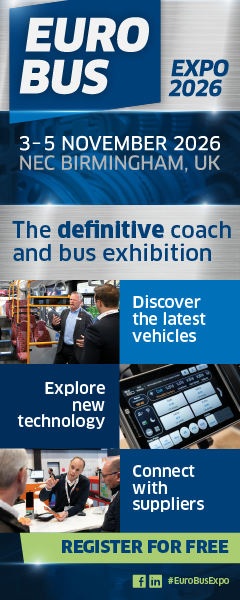
Ridango will exhibit at Euro Bus Expo at the NEC Birmingham on 3-5 November.