




















With tram gaining traction in the public transport debate, bus rapid transit could likewise be better employed, say some in the industry – but challenges remain
As Graham Vidler writes in this month’s Trade Talk column, the tram has gained favour recently at combined-authority level, with central-government funding being directed at specific planned projects. Yet bus rapid transit (BRT) can often provide a more cost-effective and flexible alternative.
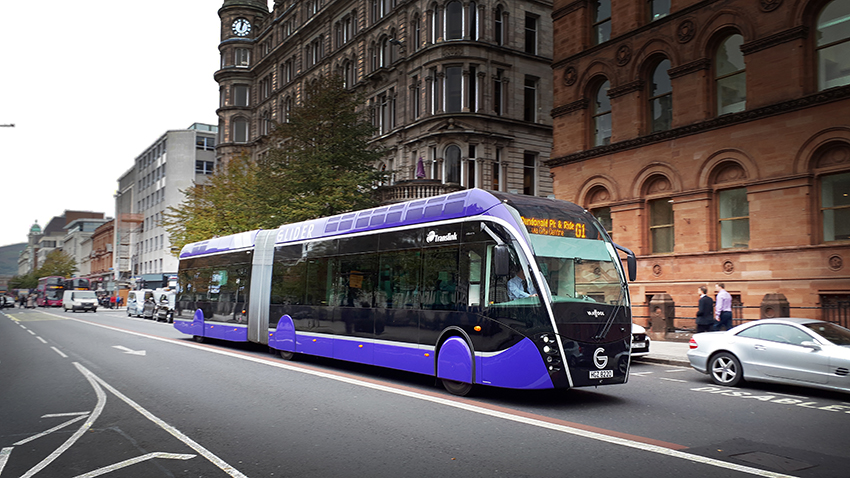
The UK has a few examples of BRT or, at least, networks with elements of it. These include the Belfast Glider, Cambridge Guided Busway, Leigh Guided Busway, Luton Busway, Bristol Metrobus and Kent Fastrack.
However, could it be employed more in this country? Does the move toward public ownership of bus networks make such projects more likely? What are the challenges? What can the industry do to better promote its usage?
Robert Montgomery, founder of the consultancy busreinvented.com, believes BRT is under-used in the UK. He says we need to completely change the public perception of the bus, which is one of “we’ll get you there eventually”.
He explains: “I’m not a fan of BRT [per se] – I’m a fan of good bus services. If you’re going to provide a good bus service, it needs to be direct, quick, and needs to be an experience that people will choose to use…

“Trams work and are a good idea, but they’re very expensive to build, have very long lead times, and can take up a lot of road space. There are reasons people like using trams but might not use a bus – speed of operation, frequency, ease of boarding, space inside. Most of the bus services in this country don’t do all those things.”
He points to what he considers good examples of BRT elsewhere in the world, such as in Queensland, Australia, and Riyadh, Saudi Arabia. “Pakistan has 25 BRT operations; they have focused on BRT instead of light rail or tram,” he adds.
Sean O’Shea, CEO of Metroline, which operates mainly in London, adds: “The advantage of BRT over tram and rail is that you can build it quicker and that’s always the case with bus-related innovation. You can do it quickly and more flexibly and, once you’ve laid a route, you can move it somewhere else if you need to.
“Places in London might benefit from aspects of BRT. I’m confident other places in the UK could too.”
Robert agrees there are several places which could benefit from BRT, mentioning the A6 corridor between Hazel Grove, Stockport and Manchester, and the Transport for West Midlands 74 bus route, which goes from Dudley to Birmingham.
‘BRT-like’ or BRT?
All of the UK examples have some characteristics of BRT. However, Ben Clark, Associate Professor at UWE Bristol’s Centre for Transport and Society, points out that, along a spectrum of bus transport models, the best examples in this country are perhaps better described as “enhanced bus” or, as one might put it, BRT-like.
“We have systems that have elements of BRT, like Metrobus in Bristol, but I’d say it maybe doesn’t quite reach that full BRT-level,” he says.
Robert agrees, adding that each of the elements of BRT are important. “There are probably 100 different issues you need to optimise to make a BRT work… There are a lot of boxes to tick,” he says. “Each box you tick makes it that bit more attractive and that bit faster.”
Bus priority
Bus priority is an aspect of BRT, which is recognised industry-wide as being crucial to the success of the transport mode and ultimately to reducing road congestion. It is widely used but often “piecemeal”, says Ed Cameron, Director of Whippet.
Whippet is one of the operators using the Cambridge Guided Busway. He says lack of bus priority is an issue across Cambridge rather than being specific to the Busway.

“If you look at bus lanes in Cambridge, you’ll get sections of sometimes only a couple of hundred yards. They all are important but, in terms of timesaving, they don’t do much. Whereas BRT is an entire corridor. The St Ives section of the Busway is 12 miles of bus priority.”
Bus priority measures may have improved since the National Bus Strategy, but Robert contends we don’t have authorities which are “brave enough”. For example, he suggests that, with infrastructure changes, buses might be taken straight across roundabouts, where they would have priority. He adds that even knocking down buildings – as might happen for tram networks – could be considered.
Speeding up boarding
Fast boarding is another important component of BRT. Robert questions why bus drivers deal with payment, for example.
Ed says tap-on, tap-off payment, which is used by 75% of Whippet’s adult passengers, has led to a saving of eight seconds per boarding for its operation. “If you’ve got 100 people over a route, that soon adds up to quite a time saving,” he says. “The bigger question is about revenue risk… and how much you try to manage that.”
Bristol Metrobus goes further in having ticket machines at all bus stops so payment can be made before boarding, although Ben points out that the advantage of this has been limited by the advent of tap-on, tap-off, which is also permitted on board.
Artics and double doors
Robert is an advocate for articulated buses, which are common in other countries, over double-deckers in urban environments. The former Managing Director of Stagecoach UK adds: “Most buses in this country only have a single door, so you’ve got to wait for people to get off before you get on.
“The driver might be waiting for everyone to get up the stairs before it moves or waiting for them to come down the stairs to get off. If you do BRT, ideally you do, not just 18m, but 24m and you then have a very fast-flowing vehicle. There’s a use for double decks, but mainly on longer routes when you’re on the bus for a longer time.”
Sean addresses the phasing out of the capital’s “bendy buses”, used from around 2002-2011. “It became something to challenge in the build-up to the 2008 mayoral elections,” recalls Sean, who has been at Metroline since 1990.
“Articulated vehicles did have a bad reputation for safety. We didn’t actually operate any at Metroline. But if you imagine an articulated bus turning up at one of the mainline stations in central London, it could take on a huge number of people really quickly over three doors or it could get them to alight really quickly.”

However, he adds: “Technology has moved on since they were last used, so any concerns over safety could be mitigated by new features.”
Robert believes double-deckers are more dangerous than articulated buses due to the presence of stairs and argues that, with enough axles, the turning circle is not much different to that of a standard-length bus.
However, Ed points out the challenge is infrastructure. He says: “It has to pull up level with a fairly long stop to get the three doors close enough to the kerb. Cambridge wouldn’t be well suited to it, for example,” he says.
That said, as a former Commercial Manager for Uno in Hertfordshire, he recalls the use of Citaro articulated buses on the student campus. “It worked very well because you had huge volumes of people on a very short, seven-minute journey,” he says.
I think much of a busway’s success is around the physical infrastructure being a bit like a railway station – Ed Cameron
Ed adds that, when Whippet ordered Sigma buses for its Universal contract, there was “quite a long discussion” about whether single or double doors should be used.
He says: “The compromise is the number of seats that you have to take out to put in a double door – also, where someone in a wheelchair might board and where the bay on the bus is. In practice, most of the stops – certainly in Cambridgeshire – are not suited to a centre door.
“For short journeys in an urban environment where you’ve got a lot of people getting on and off, probably it is right as long as your stop infrastructure is correct. But, for those interurban, longer journeys, people want to sit down for 30-40 minutes and, therefore, you need seated capacity.”
Current UK examples
The Cambridge Guided Busway is the longest of its type in the world, with 15 miles of it being along a disused railway line. It is the segregation aspect that is significant and the “gold standard” for BRT, according to Ed.
“I think much of a busway’s success is around the physical infrastructure being a bit like a railway station,” he says. “If you move into a village with a railway station, you know there’s a strong certainty you will have a train service at some point for ever… They don’t come and go like bus services can. A bus stop on a BRT corridor is probably very similar in terms of people’s perceptions. So, I think people who live in the vicinity of a busway stop are drawn to it.”

However, he adds: “Probably, people would say the Cambridgeshire Busway is over-engineered. If it was going to be built now as a bus lane, it wouldn’t be a concrete guided track because it’s probably too engineered, too expensive… But it opened 14 years ago and at the time it was absolutely the right thing to do.” The original cost was £181 million, while the ongoing costs include the £4.7 million recently confirmed for fencing which is set to be installed for safety reasons as a path runs alongside it.
The Busway is unquestionably fast outside Cambridge. Your correspondent noted an average of around 40mph on a journey on the stretch between St Ives and the edge of Cambridge. However, when turning off the Busway and into the city, it hits the congestion and slows.
Transport for Greater Manchester says the Leigh Guided Busway has sped up bus journey times between Leigh and Manchester city centre from 65 minutes to under 50 minutes and has coincided with a doubling of patronage on the route. However, Robert also notes the similar slowdown at peak times in the centre of the conurbation.
The effect of franchising on expansion of BRT
The question of whether BRT networks are more likely as more combined authorities take the franchising route is complex, says Robert.
“I think BRT done in partnership in big cities with public investment and public involvement is more likely to work than if you simply tell a private operator you can develop a BRT on that route if you want.
“In order to make it work, you’ll probably… need to put to use your powers to provide the priority. And some of the infrastructure costs might very well be a level where, from a private sector point of view, you wouldn’t be able to pay it from the fares.”
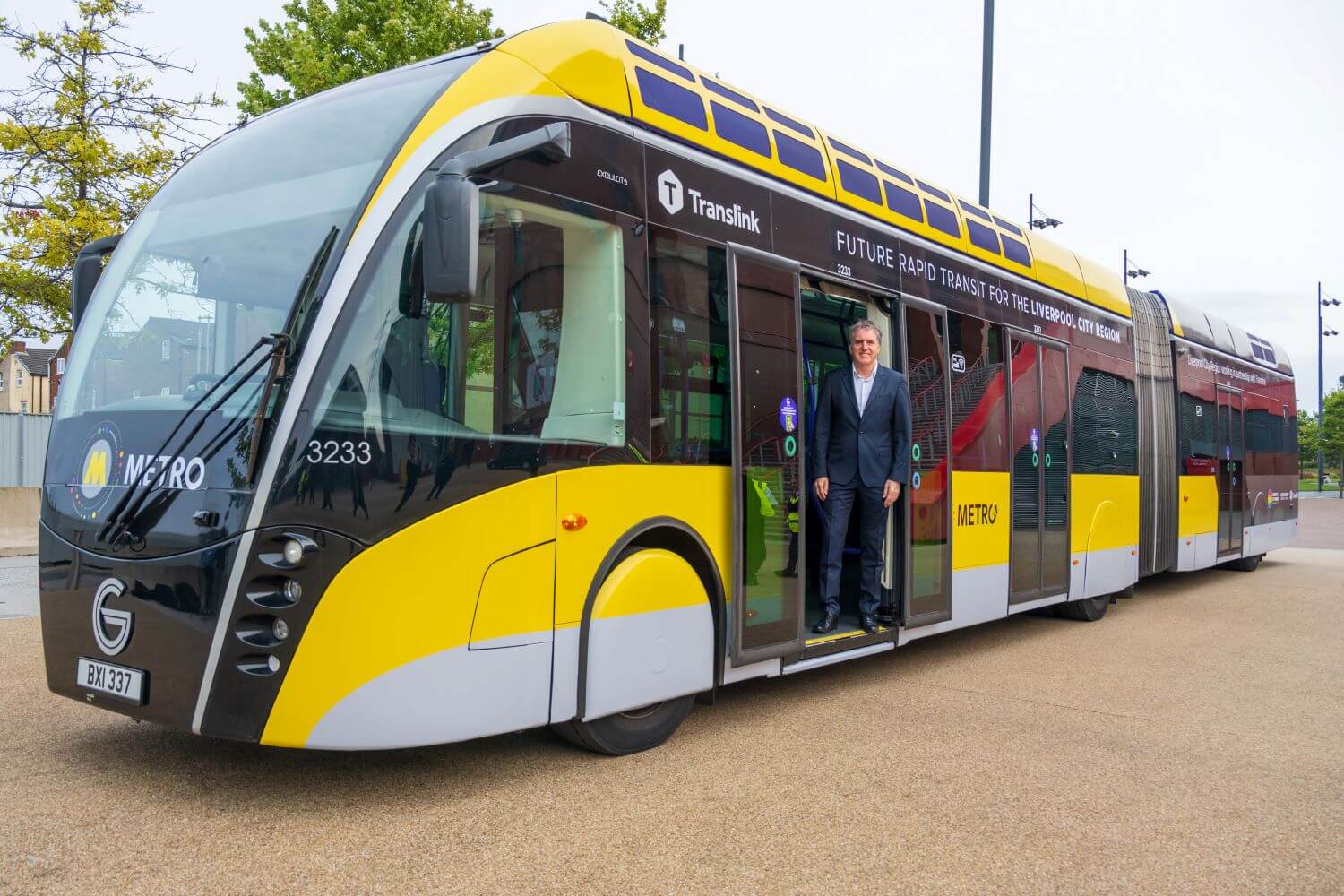
However, he is supportive of how Liverpool City Region Mayor Steve Rotheram is planning to bring BRT in the style of Belfast’s Glider network to the North West city’s soon-to-be franchised bus network by 2028.
He says he is proving that, “it’s a matter of, if you want to do it, you can do it. It’s just a case of how brave you are about maybe saying to car drivers, ‘we know you’ve always driven down the street to go to work every day for the last 20 years, but you’re not going to do it anymore.’”
What can the industry do?
While local authorities hold much of the power, Robert says regarding what the industry can do: “It can be proactive in identifying potential BRT corridors and indicating a willingness to get involved in maybe diversifying the kind of operations they do.”
The latter may include being brave about considering articulated vehicles, he says. Referring again to the work of the Liverpool Mayor, he adds: “He will make a lot more progress if major operators join that process and talk to him about the pros and cons of one vehicle or another…. You just need that spirit of collaboration.”
Although operators are clearly keen to boost patronage and consider BRT as a way forward, Ed points out that there are challenges. He mentions current proposals to expand the busway system around Cambridge but says it is held back by challenges over land ownership and objections.
“It’s no different to a major road scheme or a new rail network,” he says.
“Probably the [St Ives section] of the Busway – because it runs along what used to be a railway line and mostly that land ownership was relatively straightforward and, although overgrown, still existed – was simpler.
“Yes, we need more BRT and we ought to do more to push it, but practically it’s incredibly challenging to put in something from scratch.”
We need to do more than the current style of ‘everything’s a double- deck, the bus stops everywhere and it’s only got one door – Robert Montgomery
However, Robert sums it up by urging the industry and local authorities to be imaginative and creative.
“To live without congestion, we need to do more than the current style of ‘everything’s a double-deck, the bus stops everywhere and it’s only got one door.’
“If you look around the world, there are a lot of systems that work with buses having a lot more bus priority, a lot more capacity, longer single-deck vehicles, multiple doors. It’s just a kind of ‘not-invented-here thing’, we’ve always done it this way, so all of us carry on.”