



















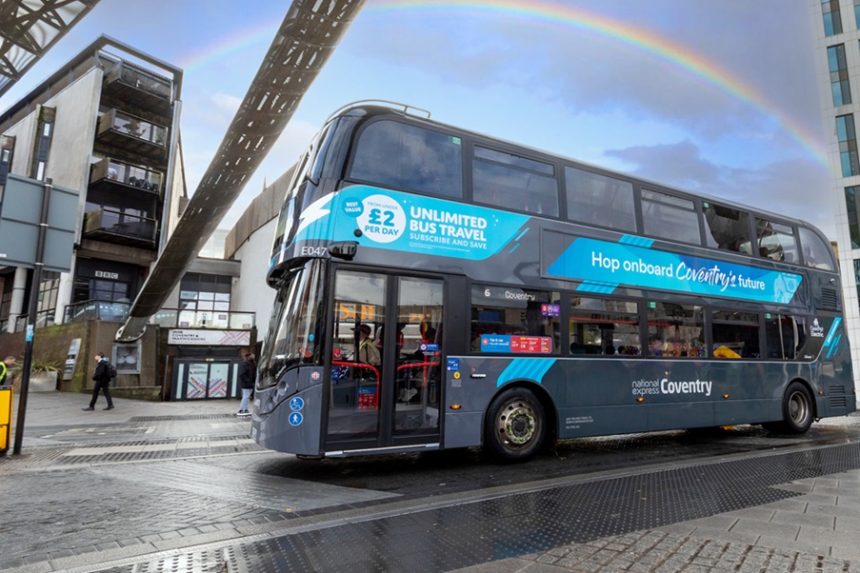
The All Electric Bus City project in Coventry will be completed the end of 2026, papers from the West Midlands Combined Authority (WMCA) have shown.
The Department for Transport (DfT) chose Coventry as the winner of that competition in 2021, with an intention that transition of every bus to battery-electric would be achieved by 2025. The All Electric Bus City scheme includes services within the city boundaries plus those running into Coventry from neighbouring areas.
WMCA papers for a board meeting on 14 November note that as of then, 204 buses of a total city fleet of 269 were electric.
Residual diesels include 33 single-deckers utilised commercially by National Express West Midlands; 17 used on Transport for West Midlands (TfWM) contracts; 13 on Warwickshire County Council (WCC) contracts; and two for Homes England.
Besides the DfT funding to deliver the transition, £73 million was committed by operators; £15 million by WMCA; and £5 million from WCC.
The 33 buses for National Express West Midlands in Coventry are expected to come into service during 2026. Associated work includes securing a lease from Coventry City Council on a site that adjoins the operator’s depot as well as installing infrastructure there. It also operates the Homes England service.
TfWM is currently undertaking a procurement process for its tendered services that fall under the project. Contracts will start in July 2026, initially using diesel buses but with a requirement for electrics to have taken over by the end of the year.
WCC contracts that will ultimately occupy electric buses will commence in January 2026, with electrics in place by July.
Extension of the transition period is because of “the substantial economic shocks that have occurred since funding was awarded and the uncertainty this has injected into the market, causing delays in finalising the project scope,” WMCA notes.
It adds that when Coventry was confirmed as the winner, the extent to which services would recover from pandemic impacts was unclear and the scale of the city’s future commercial network was uncertain. Additionally, neither TfWM nor WCC were in a position to award long-term contracts.
The TfWM contracts will be for an initial five-year term. WMCA acknowledges how that will overlap rollout of bus franchising in the West Midlands but says their nature will give flexibility to replicate any service standards required of the franchised network.
DfT is “supportive” of the extension of the project, which falls within the delegated powers of WMCA as a devolved funding package.