


















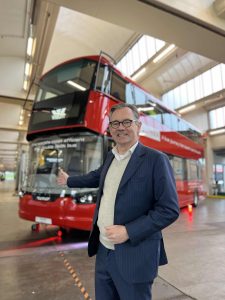
Hot on the heels of further detailing of its work in the coach segment earlier this year, Wrightbus has laid out its intentions for the highly competitive bus market with the launch of the next generation Electroliner platform on 12 November.
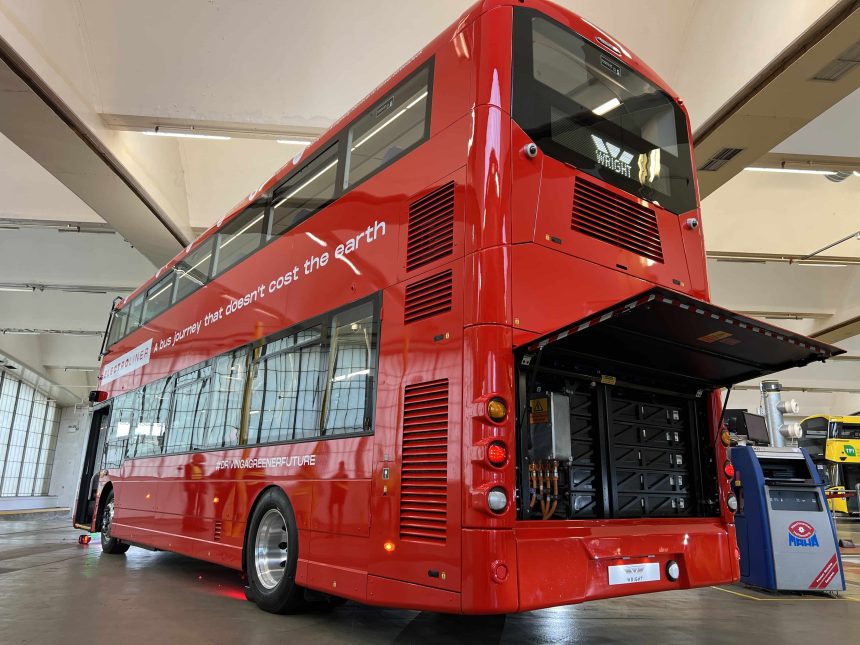
The Electroliner, now in its second generation, includes the single-deck GB Kite Electroliner, and the double-deck StreetDeck Electroliner.
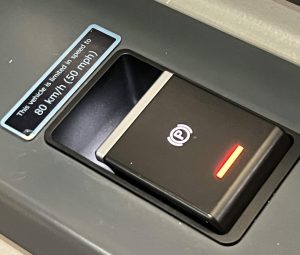
While visually the range is virtually unchanged — a salient feature is the inclusion of a new electronic parking brake — the range benefits from TCO improvements under the skin, biggest of which is a change in battery supplier to CATL.

New battery chemistry and TCO improvements
Switching to CATL brings a move to lithium-iron-phosphate (LFP) battery chemistry, away from nickel-manganese-cobalt (NMC) of previous models. Wrightbus says this brings cost advantages and increased safety, with less thermal-runaway risk, while a slimmer battery pack allows a lower floor height.
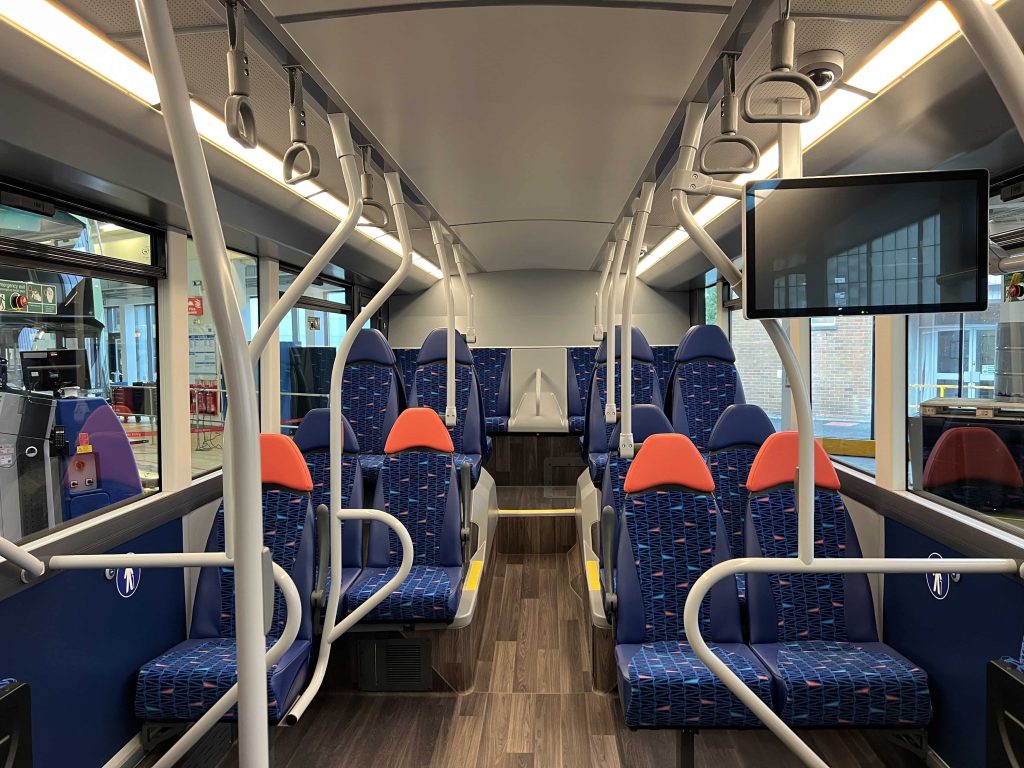
Supplied to both variants is a “bespoke” 442kWh battery that delivers a range of 275 miles in the StreetDeck and 300 miles in the GB Kite. The latter can also be specified with a 528kWh battery for a claimed range of up to 375 miles. Wrightbus says it has design exclusivity of the new battery pack for a “period of time”. Integration for the StreetDeck sees them distributed throughout the chassis; for the GB Kite variant they sit on the roof, allowing for increased passenger capacity.
 Both models enjoy 250% faster charging speeds, with the StreetDeck benefitting from up to 38% more range than the first generation and the GB Kite up to 46% more range.
This generation of Electroliner is also the first to use the new Voith VEDS 1.5 driveline. The driveline includes an upgraded lightweight inverter, DC/DC converter (6.0 kW continuous) and a new generation combined charging unit that reduces charging time. The charging socket is CCS2 compliant, supporting up to 150 kW plug-in, and 380 kW/500A opportunity charging.
Other changes include a 75-minute rapid charge at 380kW (an improvement over the three-hour charge time of the first generation Electroliner), a 15-year warranty on the new batteries, and a TCO reduction of 11% over the previous generation. There is a structural warranty of 15 years for the body. That can be extended up to 20 years.
A key feature of the new generation is compliance with the Transport for London (TfL) Specifications for New Buses version 2.5.
Paul Thomas, Chief Technical Officer at Wrightbus, notes the step up from version 2.4 to 2.5 of the protocol is huge in terms of HVAC requirements. In London, the requirement is for continuous operation up to 45°C, with relative humidity not exceeding a maximum of 50% when interior temperatures are between 30°C and 40°C, and no more than 70% when bus interior temperatures are between 0°C and 24°C.
“Managing that water and temperature is no mean feat,” says Paul. “Even the biggest manufacturers from China have struggled. It means we have to carry a lot more equipment on the bus, and it is a challenge to get that in a double-decker. But we met this requirement using one of our key UK suppliers, Grayson Thermal Systems.”
Warranty to last a lifetime
That Wrightbus chose to move to CATL as its battery supplier should surprise no-one — CATL is the largest battery manufacturer in the world. But the priority of that move was to get a battery in the bus that would “last the life of the bus”. Forsee Power only offers a seven-year warranty for the first generation Electroliner. Operator feedback played a role in Wrightbus’ decision to move to the new supplier.
“As soon as there were discussions about other bus manufacturers offering a 15-year warranty, we picked up those rumours,” says then-Wrightbus-CEO Jean-Marc Gales. “A 15-year warranty is the most important thing because it covers two seven-year cycles in the London market.”
But Wrightbus also predicts the extended range from the new batteries will make it a popular choice for regions outside of London. In particular, Jean-Marc notes the 528kWh single-deck as ideally suited for “very long and very low traffic routes”.
So far, that belief is justified by an apparently even split between London and the rest of the UK for the 900 advanced orders for the new Electroliner.
Backdrop of growth
Accompanying the launch, Wrightbus is vocal about its ambitions for the bus market. It has already captured 35% of the bus market in the UK and Ireland, with a target of 38% by next year.
The launch also comes as the company notes a “resurgence” in diesel. In November it announced the new generation StreetDeck Ultroliner, now powered by a Cummins B6.7 litre six-cylinder diesel engine, driven through a Voith DIWA.8 NXT 7-speed transmission. Confident it has a winner on its hands, Jean-Marc says Wrightbus expects to sell some 240 models next year.
He is otherwise cautious to be drawn on what the mix of Wrightbus’ blended approach to technology will be in the future. “Nobody is ever right when it comes to these types of predictions,” he says. “There will be a mix — battery-electric will probably in the short term win, and there will continue to be diesels for applications where electric is not suitable for longer routes or due to the weight of the batteries.
“But there is a third option, and that’s hydrogen. Hydrogen is as simple to refuel as diesel. There are depots you cannot electrify and if you want to go green, obviously diesel is not the right route.
“We are currently working on the third generation Hydroliner. But we’re working on all three technologies, and that’s the unique thing. We have the class-leading, most efficient battery-electric bus; we have the class-leading most efficient double-decker diesel in the UK; and we are continuously working to make our hydrogen double-decker more competitive.”
Systems integrator
When selling its products Wrightbus majors on its specialty as a systems and components integrator. Paul King, Chief Procurement Officer, reminds us that key to the value of the bus is the partners chosen by an OEM, integration, and working with “the best performers in the world.”
Jean-Marc agrees, noting that systems integration is the company’s strength. “We’ve got that know-how. We integrate it, we validate it, we homologate it. That’s our strength. And we want to keep it like that — because only as a systems integrator do you have a future in this industry.”
Not only that, according to Paul, more than half of the material in the new Electroliner is from UK suppliers. “If 75% of the value of a bus is in components from suppliers, then 55% is coming from UK suppliers either in Northern Ireland, or 47 counties in the whole of the UK,” he says. “That’s supporting UK jobs and getting that balance right is something we feel really proud of.”