




















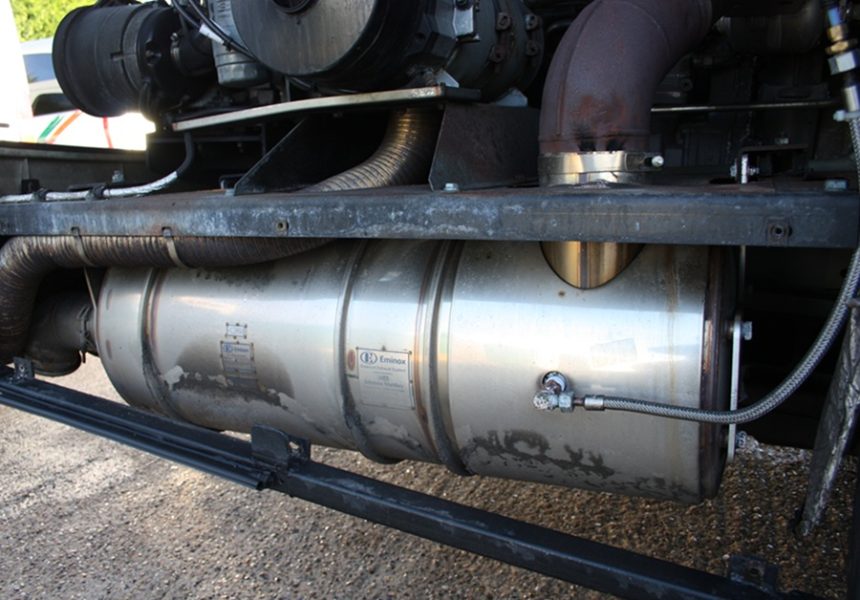
Adoption of Euro 7 emission standards by new vehicles in Great Britain including coaches and buses will be in line with the EU implementation, proposals within a consultation published by the Department for Transport (DfT) on 13 April state.
Unlike previous Euro ratings, Euro 7 brings all vehicle types under one regulation, although test procedures and limits differ between light-duty and heavy-duty categories.
For the latter, a new limit for nitrous oxide is introduced, and levels for pollutants including NOx, particulate matter (PM), carbon monoxide, ammonia, and non-methane hydrocarbons are what the consultation terms “reinforced.”
Euro 7 will also introduce requirements to limit PM from brake wear and tyre abrasion. Those will apply to all vehicles, including those that are zero-emission at the tailpipe. CO2 emission reductions are not part of Euro 7. They are within separate EU work, although Head of Daimler Buses Till Oberwörder has repeatedly criticised that as being too ambitious.
If adopted as laid down in the consultation, Great Britain will see implementation dates for Euro 7 echo those in the EU. Northern Ireland already applies current EU standards. Across heavy duty vehicles including coaches and buses, four dates are expected:
-
- For new vehicle types: 29 May 2028
- For all new registrations except from small volume manufacturers: 29 May 2029
- For all new registrations from small volume manufacturers: 1 July 2031
- For C3 class tyres used by coaches, buses and HGVs: 1 April 2032.
Despite those, the consultation acknowledges how legislation to implement the heavy-duty requirements is still under development by the EU and the United Nations Economic Commission for Europe.
In addition, the document notes an awareness of ongoing discussions in the EU about delaying heavy-duty vehicle implementation dates. “If this happens, we propose to delay our implementation dates in the same way,” it states.
With that in mind, a further consultation on heavy-duty vehicles will follow once the relevant EU legislation is available and dates are confirmed, but DfT says it is still interested to hear views on the proposed approach and timeframe.
The consultation seeks responses to questions on implementation, challenges and other factors, along with giving opportunity for free comment. It runs until 25 May.
Euro 7 has proved contentious with heavy vehicle manufacturers. Some claim that it will deflect investment from zero-emission. In 2023, Iveco Group CEO Gerrit Marx described it as “plain stupid,” saying the required reductions are “technically unfeasible.”