





















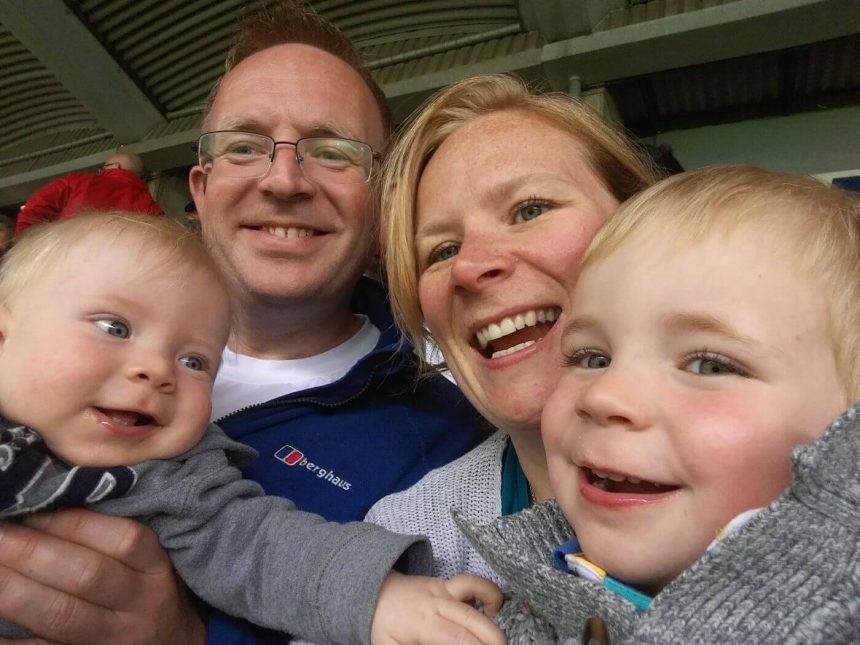
A North East woman is campaigning for improved safety standards and post-incident policies across the PSV industry after her husband died following a collision involving a minibus in 2023.
In memory of John Liddle, Louise Liddle is calling for standardised and better legal and procedural support for drivers, improved training, more accountability, and improved communication and confidentiality practices.
John, 44, was cycling home in Rowlands Gill, Tyne and Wear, in May 2023 when he was struck from behind by a minibus which was overtaking. He suffered head injuries and died a few weeks later in hospital. The father of two, who was wearing a helmet and yellow cycling jacket, was just 200 metres from his home when the collision occurred. After investigations, the driver of the minibus did not face criminal charges. In response to the Coroner’s Prevention of Future Deaths Report, the speed limit on that section of road has been reduced.
The more we’re devolving powers to the combined authorities, the greater risk there is of inconsistent standards
Louise’s devastating loss was confounded, she says, by events in the aftermath of the incident. She says police had to wait more than nine weeks before being able to interview the driver due to issues around how he would be legally represented. She adds this led to delays in her receiving information from the police and in the release of John’s body so she could arrange a funeral.
She also says the driver returned to work almost immediately and highlights what she sees as a lack of consistency over how operators support drivers involved in serious incidents.
Driver support needed
Considering her own experience, Louise is pushing for better quality of support for drivers post-incident. “Police had to support this driver through every step of the way,” she says. “The police should have been supporting me and he should have been looked after by his employers.”
Transport law specialist Backhouse Jones, which we asked for comment on the campaign, says: “Drivers are often supported by large and small companies on a voluntary basis in terms of initial legal support post collision. However, there can be valid reasons why a company cannot fund this. Smaller businesses may simply not have the cash available for legal representation if prosecuted – the cost of which can run into many thousands, even tens of thousands of pounds.”
It adds: “Unfortunately, funding for legal advice and assistance to citizens has been curtailed over successive governments and decades. Barristers’ and solicitors’ professional associations have long sought to reverse this trend, but coverage remains very limited, and the financial tests to qualify can be severe.
“One potential solution would be either to legally require cover under mandatory road traffic accident insurance or to improve the cover available through the legal aid scheme, providing more consistent and reliable access to legal support for all drivers.”
Louise was encouraged to see publication of the government’s Road Safety Strategy in January but had been hoping for further measures. In particular, she would like to see a national, central register of drivers’ records across industries that operators could consult when recruiting.
“[The Road Safety Strategy] relies on local authorities or regions aligning their local safety standards and initiatives with overall road safety goals,” she says. “For me, this then creates inconsistency across the sector and, as a result, quality differs from area to area.
“When you have drivers that can move up and down class levels and geographies, having different standards and initiatives in different areas can create huge variances and uncertainty for these drivers.”
Are PSV safety standards high enough?
Regarding Louise’s call for minimum national safety standards, Backhouse Jones says: “Passenger transport is one of the most regulated activities any business can undertake.”
It adds: “It must also be remembered that bus and coach operation in the UK is an exceptionally safe industry, carrying millions of passengers on highly congested roads, often through historic towns and cities with narrow streets and high volumes of pedestrians and cyclists, yet achieving some of the lowest incident statistics in the world.
“We accept this is cold comfort to bereaved families and that the industry must always seek to improve and learn from any near miss or tragic incident.”
The devolution factor
Louise is concerned about the effect that devolution of bus services may have. “The more we’re devolving powers to the combined [and other local] authorities, the greater risk there is of inconsistent standards,” she says, clarifying her belief that government-level intervention would be needed in order for local authorities to set consistent standards when awarding operators contracts.
Driver CPC revamp?
She highlights the lack of standardisation of Driver CPC content, saying that drivers could repeat the same course every time “just to tick the box”. She also says the driver involved in her husband’s death did not administer CPR and she questions whether suitable training in that regard, perhaps as part of CPC, could have made a difference.
Backhouse Jones says on Driver CPC: “The range of courses available is large already. Once a test is passed, none are mandatory, but 35 hours (normally five full days) is required over five successive years. There is scope for improvement, as ever, and these are consulted on from time to time.”
Beverley Bell, CEO of Beverley Bell Consulting and Training, which is also a major shareholder in CPC provider Ridgeway Training, says: “Driver CPC is not enough about the quality of the delivery.
“I take the point about standardisation and quality of content. I feel Driver CPC is a wasted opportunity; so much more could be done to make it more engaging for the drivers.”

In light of some circumstances around her own experience, Louise has called on the PSV industry to “protect the privacy and emotional wellbeing of victims’ families”.
Backhouse Jones says: “We agree completely and would add that the same is true of the driver involved, whether they ultimately face prosecution. This is something that social media platforms and sections of the press should be obliged to address.”
Support for PSV safety campaign
Louise has been liaising with Confederation of Passenger Transport (CPT) and organisations such as BRAKE to promote her campaign and seek action.
CPT Operations Director Keith McNally says: “CPT has been working with members to develop guidance for operators in relation to fatal incidents.
“When such an incident occurs, it is crucial that operators respond appropriately, not only to protect their reputation, but to ensure the right support for the bereaved and the driver.
“CPT already provides members with a range of resources, including a Crisis Communications Guide, covering various scenarios. This new guidance is designed to supplement that, ensuring that, if the worst happens, operators are as well prepared as they can be to support all those affected.
“The guidance sets out a series of actions and considerations for operators in the immediate aftermath and in the following days. It also provides good practice in trying to minimise the risk of a serious incident, suggests some precautionary measures, and makes specific recommendations around a plan that can be used in the event that an incident does occur.”
Louise has been supported by her local MP, Joe Morris, who said last year: “This summer I toured my constituency, asking constituents what mattered most to them, and road safety was the most consistently raised concern. From dangerous driving to deteriorating road surfaces, people across the North East are rightly calling out for safer roads.
“As Louise’s local MP, I will continue to press for meaningful improvements to protect all road users and ensure that no family has to suffer a tragedy like this again.”
Backhouse Jones notes the considerable procedures around safety which are in place within the PSV industry but acknowledges: “Fatal and serious injury accidents are a tragedy which impact the individual and family hardest but also the PSV/HGV driver and company profoundly too.
“Anything that can be done to improve the compassion to all impacted should be of benefit.”
Campaign summary
Louise Liddle is calling on the coach and bus industry and other relevant organisations to:
- Get consistent legal and procedural support for drivers
-
- Ensure all bus companies provide appropriate legal representation for drivers involved in serious incidents.
-
- Prevent long delays in police investigations caused by inconsistent company policies.
- Standardise driver support after serious incidents
-
- Require all companies to offer proper psychological and professional support for drivers involved in traumatic events.
-
- Avoid situations where drivers return to work too soon without necessary support.
- Improve professional standards and training for bus drivers
-
- Introduce clear, mandatory standards for driver CPD.
-
- Include specific training on emergency response (eg, CPR) and dealing with collisions.
-
- Promote recognition of bus driving as a professional role with accountability and responsibility.
- Strengthen accountability and transparency within the industry
-
- Establish consistent procedures for investigations and communication with affected families.
-
- Address the lack of responsibility when a driver is involved in a fatal incident but faces no professional consequence.
- Impose minimum national safety and quality standards for bus companies
-
- Implement a national quality framework for all regional transport contracts.
-
- Require uniform safety, training, and conduct standards as conditions for winning public transport contracts.
-
- Create consistency across regions rather than varying practices by company.
- Improve communication and confidentiality practices
-
- Introduce clear policies preventing drivers or colleagues from discussing ongoing incidents publicly or locally.
-
- Protect the privacy and emotional wellbeing of victims’ families.
- Have greater focus on road safety culture in public transport
-
- Elevate safety standards and accountability expectations across the public transport sector.
-
- Encourage a culture of responsibility, professionalism, and continuous improvement