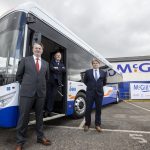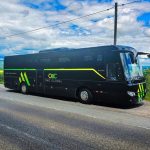






















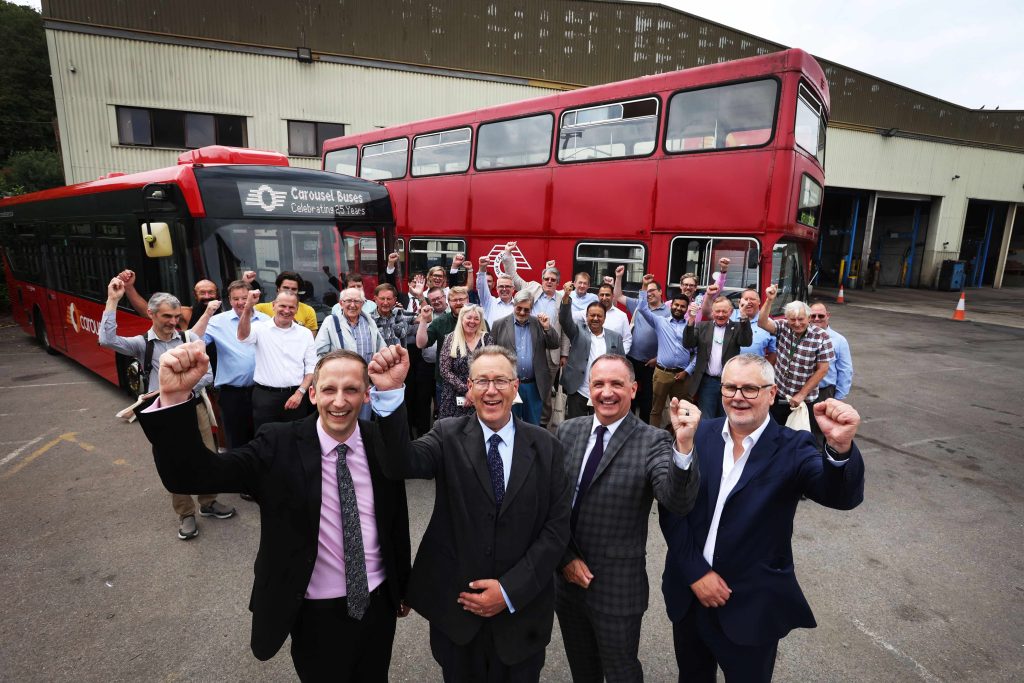
Carousel Buses celebrated its 25th anniversary at its High Wycombe depot in July, marking the occasion with a special gathering of employees and uniting directors past and present.
The regional undertaking began operations in 2000 with two second-hand MCW Metrobuses on school and rail replacement work. It now runs more than 100 vehicles across Buckinghamshire, Berkshire, Oxfordshire, and Surrey, and employs over 200 staff.
It was bought by Go-Ahead for £3.1 million in 2012, and since then has expanded from its Hughenden Avenue depot to Reading, Henley-on-Thames, and Windsor. It has had a noteworthy history, being involved with a successful PickMeUp demand-responsive transport (DRT) service launched in 2022, and investing £2.5 million in infrastructure and staffing when Arriva closed its depots in Aylesbury and High Wycombe in 2024.
routeone met with Luke Marion, Managing Director of parent division the Oxford Bus Company, to reflect more on the growth of the business and its expansion under the leadership of its various directors and Go-Ahead.
Right place, right time
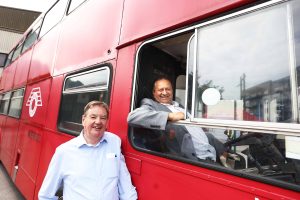
Steve Burns founded Carousel with John Robinson, then proprietor of Abbey Coaches, in High Wycombe, in 2000. Together they each bought an MCW Metrobus and launched their first venture on the A40 to Uxbridge (now the 102 service to Heathrow).
In its early days the company made efforts to stand out as a quality operation. A great deal of focus was placed on presentation, with Steve and John enthusiastic on how vehicles were turned out, culminating in the red ‘flying polo’ livery.
At some point before 2005 Abbey Coaches closed. But John realised the new business with Steve was going places. They picked up tenders, expanding into Buckinghamshire, and won a contract by Heathrow Airport in 2003 to expand the service to Uxbridge. Funding was provided for some Mercedes-Benz Citaros. A major rail replacement win followed the partial collapse of the Gerrards Cross Tunnel in 2005. These events put Carousel in the “right place at the right time” as Luke puts it, and the company quickly expanded to over 20 vehicles, becoming a competitor to existing operator Arriva.
Growth came more slowly between 2005 and 2012, but in 2011 the original founders expressed a desire to sell. Initial interest came from Arriva, but Go-Ahead proved to be the successful bidder, following its promise to keep the Carousel brand and respect the heritage already built up.
The acquisition “initially introduced constraints,” Luke notes. A qualified auditor, Luke joined Oxford Bus Company in 2012 as Finance Director, having spent his early career involved in low-value, high-volume products and transport logistics. He became Finance and Commercial Director in 2014. “It was a bit of a challenge. Carousel had started with a wheeler-dealer culture, with a strong leader. Like any company that has a strong leader who makes a lot of decisions, which Steve was, if you take someone like that out of the business, the people there must learn how to take those decisions themselves. In a world where we need people to take more ownership and do more things themselves, that did take a while to get through.”
Internal consolidation aside, efforts were made to co-exist peacefully with Arriva following the takeover, while expanding premises. Go-Ahead ownership saw standardisation of fleet and ticketing systems to fit with the group structure. Those incremental steps to professionalise the business were headed by Philip Kirk, who had already run buses in High Wycombe. Luke notes that Philip made those initial efforts to bring Carousel into a group mindset while still respecting what was already good about the business.
Philip stepped down from his position as Managing Director at Oxford Bus Company in 2014, which by that point incorporated Thames Travel and Carousel Buses. Stepping into his place was Phil Southall, who would enjoy a long stint in charge and oversee much fleet renewal, including the purchase of the company’s first brand-new buses.
“Phil brought the Wrightbus StreetLites in and did a lot of work to standardise the fleet,” Luke explains. Under his tenure, Ticketer machines were introduced, as was an app for real-time tracking. Relationships with the local authority were strengthened, which allowed the business to win more tenders, and as Arriva continued to deregister routes, Phil took the view that a long-term, gradual withdrawal was in play. A considered approach was taken to help the Carousel business grow incrementally, and by the time Phil was ready to move on within Go-Ahead in 2022, the business was running approximately 40 vehicles.”

Consolidating efforts
In 2022 Luke, who had always expressed an interest in advancing on the commercial side, was appointed Managing Director of OBC, officially taking up his duties the following year. His tenure has been marked by the COVID recovery, ascension of Carousel in High Wycombe and further acquisitions under the Go-Ahead brand. He moved the Thames Travel business to Didcot in 2019 and purchased the freehold of the Carousel depot in 2016 alongside its premises next door, in what would prove to be a good preparation for Arriva’s withdrawal. He saw Go-Ahead acquire City Sightseeing in 2017 and worked on the acquisition of Pulhams Coaches in 2023, Swanbrook in 2024, and Pearces Coaches in March.
There had been differing schools of thought during the patronage recovery period on how to respond to the lack of demand. Services had been reduced during lockdowns and into the extended recovery period some within the business argued for a need to “adjust to a new normal” by taking mileage out permanently. Others wanted to take advantage of government subsidy and continue running the mileage to give patronage time to recover. “I was definitely in the second camp,” Luke says. “Our rival in High Wycombe took the view to cut frequencies during COVID and think very hard about putting it back. That presented a good opportunity for us. We were always the smaller bus operator in High Wycombe, but we suddenly became the larger operator, by default almost, because Arriva didn’t want to recover the mileage and grow back to that size. That gave us the opportunity to do more work.”
Arriva ceased operating bus services in High Wycombe and Aylesbury on 27 July 2024.
“When Arriva did finally throw the towel in, its operation was easier to take on, because it wasn’t bigger than our own by that point,” explains Luke. “If we had done that five years before, we would have had 40 vehicles, and Arriva would have had 50. Trying to take that on would have been an even bigger ball game.
“We took on the network and tried to build back and recover. It had been run down to frequencies lower than they needed to be because some services had not recovered from COVID. Other factors were a struggle for drivers and engineers.”
One of the biggest operational challenges from Arriva’s retrenchment was the expansion of Carousel’s depot facilities. That’s where Luke’s purchase of the freehold paid off. An initial plan had been to use the former Arriva depot, but the operator maintained a long lease on that facility, which meant impractical rent and a hindrance to future depot electrification. “When that comes forward in the future, you need to own a freehold,” Luke says. “You can’t rent a site and spend millions on improving it. It isn’t great business sense.”
After serving notice on the tenants occupying the freehold next door and surviving a hard winter, Carousel eventually expanded, installing a bus wash, larger fuel tanks and break facilities.
“It was challenging,” Luke reflects. “We weren’t perfect. But it was a low base we had to climb over in terms of customer expectations, so even from the start we had a lot of positivity from the council and customers and stakeholders. That really helped us on our way.”
The Rural Mobility Fund-supported PickMeUp service helped build on top of that. Demand came back stronger and helped the company on fare revenue and in the eyes of the council, which wanted an operator more likely to answer ‘yes’ when requests to cover services arose.
Community cohesion
With the takeover of Arriva’s erstwhile network, Carousel has established itself as the primary operator in High Wycombe. To mark its position as a fixture in the local community, the company this year launched its own Brand the Bus competition, modelled after the same initiative at OBC.
That community engagement was warmly welcomed by the town’s radio station and competition partner Wycombe Sound, validating Carousel’s efforts. The competition opened in January and closed in March, and saw Thames Valley Air Ambulance chosen as the winner in June, with Chiltern Music Academy and Wycombe Homeless Connection recognised as runners-up.
“It seemed logical now we’re running all the network and we’re more of a community,” Luke says. “The response has been good and we’ve had a range of charities, some I had never heard of.”
More than 17,000 votes were cast across both competitions. The winners will now receive a branded bus wrap, alongside radio and football club advertising, with the winning bus to be unveiled in the autumn.
Meanwhile, PickMeUp, which was seen as a useful service for High Wycombe’s less accessible areas, is about to enter its next phase. Luke expects it to renew for at least one more year. The service was launched in 2022 and was attractive to OBC as it gave the company more buses in areas of High Wycombe at a time when it was primarily an interurban operator, and Arriva was the urban operator. When Carousel took over Arriva’s routes, PickMeUp was refocused to its original intention — consequently, it has seen a reduction in users.
“We have a number of improvements we want to make to it in terms of the next round of changes to the booking algorithm,” says Luke, who notes that DRT is always a challenge owing to lack of integration with the existing network. Data from technology provider Via does however suggest that PickMeUp is the best performing Rural Mobility Fund service nationally in terms of passenger numbers. “We had loads of work to get those with our app to download the PickMeUp app when they were already using our services,” adds Luke. “We’ve learned from those things so it’s better integrated than before, and there are more ideas from Via which could inform the next round of improvements. Things are positive, and the council wants it to continue.”
Luke recognises that his tenure will likely be remembered for such projects and for Carousel and OBC’s expansion outside the realm of traditional buses. Having said that, he confesses that the industry has become addictive for that very reason. “The thing with the bus industry is that it doesn’t stand still,” he says.
“The sector is (quite literally) always moving, and there is always something to think about — you never get stuck in a rut. You can always challenge yourself, ask how we can improve a certain route or deliver better connectivity to a community, hear from customers as to how we can deliver better for them. There are always new vehicles, always new technology, and lots of new people to meet. There is always a reason to talk to anyone in the public and private sectors because everyone needs transport.”