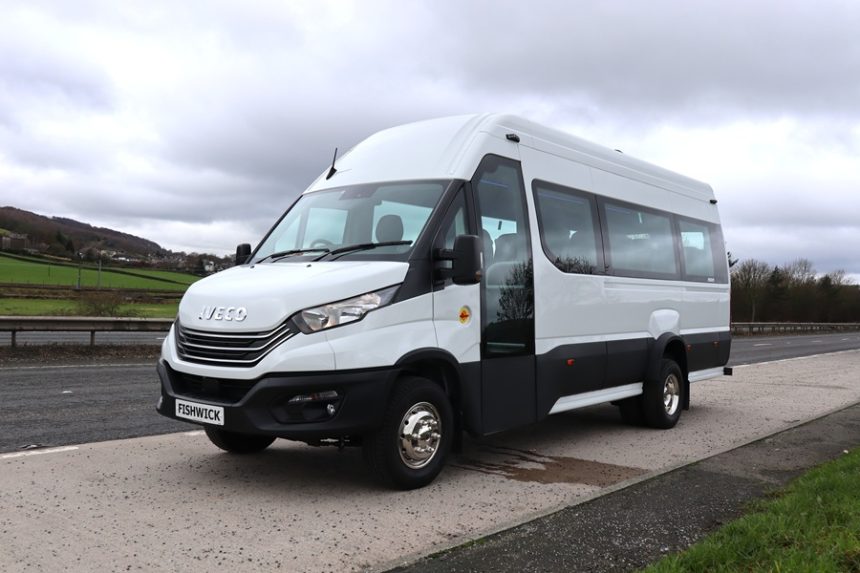
The Iveco Daily is an established base vehicle for minicoach and minibus use. Its strength in such converted formats majors on gross weight, with OEM ratings in that field of up to 6,500kg giving good scope to combine seating and luggage capacity, and a passenger lift when needed. It is those aspects and others that dealer David Fishwick sees as positives of its burgeoning Daily conversion range.
Many configurations are offered by the Colne business. It utilises the Daily in two forms as supplied by Iveco. One is a straightforward panel van at up to 5,600kg GVW. The other is a ‘vendor van’. To the latter Iveco fits items including a powered plug passenger door and side and rear windows at the factory, and uprates GVW to 6,500kg. That greatly simplifies the later fit-out requirement.
For vendor vans, subsequent conversion work commissioned by the dealer is thus to the interior only, with trim and wheel liners also added. For panel vans, the task is more involved, although end results are similar. The latter products see one of two partners – Bus and Coach World and Onyx – carry out the full process of creating a minicoach or minibus. The OEM manual passenger door it kept in those cases.
Lengths of 7.17m and 7.54m are offered ex-Iveco, with the former largely serving as the base for a 16-seat accessible model. The difference is behind the rear axle.
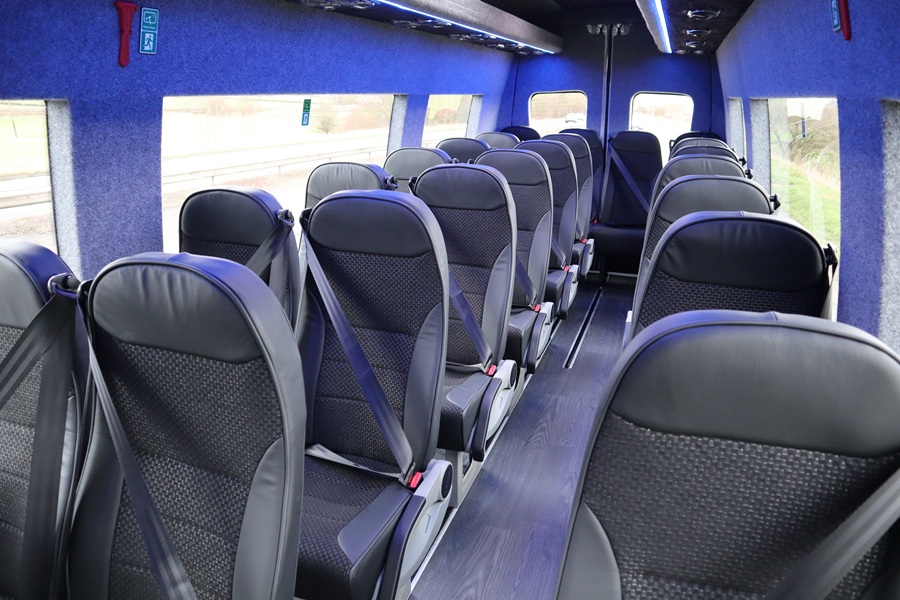
For van or vendor van conversions, a full range of options is available, from a relatively simple, 22+1-seater for school transport and local private hire to a top specification in 1+1 layout with a large boot suitable for golf tours. All Dailys used are to the maximum H3 height, giving over 6ft of headroom throughout.
David Fishwick Dealer Principal Matt Eames underlines how the vendor van’s upper 6,500kg GVW is core to maintaining a high luggage tolerance, although the panel van at 5,000kg or 5,600kg remains versatile. Various stock examples of both types are built and kept available with a focus on high-demand periods. Some have removable seats to leverage luggage space when a fixed boot is not fitted.
Variety of specs on Daily already completed by David Fishwick
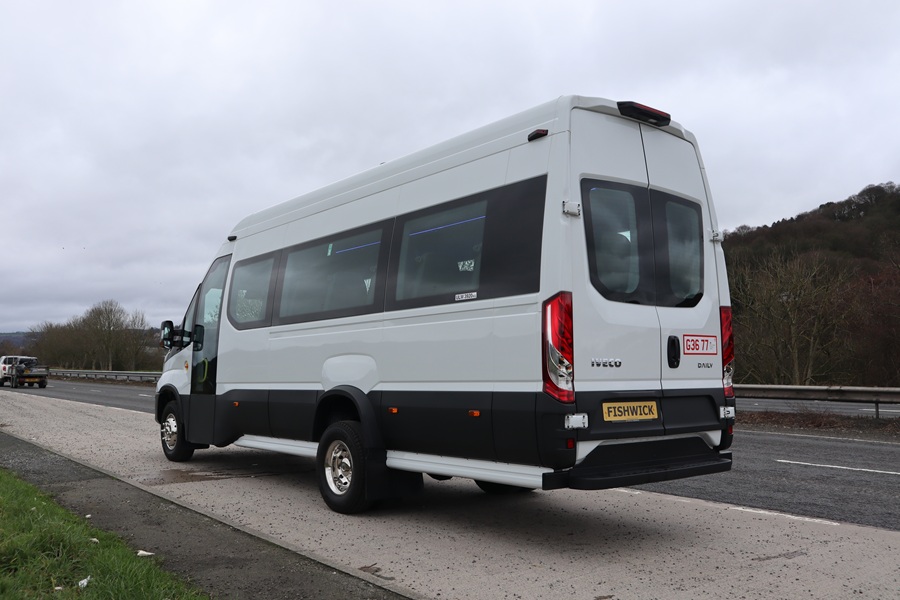
Of diesel examples completed, several were at Colne when routeone visited. One was a mid-range 22+1-seater in white on a 6,500kg GVW vendor van. Another was a metallic blue van conversion to a slightly higher spec but on a 5,600kg GVW base. Matt calls it “a traditional minicoach.”
One more was in silver with 16 seats as part of a high-end fitout including two tables. Each position is in real leather, a fridge is within the ‘back to back’ area made by the table arrangement, and wood-effect flooring is fitted. This minicoach is also a vendor van.
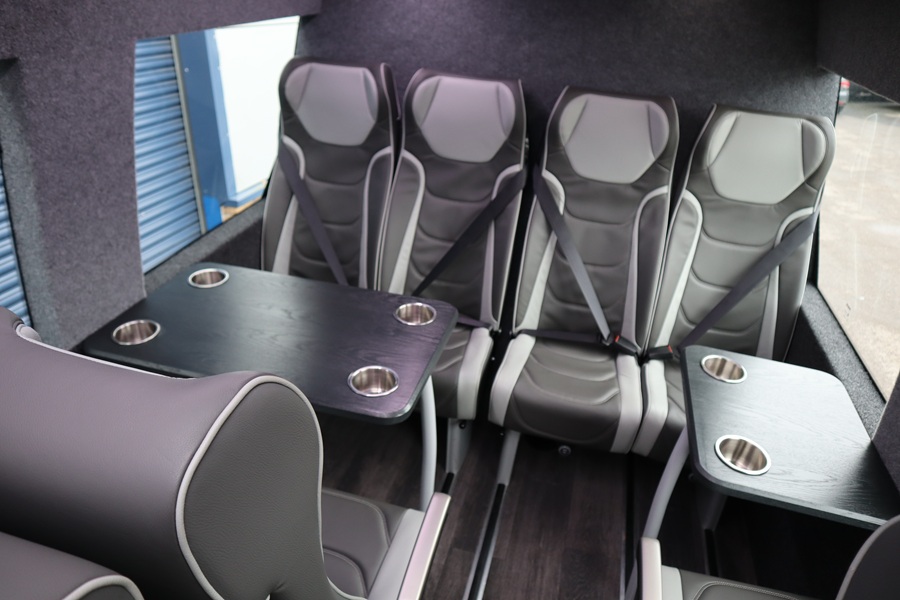
Further illustration is given by a bespoke configuration to suit the golf and VIP market. It has 500mm-wide seats in a 1+1 layout and carries 13 passengers, although that can be further reduced to accommodate tables.
As befits such an application, the minicoach in question has a shore power connection and even solar panels on the roof coupled to a battery bank in the saloon to allow the driver to stay aboard and use fittings as required while passengers are playing golf.
Matt acknowledges how minicoaches often have multiple lives. For some vehicles Fishwick sells, it expects to see them two or even three times as they cycle back through the dealership. A close relationship with one of its conversion partners on reworking thus exists, where the configuration can be changed to suit later use.
Mid-range offering does well on test
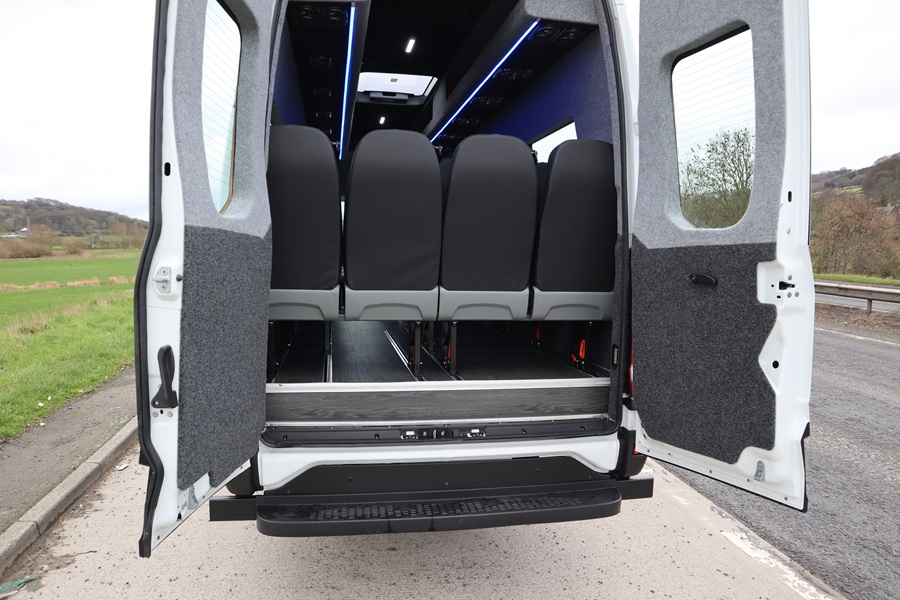
routeone was able to drive the white vendor van with 22 passenger seats. Those positions are tight to the back doors, but the rearmost three rows of seven are removable. The idea is that rows five and six can be demounted as needed, with the rear row being moved forwards to create luggage space.
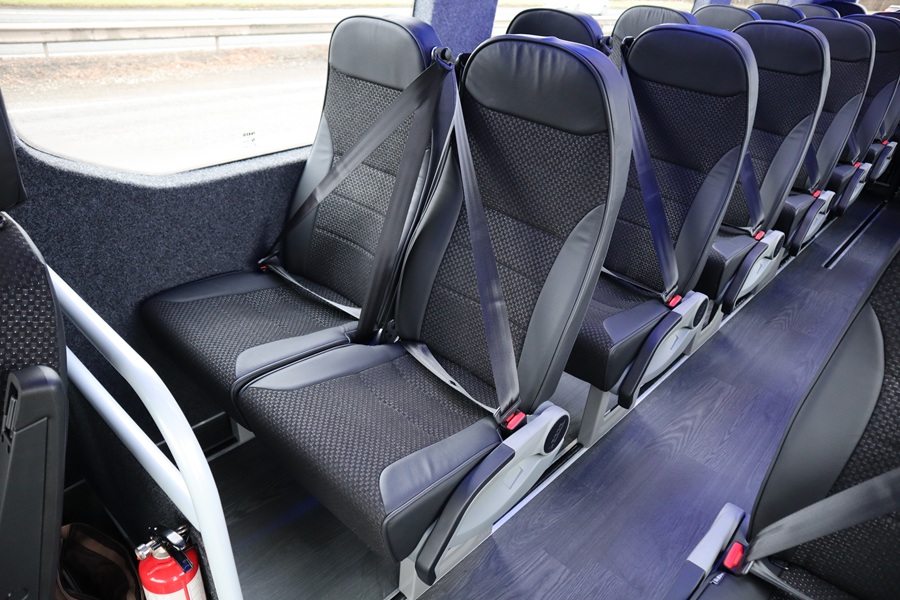
Sege has provided the slim-backed seats, which lack recline. Prime Passenger Seating’s Buckingham model is an alternative. As seen, three-point belts are fitted along with a trim that is a combination of upholstery and synthetic leather. Legroom is moderate and the window pillars are reasonably thick. Wood-effect flooring is fitted along with grey carpet on sidewalls.
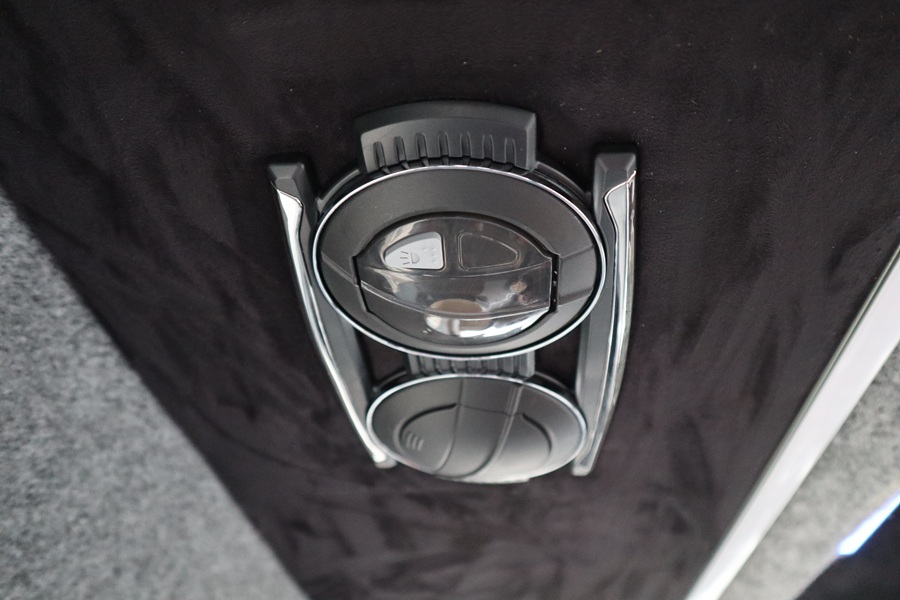
Overhead are surprisingly tall and deep luggage racks within which reasonably-sized bags fit. On the undersides are passenger service units. They are to a stylish design, with matching circular fitments for the air vent and reading light bookended by chrome strips and surrounded by a suede trim. USB charging points are also present in seat frames.
An Eberspächer saloon heater is part of the package. High-specification models get a saloon air-conditioning unit as standard, something that is optional on others, including the test vehicle.
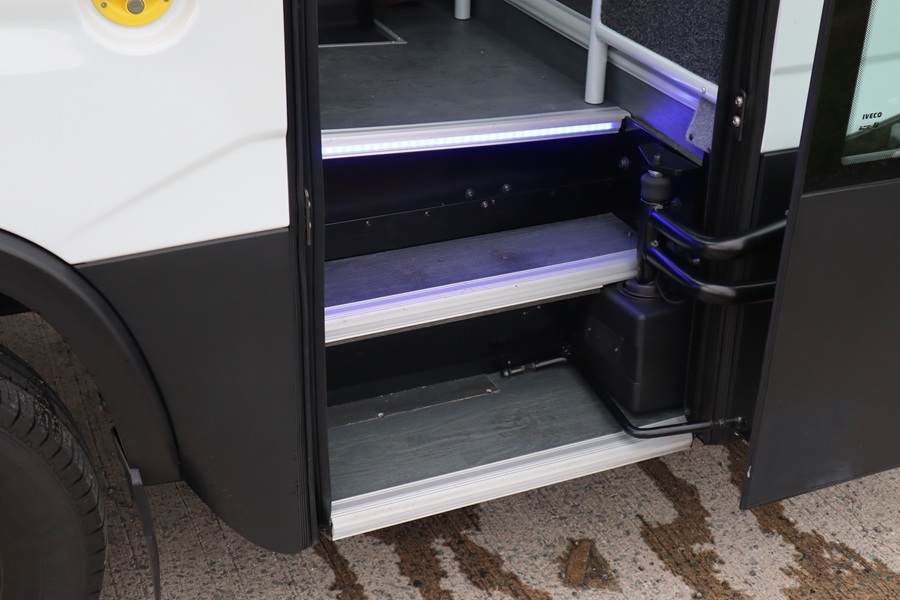
The powered passenger door is fully glazed, with two steps to the platform and one more to the flat gangway. On the metallic blue panel van conversion, the arrangement behind its manual door is the same, but the third step is in the middle of the saloon. When an accessible variant is required, that difference should be considered. For the sake of simplicity, single-glazed side windows are used.
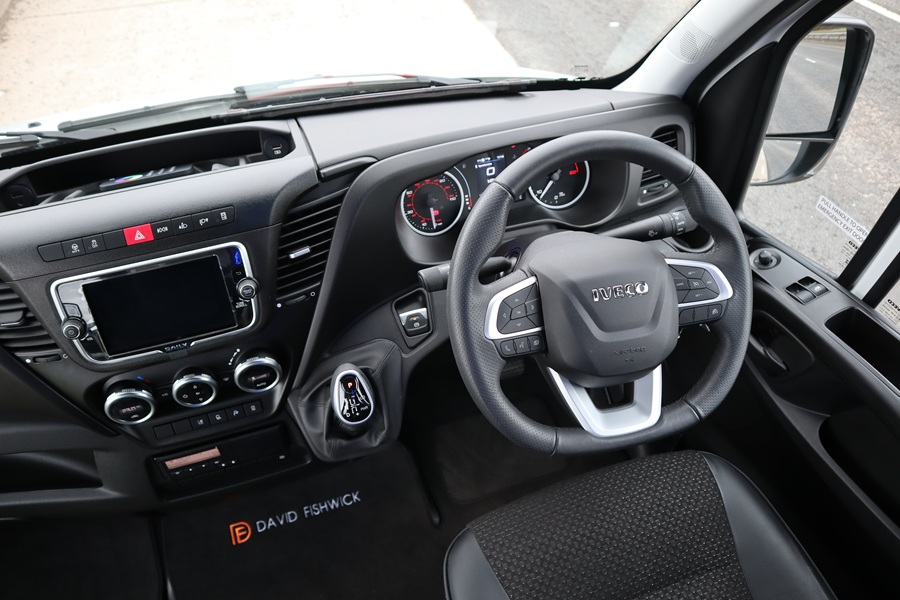
Cab is anchored by central touch-screen display
The driver gets a largely futuristic cab, although dials on the test vehicle are analogue and not the digital types now seen on larger coaches. A prominent touch-screen unit is at the centre giving functions including satellite navigation, radio, reversing camera display, phone connectivity, and driving scores and tips.
Access to the cab from either side is good, with use of a small electric handbrake switch on the dash meaning that no ratchet lever is to the nearside of the driver’s position.
Space behind the seat is suitable for a small bag and there are many other areas for storage of further items. The seat is excellent and comes with air suspension and a heating element. A standard-sized windscreen is used; Fishwick does not offer a panoramic alternative.
Daily remains a sprightly on-road performer
Vendor vans at 6,500kg are completed with built-out rear arches to suit a larger twin wheel arrangement on the drive axle. They are highly noticeable in the mirrors.
Steel suspension is used all round, with no air option. The vehicle thus sits quite high at the back when unladen, and so the rear step is lowered to function as the underrun bar, although that is not necessary on lighter variants.
Power comes from the 2,998cc F1C engine developing 176bhp and 430Nm of torque. It drives through the eight-speed Hi-Matic automatic gearbox. When proceeding normally, the transmission upshifts at low engine speeds, but it will rev the power unit hard when pushed. Kicking down by two gears is possible when a sudden burst of pace is needed.
While power and economy modes can be selected, performance in economy suggests that the former may be superfluous. At a road speed of 62mph, the engine is turning at slightly over 2,000rpm, which is beneficial to ambience and, no doubt, fuel economy.
The ride in an empty vehicle is firm, but that will improve with passengers aboard. Sound deadening of the engine is excellent, and Matt notes how the body as a whole is generously insulated.
Steering is well weighted, and the wheel is flattened at the bottom to take account of larger drivers. The Daily comes with a ‘City’ button. When engaged, it boosts the electric power assistance to reduce driver effort by what Iveco claims is up to 70%.
Versatility sits at Iveco Daily range’s centre for David Fishwick
Matt views the new Daily-based range as a ‘full service’ minicoach and minibus offering. The three-year/100,000km Iveco warranty is matched by Fishwick on the conversion, and Bank of Dave – owned by proprietor of both businesses David Fishwick – can offer leasing, hire-purchase and contract hire options.
The dealer’s extensive contacts around the mini vehicle industry coupled to scope for rework by a converter adds to the equation and Matt believes that a 15-year life or longer will be possible from cradle to grave, potentially capturing more than one configuration.
Flexibility on fitout both at the beginning and later is key to that belief; as an example, the dealer recently took back an older but low-mileage minibus that it expects to place with a community transport group.
“This is not a product line; it is built to the customer’s specification,” he adds. Base Dailys are on hand to allow work to begin promptly, with around four months the likely lead time from order placement by the customer to completion by the converter.
When an accessible layout is specified, up to six wheelchair users can be carried; PLS is Fishwick’s favoured lift supplier thanks to product quality and good support. Matt expects that the 22 seats plus driver configuration will be the most popular, but he is keen to discuss individual requirements with buyers and confident that a solution can be found.
As is well known, the Daily drives nicely, and with 176bhp on tap plus the Hi-Matic gearbox, gives a smooth and refined ride. As tested, the middle-range vendor van option makes an useful all-rounder. Visual examination of other variants shows that the customer impression is positive across the variety of interior fit-outs possible.
Fishwick has further irons in the fire for its minicoach offering to sit alongside other work in smaller and accessible minibuses. The dealer is confident in its new Daily-based products – a position that would seem to be well taken.
Facts and figures – David Fishwick Iveco Daily
Engine: 3.0-litre, four-cylinder F1C
Power: 131kW (176bhp) @3,500rpm
Torque: 430Nm (317 lb ft) @1,600rpm
Emissions: Euro VI using EGR and SCR
Gearbox: Hi-Matic eight-speed automatic
Tyres: 225/75 R16
Length: 7.54m
Height: 2.84m
Width: 2.01m
Wheelbase: 4.10m
Gross vehicle weight: 6,500kg
Unladen vehicle weight: 3,920kg
Fuel economy: Not yet known.