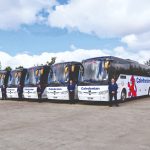




















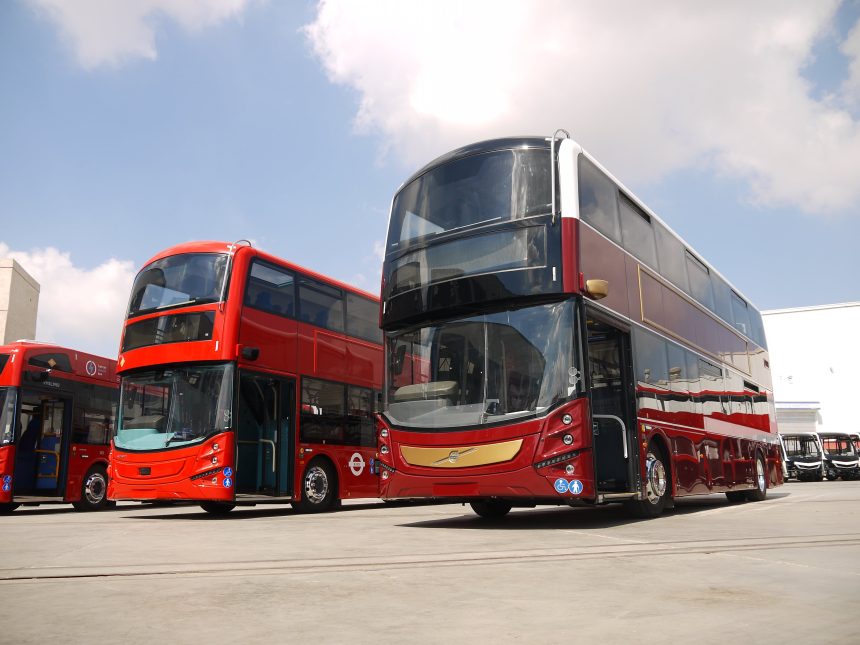
On 16 September Manufacturing Commercial Vehicles (MCV) held a special event in Cairo to inaugurate a new production line dedicated to Volvo’s electric bus range for Europe.
The facility took one year to complete and is located in New Salhia City, Sharqia Governorate — about an hour and a half from Cairo. Funded through a framework agreement between Volvo and MCV worth approximately E£3 billion (approximately USD$60 million), the 10,000 square metre facility comprises part of a wider 300,000 square metre factory and is dedicated exclusively to building Volvo buses for export markets in Europe.
Chassis for the 7900 and 8900 electric models will receive bodies there, as will the BZR underframe upon completion of a technology transfer. Production capacity is 1,200 buses per year with the first rollouts expected in autumn.
In an opening ceremony, senior government officials and industry leaders including Lieutenant General Kamel Al-Wazir, Egypt’s Deputy Prime Minister and Minister of Industry and Transport, and Hazem Al-Ashmouni, Governor of Sharkia, joined the Swedish Ambassador to Egypt, Dag Juhlin-Dannfelt, Volvo Buses Global President Anna Westerberg, and other senior figures from MCV and Volvo International.
Press and official visitors were then given a brief tour of the production line and of some of the vehicles bodied by MCV, which included vehicles for De Lijn, and right-hand drive models bodied on a separate UK production line for Lothian and London operators.
‘Partnership is the new leadership’
The inauguration falls under a new venture whose strapline is ‘partnership is the new leadership’. Following an initial strategy with Volvo, MCV says it concluded that a new dedicated manufacturing facility was necessary to support the long-term nature of its business objectives.
The main assembly hall is one of several new buildings being constructed to meet what the company says are “demanding export markets”. It says it is moving forward with a very rapid and substantial growth.
That has required significant investment and manpower. MCV expects the venture to see additional employment for over 2,000 people in Egypt alone as the new factory matures.
For Volvo, the launch comes in response to the decision to end the production of complete buses in Poland back in March 2023, and a focus on collaboration with bodybuilders.
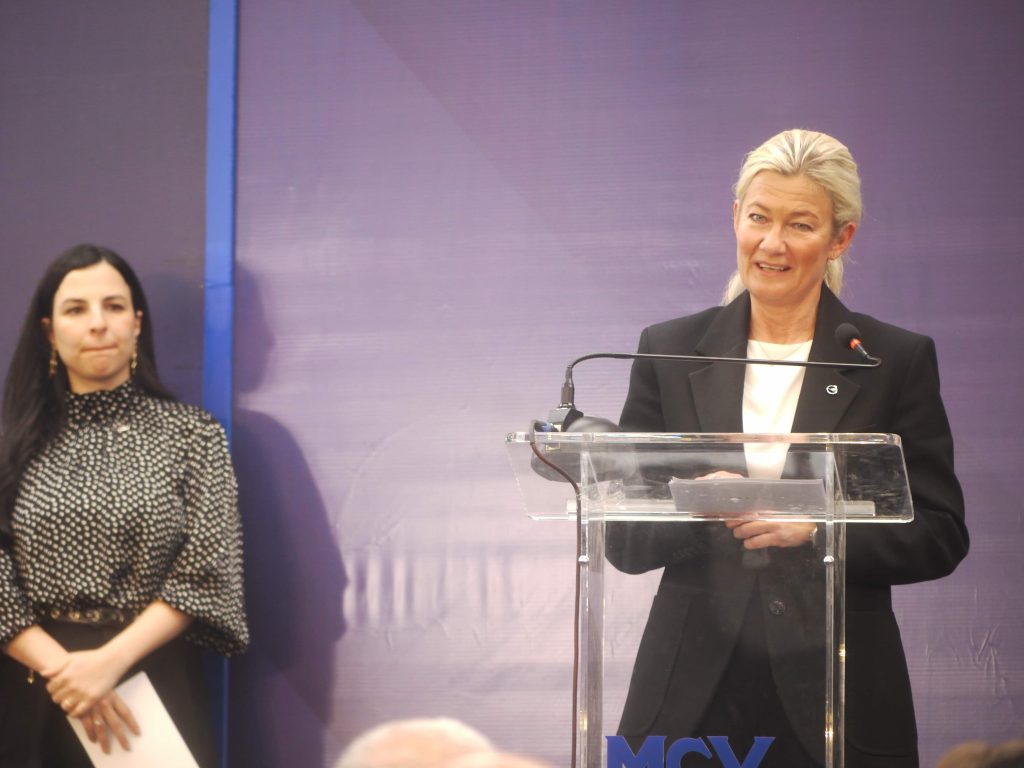
Speaking to the conference, Anna Westerberg says partnerships with bodybuilders such as MCV give Volvo greater flexibility to meet the demands of customers; and that companies like MCV and Volvo have much to learn from each other and are more successful when joining forces and combining “different competencies”.
‘Customer demands’ clearly translates as a call for greener vehicles. Lieutenant General Wazir notes that Egypt is determined to be one of the main global exporters of electric buses and that the collaboration demonstrates a quality product, localisation of industry, and support for the country’s export strategy.
“We understand it is the future of transportation,” he says, with the partnership acting as a “certificate” that Egypt is capable of producing an internationally recognised product. “This is a clear message we are not waiting for the future; we are making the future. This factory is just one example.”
What progress for the UK market?
For the UK market, Volvo’s focus remains on the BZL. A spokesperson tells routeone that there are no imminent plans for a low-entry BZR chassis to debut in Britain, citing little demand for interurban offerings.
As for the BZL, progress is “always ongoing,” according to Mattias Rangeby, Senior Vice President Volvo Global Bus Technology. “When it comes to energy efficiency, storage, emergency braking, city braking in London, these developments are going on. We have been testing and gathering a lot of data on city brake functionality, and there has been a lot of ongoing development.
“It should come as no surprise that we need to continue to develop the product and every second or third year there is a new generation coming. There are different expectations: the amount of energy, the number of passengers, the type of battery chemistry. Unfortunately, as of today it’s not a one-size-fits-all solution and we need to make sure we have a good block system that we can fit for different markets.”

MCV and Volvo: strong UK legacy
MCV celebrates its 30-year anniversary in 2025. In the UK the company has now been present for 23 years. While MCV and Volvo’s production line for the UK is distinct from the recently inaugurated European facility, several UK-bound vehicles were on display, and both companies say they are on track to deliver around 800 models this year.
Ashraf Fawzi, Managing Director, MCV Bus and Coach (pictured, below right), says the UK market is one of MCV’s biggest in terms of its global strategy. “We believe that the MCV product has been successful because we offer the right equations, combined by a good reputable chassis well supported in the UK — and a quality value for money for our body manufacture.
“Also, our aftersales service: MCV is unique in terms of foreign body builders in the UK insofar as we provide a product with physical support on the ground — we have our own technicians, sales team, stores for sales support, and engineering support, which satisfies a lot of boxes for the UK market.”
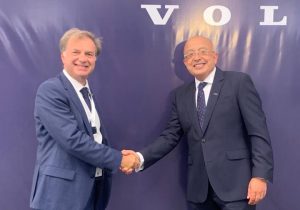
Domenico Bondi, Volvo Buses Managing Director UK and Ireland (left), adds that MCV offers flexibility, pertinent as London remains the BZL’s main target market. The goal is to satisfy criteria from Transport for London (TfL). With the nature of London bus tenders to drop in electric operation in place of diesel, a focus on the BZL technology has been on maximising route coverage without the need for top-up charges.
“TfL is a very demanding entity,” Domenico notes. “Its requirements are stricter and stricter each year and it often asks for changes to technology development quickly. Specifications are very different today than they were five years ago.
“MCV has so far been able to respond together with Volvo in a structured way. It also offers flexibility in terms of operator customisation, livery and interiors. Only companies with a strong engineering background can satisfy that kind of demand. MCV is used to large procurement, able to handle several projects for different operators at the same time. That ability to generate volume is key for us.”
Another aspect of Volvo satisfying the demands of the UK market is its own presence here. Domenico is keen to emphasise that, noting that Volvo employs nearly 3,000 people now. “We rely on a brand, safety standards, network sustainability, corporate social responsibility,” he says. “Customers want peace of mind and an asset that is looked after well by their provider. Volvo is distinguished by its terms of service. It is a Swedish brand with a well-established British workforce, and we can provide a service to all our customers, both coach and bus, 365 days a year.”

Sustainability goals
The unveiling of a new production facility in Egypt was joined by confirmation of the imminent arrival of the Volvo BZR e-coach, which the manufacturer says will offer up to 700km on a single charge (with first deliveries to European operators next year).
The BZR chassis will use different partnerships with body production informed by customer interactions. There are “clear incentives” for these types of solutions and different applications for routes, with firm commitments already in place, according to the manufacturer.
Both developments spell significant steps forward in Volvo Group’s global electrification strategy. During the inauguration of the new MCV facility the Group furthered detailed where it is on that path. The company is now investing heavily in battery-electric, internal combustion engine (ICE) and fuel cell technology.
Mattias notes that the company’s general statement now is “more or less battery-electric where possible, ICE and fuel cell where needed”. He says Volvo intends to have a rolling fleet by 2040 to be fossil free, with a business model centred on circularity of materials.
Volvo’s common architecture and shared technology (CAST) system will see solutions migrate from truck to bus. Longevity is also a priority according to Mattias — Volvo wants customers to trust that products have a service market of at least 15 years, with a circular economy following.
While a joint venture with Daimler is running hydrogen fuel cell-electric vehicle tests, Mattias warns that the total cost of ownership of hydrogen means it remains inaccessible to many without incentives.
A strong angle from the Volvo Group amid all these developments is holistic sustainability. That is in response to increased global legislation, but sustainability is already at the core of Volvo’s ambitions. 90% of vehicle chassis today is recyclable, according to Kitty Muffolini, Senior Vice President responsible for bus purchasing.
She reports also that the company is on good track to a target of 50% reduction in emissions from Volvo’s own operations by 2030, a 40% reduction in emissions from its vehicles (when in use) by 2030, and 100% fossil free transport solutions by 2040.