





















With elections taking place on 7 May in Wales and Scotland, the Confederation of Passenger Transport (CPT) has laid out its key asks of the next governments in those nations.
Addressing slow bus speeds through bus priority and other means led the agenda in CPT’s Scottish and Welsh manifestos, which were published in November 2025, and it remains the No 1 issue, in the view of the trade body.
It cites research showing that a 10% increase in bus speeds could boost passenger numbers by 2.5% and reduce operating costs by 8%, which would mean a saving for households, local authorities and central governments.
Although not all the parties had published their manifestos as routeone went to press, several of the leading contenders had indicated their commitments with regard to bus services.
We spoke to CPT Scotland Director Paul White and CPT Wales Chair Martin Gibbon about some of those plans and the trade body’s hopes for the next parliamentary periods.
Uncertainty in the Senedd
After 27 years of Labour government in Wales, the party seems set to lose power as Plaid Cymru has a narrow lead over Reform UK at the top of the latest polls.
If they are to lose out in what is likely to be a coalition or minority government, Labour’s legacy will be the setting in motion of bus franchising – due to begin next year.
However, bus reform aside, the key issues for the sector in Wales remain. Slow bus speeds are a problem in the country, much like anywhere else, with Cardiff ranking the fifth slowest city for driving in the UK, according to a 2019 survey.
CPT is calling for that 10% increase in bus speeds over the next Senedd term. “The manifesto is about one simple practical idea, which is that, if we speed up buses, everything else gets better: reliability, frequency, costs and passenger growth,” says Mr Gibbon.
Despite the UK government’s 2023-instituted single fare cap scheme not applying in Wales, ticket cost subsidies are increasingly hitting the agenda there. Following launch last autumn of an under-22s cap pilot, SNP has pledged a £2 adult fare. The Green Party plans free bus travel for under-22s and a £1 fare for adults.
If we speed up buses, everything else gets better: reliability, frequency, costs and passenger growth – Martin Gibbon
While the downsides of such fare caps have been noted, Mr Gibbon says: “I do think that revenue schemes are helpful, of course…
“But I come back to what I said before: to deliver long-term meaningful growth, what is required is meaningful action where bus priority and tackling congestion is concerned. That is the key to unlocking passenger growth, and indeed, cheaper fares.”
It could be argued that Wales – with almost double the percentage of people living in rural areas compared to England – needs relatively more investment in services than fares. Labour has promised 100 new bus services, if it wins. Plaid Cymru, which also supports franchising, has vowed to reverse cuts to local bus services.
CPT is calling for five-year settlement plans for bus services in Wales. Mr Gibbon, who is Stagecoach South Wales Managing Director, admits the current one-year funding settlements make planning difficult for operators.

However, he is pleased with the prominence of bus in the build-up to these elections. The place of coach in the political agenda is also important, with CPT asking for improved facilities and a requirement for regional transport plans to collect data on the current and potential coach market.
While the wheels are in motion as regards franchising, CPT stresses that government control is no guarantee of success and has called for a “commitment to undertake a value-for-money assessment in each region of Wales before franchising is rolled out”.
Reform UK, which has been gaining on Plaid Cymru in the polls, has talked little about its plans for bus. On whether this is a concern, Mr Gibbon says: “I have no doubt that, whatever party comes into power post-May, there will be an opportunity to be able to liaise with that party and outline our asks.”
Bus speed call in Holyrood
As is the case for Wales, local and national action to tackle the congestion that buses face, via bus priority investment and addressing the impact of road works is a key ask.
A recent poll commissioned by CPT Scotland, published last week, revealed that 58% of people support bus priority measures and only 22% oppose them. Although Mr White is encouraged by a trebling of the Scottish Bus Infrastructure Fund budget for the 2026-27 financial year, he has stressed the need for multi-year funding.
With so little of Scotland being urbanised, support for rural coach and bus is high on the agenda for CPT. Its manifesto asks the next government to consider designating socially necessary services, and calls for improvement of rural zero-emission infrastructure and a greater focus on public transport and coach tourism in rural areas.
Despite the latest round of the Scottish Zero Emission Bus Challenge Fund bringing the proportion of the Scottish bus fleet that is zero-emission to almost 30%, Mr White says: “There is still a lot of work to be done, particularly for SMEs, rural operators and coach operators.” He adds that he would like to see end-dates for sale of new non-zero-emission buses “aligned with Scotland’s readiness and not set for an English timetable, with regards to the rurality of Scotland”.
It’s great that there’s lots of focus on bus, but I’m very aware that just ticketing offers aren’t the solution to better buses – Paul White
CPT argues that the Network Support Grant rate in Scotland is effectively no higher than that of its predecessor, Bus Services Operators Grant, in 2012 and it has called for a review.
Finally, with Scotland’s free bus travel for under-22s scheme being blamed for a rise in problems on and around the transport mode, the trade body supports the removal of the concession where use is linked to crime or serious antisocial behaviour.
Alluding to an issue which has arisen since publication of the manifesto, he adds: “Probably the one big change is the focus on fuel costs and the need to prioritise the sector should there be any scarcity.”
As in Wales, fares are becoming more of a hot topic in Scotland. The Scottish National Party, which looks set to retain its place as the dominant party in Holyrood, has introduced free bus travel for under-22s and a £2 fare cap pilot scheme for selected areas.
The Scottish Greens want to go further by making bus travel free for everyone. On that, Mr White says: “I will hold fire from saying whether it would be a good or bad policy, but I think it would be an expensive policy.”
He adds: “It’s great that there’s lots of focus on bus, but I’m very aware that just ticketing offers aren’t the solution to better buses, if we’re not looking at infrastructure improvements, and how we get a stronger network of services in rural areas.”
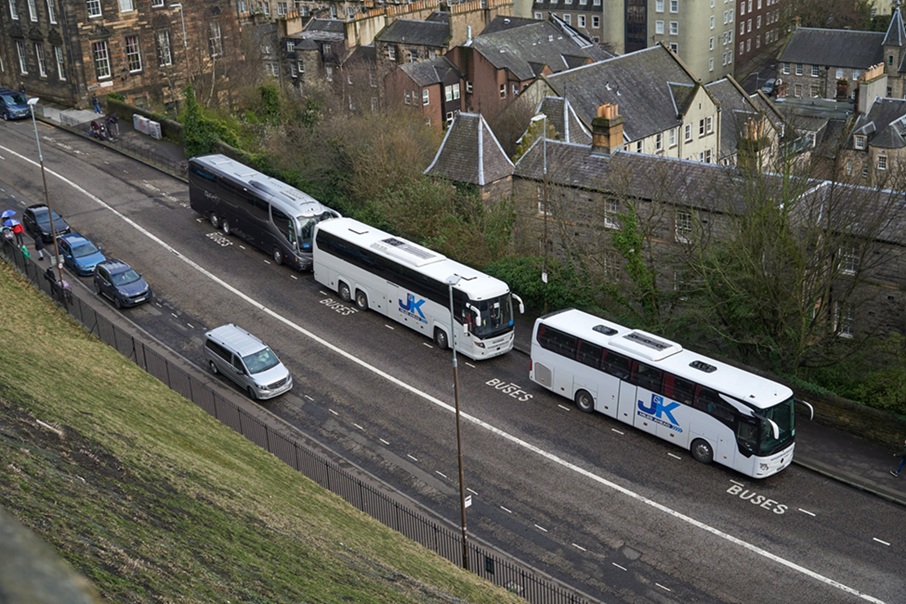
Mr White is keen for better appreciation and facilities for coach, noting particularly work CPT is doing in Edinburgh. It is liaising with the chamber of commerce there to raise the profile of coach in the business community amid a move to keep coaches out of the city-centre areas.