



















As a new Driver CPC module designed to combat violence against women and girls is launched, we look at broader action that the industry could take
The industry has welcomed the introduction of a new national training programme for coach and bus drivers to combat abuse of passengers, while also highlighting the need for a broad approach to tackling the problem.
The Confederation of Passenger Transport (CPT) commissioned Understood to develop a new Driver CPC module around that can be employed by training providers across the country in a bid to combat violence against women and girls (VAWG). Launched on 17 March at First Bus’s depot in Basildon, industry representatives had the chance to experience elements of the training.
The reasons that the industry needs to address the issue were made clear. Surveys show that 72% of women are worried about sexual harassment on public transport. Meanwhile, a Department for Transport survey in 2023 revealed that around a third of women feel unsafe using public transport after dark.
Research by the Suzy Lamplugh Trust in 2021 highlighted that 88% of women had experienced unwanted behaviour on public transport in the previous five years and that 56% of these incidents happened on buses.

Further, according to a 2024 Transport for London (TfL) survey, nearly one in four women experienced unwanted sexual behaviour on London transport in the previous three years.
The resulting negative impact on patronage is shown by a 2024 survey of 1,000 participants by Plan International, which found that women and girls spent, on average, £528 per year to avoid public transport in the interests of safety.
As Keith McNally, CPT Operations Director, stressed when launching the training programme: “This [training] ultimately will make a difference to the number of people travelling on buses. If you’re a commercial operator, ultimately this will make a difference to your bottom line. People won’t use buses if they don’t feel safe.”
The training module has three principal aims: to help drivers to spot instances of VAWG, give them the confidence to know how to act and, finally, encourage the reporting of it.
This [training] ultimately will make a difference to the number of people travelling on buses – Keith McNally
It is not just about tackling the most serious crimes against women and girls on public transport, but those attending the course will be helped to see the full spectrum of potential behaviours as most harm starts at a low level.
It will be stressed that drivers are not expected to act like superheroes or the police, and that there is no single right way of dealing with a situation. The priority is always to ensure the driver as well as all passengers are safe.
The training centres on the four Ds: distract, direct, delegate and document. Simple actions to “distract” or create a diversion can defuse a situation before it escalates.
Meanwhile, a “direct” action such as asking an offender to stop may be necessary. “Delegating” may involve alerting the control room or emergency services. “Documenting” is also important to strengthen statistics, as well as being vital in helping police should a situation develop into a crime.
Rebecca Miller, Bus Users UK Director for England, says the training module is “extremely important”. She adds: “Training drivers is a positive first step to get the information to the drivers, so they know how to respond and recognise these situations while they are occurring – particularly because they’re seen as the steady hand on the bus and the person that people go to when they have an issue.”
Promoting the positives around bus safety
However, while the concerning statistics about women’s safety on buses need to be stressed within the industry to bring about change, is there a case that we should better promote the positives of bus travel to the public?
Transport for Greater Manchester (TfGM) says incidents of crime and antisocial behaviour on its network number just one per 20,000 passenger journeys. Data last year from Transport for West Midlands reports 2.2 incidents of antisocial behaviour per 100,000 journeys.
Rebecca says: “What tends to happen is that we hear about the negative things. Someone having a bad situation on a bus is going to start filming that, but they’re never going to start filming when they have a smooth journey. Generally speaking, buses are quite a safe mode of travel. I think we need more of a balanced approach to it. More can be done to show the positive side…

“The industry as a whole needs to work on myth-busting and it is our duty to push further on that and show bus travel is a safe and positive way to get around.”
Stagecoach East’s Buses and Businesses Against Abuse scheme, which was launched in 2024 and is now being rolled out nationally, as well as providing driver training, has helped push the positives with its “This bus is a safe place” destination message, as well as onboard promotion via posters.
Bus shelter design
Rebecca also says we need to encourage accurate statistics through making it clear to passengers how to report incidents – and not just via digital means.
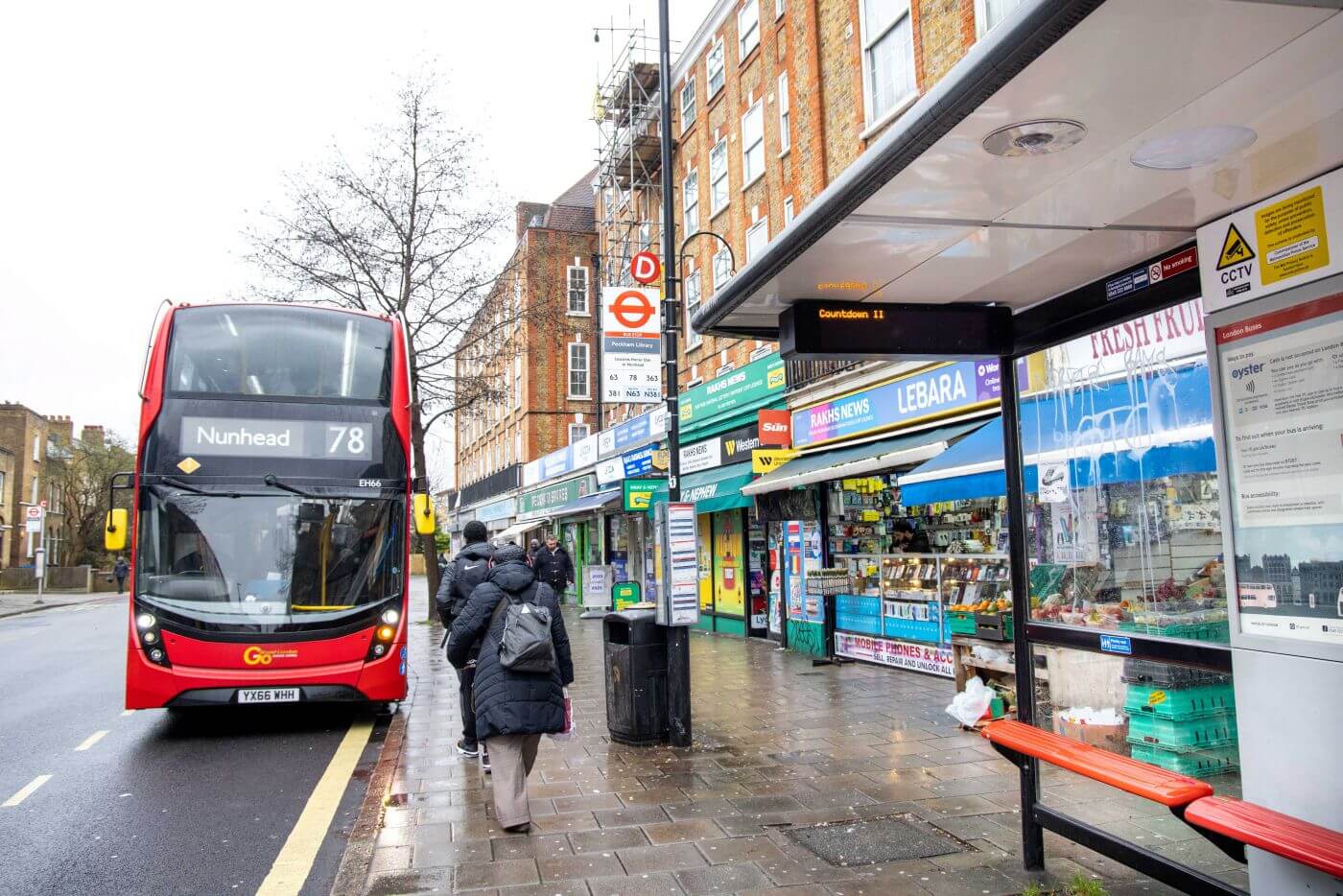
Regarding broader actions needed in the industry, she adds: “I think the driver training is a good first step, but there’s so much more. We need to look at the journey as a whole. You have to look at before the passenger even gets on the bus; is the stop well-lit and well-maintained, are the hedges around it groomed so there’s a line of sight and people feel safe there?” TfL announced in February it was expanding a 12-month trial of new bus shelter designs, which includes CCTV at selected sites and better lighting.
CCTV adds to safety
While there is room for improvement when it comes to CCTV at bus stops, the fact that buses can have around dozen cameras on board should make people feel safer.
Geoff Cross, Managing Director of Centrad, a supplier of camera technology for the industry, says: “Bus and coach travel is already one of the safest forms of transport in the UK, but public perception does not always reflect that. Most modern buses are fitted with multiple cameras covering the driver, passenger saloon, entrances and exterior, and this provides a strong deterrent against antisocial behaviour, harassment and violence. When incidents do occur, clear video evidence allows operators to deal with them quickly and gives drivers reassurance that they are supported.
“Training programmes like this are important because drivers are often the first point of contact when something happens, but technology also has a role to play.
“We are also starting to see more intelligent systems that can flag incidents automatically or allow operators to check on a vehicle instantly if a problem is reported.
“As an industry, we probably do not talk enough about how safe buses already are. The combination of trained drivers, onboard cameras and connected technology makes modern buses very well protected environments, and continuing to invest in both people and technology will be key to maintaining passenger confidence.”
Making the most of tech
Other technology is also being employed and should be considered by operators and local authorities. Among examples is Inclutech’s Safe Travels app which is being piloted by Transport for Wales.
This provides staff and passengers with the ability to make a nonverbal report of inappropriate behaviour and the option of supplying video or photo evidence with it.
Becca Hume, Inclutech founder and CEO, says: “In relation to the new driver training programme, it’s really encouraging to see the industry taking more coordinated steps to address VAWG and passenger safety.
“From our perspective, one of the key challenges remains around reporting – both enabling passengers (and staff) to raise concerns easily and ensuring that data can be effectively acted on by operators.
“This is an area we’re focused on, and we’d be keen to support organisations looking to strengthen their reporting and response mechanisms alongside wider training initiatives.”
The industry as a whole needs to work on myth-busting and it is our duty to push further on that and show bus travel is a safe and positive way to get around – Rebecca Miller
Meanwhile, TfGM last year launched its 24/7 TravelSafe LiveChat service, which allows passengers to discreetly report crime or antisocial behaviour in the Bee Network app.
The role of fellow passengers could perhaps be promoted by operators and local authorities.
Rebecca says: “It’s really important that they don’t put themselves in harm’s way, but they should also not turn a blind eye and, if they’re better equipped with understanding how to report these situations, that would help them to become more confident with helping out someone who might be in a difficult situation.”
However, while better information for passengers on how to report and deal with crime could be an aid, the new driver training module is a significant first step.
Addressing attendees at the launch, at which Local Transport Minister Lilian Greenwood also spoke, First Bus Managing Director Janette Bell says: “If we’re going to get more passengers on our buses and equally make sure the passengers travelling with us today keep travelling with us, it is critical that passengers feel confident about using them… If you don’t feel confident about travelling on public transport, then quite simply we’re not doing our job properly.
“So, we have to work out how we’re going to create an environment where everyone feels welcome and make sure that that’s at the heart of what we do.
“And, of course, if we look at what’s at the heart of what we do, it doesn’t take you long to get to our drivers, because our drivers play a crucial role in that experience.”