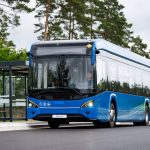





















Winning hearts and minds is a key factor in both acceptability and advocacy of safety. I was reminded of just how important this is at our recent in-person event of the Bus Knowledge Sharing and Incident (KSI) Network where we were excited to see the first demonstrations of autonomous emergency braking (AEB) on buses in the UK.
Hosted at the Science and Innovation Park in Wroughton, next to a hangar dedicated to the visionary Professor Stephen Hawking, we got to bear witness to one of the most advanced and innovative safety measures to be introduced on buses in decades.
AEB has two great values.
First, in the case of vehicle-to-vehicle collisions, it is always watching out for that risk. If the driver is distracted by a passenger, checking mirrors, or impaired for any reason, the system’s only purpose is to have your back; it will brake if the driver does not or cannot.
This also means there is significant value to be had back at the garage shunting buses around, because damage-only collisions can also be reduced.
Second is the case of pedestrian or cyclist collisions. Those tend to occur where the time to collision is very short, usually less than two seconds. The time it takes for an average driver (of any vehicle) to react is around 0.75-1.5 seconds.
Most drivers will barely have had time to put their foot on the brake before the collision. AEB can achieve far quicker reaction times that could be enough for the person to have safely passed the front of the bus and for the collision to be avoided.
Where collisions still cannot be completely avoided, AEB can at least reduce the impact speed and the chance that the person is run over by the wheels, so that the incident is less severe.
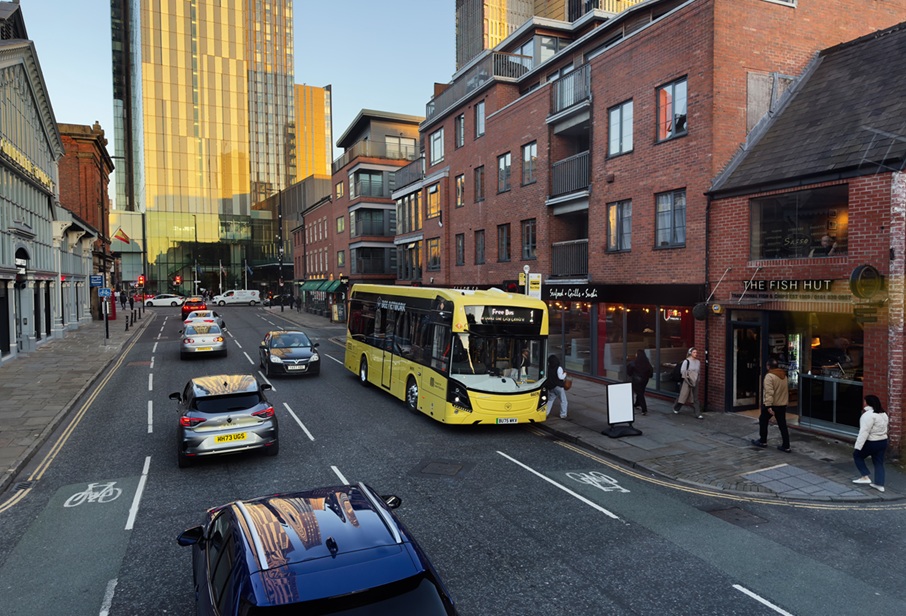
AEB has been knocking around the transport industry for a while now. In fact it’s one area where coach has had a big advantage over bus for over a decade. Mainly focused on vehicle-to-vehicle crashes, the value of AEB on coaches travelling long distances on motorways is obvious and welcome.
For buses, though, it is also the vehicle to pedestrian/cyclist scenarios that are the ultimate aspiration. But AEB has always seemed to be out of reach; most people find the thought of having unrestrained passengers (or even standing passengers!) just a step too far for comfort.
Let’s examine this. The most crucial factor in deciding on AEB is whether it triggers only when it needs to (a true positive event) or whether it triggers in error (a false positive event; when a driver would not have braked themselves).
A false positive is what is truly concerning. When the system brakes in error it is introducing a risk that wasn’t there before, and therefore has the potential to cause additional injury to passengers. That is the exact opposite of our intention.
Keeping these false positive alerts to the bare minimum is what the industry has been working to achieve – and don’t get me wrong, there’s still work to do in this space.
But actually, the worry I have heard most often is: “What if the system brakes harder than a driver would?” The associated concern is that a lot more passengers will be injured on the bus, therefore outweighing any benefit to pedestrians or cyclists.
In the case of a true positive event (such as this), we must understand that whether a signal to brake arrives by foot on pedal or electronically, the maximum braking force is determined by the mechanical effectiveness of the brake itself, tyre grip, road surface, and environmental conditions. The system cannot brake any harder than a driver.
However, I have found that for all the years of me and other advocates of AEB for buses saying just this, AEB is something that ultimately needs to be experienced to truly ‘believe’ this message. There is nothing quite like feeling the forces – the braking, the jerk, your sway and brace – as a passenger and a driver to really enable those concerns to be re-evaluated.
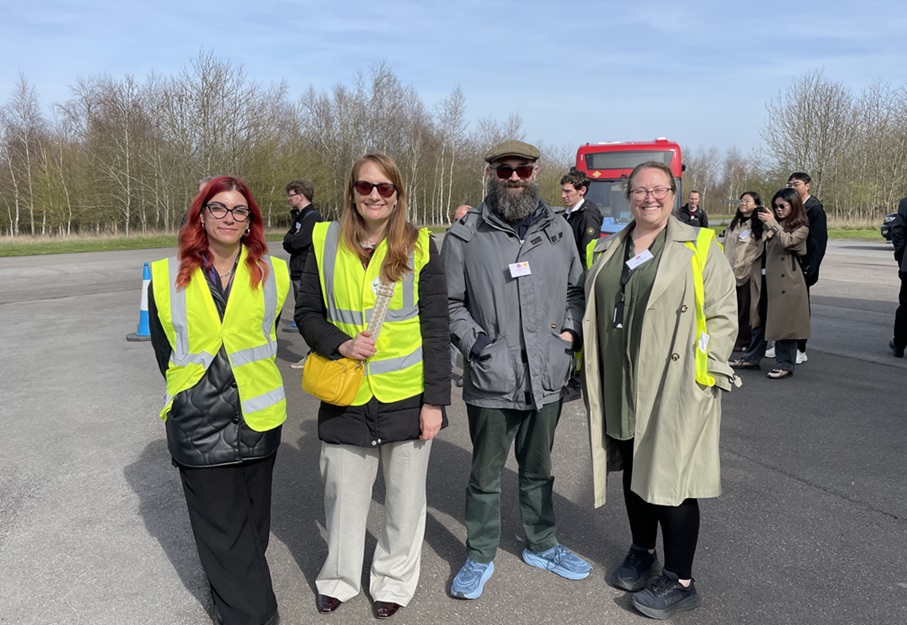
The reactions of those attending the Bus KSI Network event have been wonderful, winning over people through experience.
Our diverse group of attendees commented that the braking is no different to what they would feel in typical city traffic. Most crucially, they could see the potential of preventing the bumps, shunts and casualties, and the operational benefit that would bring.
So, whether you are implementing a small local initiative or one that has taken a decade of work amongst dozens of teams across the globe – to make safety work, we need to win hearts and minds.
#letstalkaboutsafety
Kerri Cheek is Co-Chair of the Bus KSI Network at the Bus Centre of Excellence. See bus autonomous emergency braking for yourself at the next Bus KSI Network in-person event on 3 June at UTAC Millbrook.