




















Our political insider looks at both sides of the argument on the contentious issue of UK operators buying Chinese-made buses
The issue of foreign bus imports seems to crop up in parliamentary spheres now on a regular basis.
The Business and Trade Committee has started to take oral evidence on its “China and the UK Economy” inquiry.
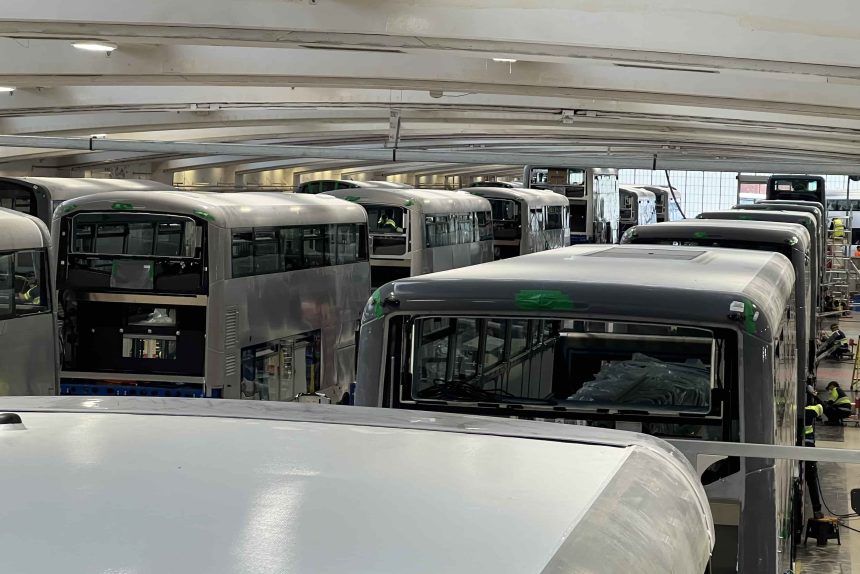
In its session on 19 May, the topic of a Scottish bus operator buying buses from a Chinese manufacturer using funding from the Scottish Zero Emission Bus challenge fund was raised again, this time by the Liberal Democrat MP for Maidenhead, Joshua Reynolds, who posed this question: “Do we, as a country, need to be better at procuring, to take price lower down our list [of priorities] and to have British-made products and British manufacturers higher up that list?”
It’s not an unreasonable question, and I wouldn’t be surprised if this were raised again in future evidence sessions for this inquiry and featured in the Committee’s final report.
From a political perspective, I can see why parliamentarians are concerned that taxpayers’ money is being used to buy buses from China when we have two established manufacturers in the UK, one of which – Alexander Dennis – threatened plant closures about a year ago citing competition from China as the main cause.
Of course, this simple political consideration masks a range of other factors which are arguably far more relevant and which make decisions to purchase buses from China entirely legitimate and sensible from a commercial and business perspective.
Operator input into foreign bus imports issue
I’ve touched on these issues before so won’t repeat myself. However, given that bus operators, and indeed local authorities, have perfectly good and legitimate reasons to buy from the Chinese, I am a little surprised that there isn’t a more vocal response from operators, and indeed the Chinese manufacturers themselves, setting out the reasons why procuring buses from China makes sound business sense.
I am a little surprised that there isn’t a more vocal response from operators
I can see that some may say that this would simply fan the flames, and encourage an even more robust political reaction from those parliamentarians who express concern over a procurement framework which allows Chinese manufacturers to compete, seemingly successfully, with home-grown manufacturers.
I guess we will just have to see where this all ends up. Or whether the status quo will prevail.
Bus lies low on political agenda
Bus policy more generally doesn’t seem to be the hot topic that it once was. With the government’s Bus Services Act 2025 now firmly in place, and with a number of combined authorities pursuing their franchise proposals, there is no longer any serious debate or disagreement about the direction of bus policy.
Government funding is now on a longer-term basis even if the quantum of funding may not be sufficient to significantly drive passenger growth.
Still, we should be grateful for small mercies, given the tight financial position the country is in. All in all, it’s to be welcomed that we seem to have a more stable policy platform today and that the debate about the general direction of bus policy is essentially settled.
Labour leadership challenge
As I write, the only poll I’ve seen for the Makerfield by-election on 18 June has it as a tight race between Andy Burnham and the Reform candidate, Robert Kenyon. My hunch is that Mr Burnham will win by a very narrow majority.
This is a constituency that voted for Brexit, and a couple of my Labour contacts tell me that, as a result, this wasn’t Mr Burnham’s preferred choice of constituency to contest. But his strong profile in the region should be a significant advantage.
Further, Restore Britain fielding a candidate and thus splitting the right-wing vote could be the deciding factor letting through the would-be next Prime Minister.

If Mr Burnham wins, I wonder how quickly he will challenge Keir Starmer for the leadership of the Labour Party. I suspect most commentators think – even hope – he would do so almost immediately.
However, launching a challenge as soon as he’s back in Westminster could come across as arrogant. He’s been away from Westminster for some years now and would not know a large proportion of his party’s MPs.
Perhaps he would be better off to bide his time for a few weeks, settle in as a humble backbencher, get to know his colleagues, and then take action around the time of Labour’s party conference at the end of September.
But what if he loses the by-election? Wes Streeting would surely push ahead with his leadership bid anyway, perhaps immediately. In the absence of Mr Burnham, Angela Rayner would probably throw her hat into the ring.
However this plays out, one thing seems certain: Keir Starmer won’t be Prime Minister come late autumn, perhaps sooner. For my money, the next Labour leader will be Mr Burnham if he wins the by-election, or Ms Rayner if he doesn’t.
Launching a challenge as soon as he’s back in Westminster could come across as arrogant
There’s a stubbornness about Mr Starmer which suggests he may have convinced himself he can face down any leadership challenge and win! Mind you, it’s obvious from the content of the latest Mandelson papers that most of the cabinet don’t rate him.
So I wonder if he does realise the game is up and won’t even stand in any leadership contest; or perhaps his wife, Victoria, will have a quiet word in his ear.
And, when the leadership contest is over, we will have a major cabinet and ministerial reshuffle. Heidi Alexander hasn’t really put a foot wrong as Transport Secretary but that is no guarantee she will stay put. The only near-certainty for the Department for Transport is that Peter Hendy will stay as rail minister to see the Railways Bill through the Lords and complete the rail reform programme. But that aside, the only bet I will make is that Mr Starmer won’t be Prime Minister for much longer!