





















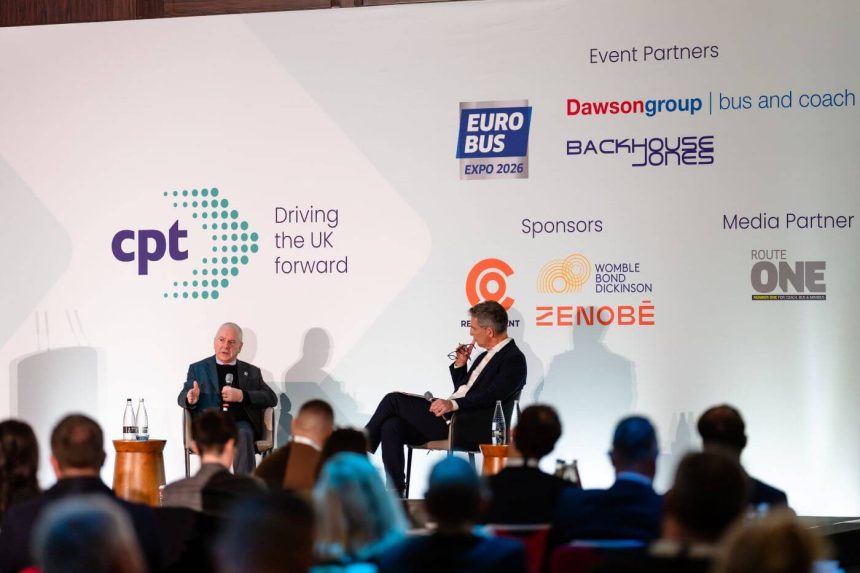
Last month’s CPT Conference reminded us of the significant role coach and bus play in our community, writes new CPT President Kathryn Pulham
Officially, he is the rail minister. But his heart is in the bus industry – or so Lord Hendy of Richmond Hill told the Confederation of Passenger Transport’s (CPT) packed, lively and thought-provoking annual conference.
Peter Hendy stepped in to fill the shoes of Simon Lightwood, our industry’s usual minister, and demonstrated that he knows how to press all the right buttons in front of 200-odd coach and bus professionals.
The Bus Services Act, he assured us, is not a “government diktat” on franchising but an open-minded liberalisation to help local authorities respond to local concerns.
And the government is providing bus funding to every council in the country – putting an end to “pork barrel” favouritism of the past.
Lord Hendy is a familiar face in our industry and it was a pleasure to welcome him back to kick off CPT’s annual gathering of coach and bus professionals from across the country.
The mood was of realism and optimism as we look ahead to 2026
It’s been a challenging 12 months for many, with new employment costs, economic uncertainty and regulatory changes hitting our industry. But the mood was of realism and optimism as we look ahead to 2026.
If we needed a reminder of the importance of coach and bus, it was provided by Pete Dyson, a behavioural scientist, who described transport as the glue that holds us all together – with people spending, on average, 400 hours a year on the move.
People, he reminded us, cannot be lumped together as human cargo – they come in many forms: customer, commuter, road user, wheelchair user.
But to avoid lulling us into a sense of our own importance, a panel discussion on the ”image problem” of our industry was an awakening. Ross Lydall, Transport Editor at the London Standard, told us that our problems can be boiled down to a four-letter word: slow.
Journey speeds are emerging as the industry’s number one challenge, across coach and bus.
Nothing puts off passengers more than the fear of getting snarled up in jams, and traffic policy in our biggest cities is proving problematic.
Speeding up buses is at the heart of CPT’s manifesto for the Welsh and Scottish elections, and you can expect to see it as a priority for the Confederation nationwide this year.
Another priority was a topic tackled explicitly for the first time at conference – women’s safety.
Sadly, each year, one in 12 women are victims of violence across society in one form or another, and coaches and buses aren’t exempt.
Some 72% of women are concerned about sexual harassment on public transport. It was notable to hear from speakers that, on average, women spend £44 a month avoiding unsafe travel routes – in other words, paying a safety tax.
CPT has taken a lead in devising driver training on handling incidents on buses. But beyond this, we must act in reinforcing what is acceptable and unacceptable to both colleagues and customers. This is a topic we all need to own – men and women.
One of the speakers aptly quoted Martin Luther King in emphasising the need for men to speak up: “In the end, we will remember not the words of our enemies, but the silence of our friends.”
At the annual dinner following conference, Paul Lynch, a fantastic CPT President of two years’ standing, passed the baton to me.
It’s a real privilege to take on the position, and I look forward to serving our members, and to meeting many more of you over the months ahead.
My priorities are simple: to champion our members, make the case for better journey speeds and safer travel, and ensure coach and bus remain at the heart of how Britain moves.