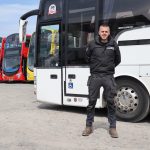





















The past few weeks have again shown the important of collaboration across the coach and bus industry, writes CPT President Kathryn Pulham
If there is one thing my first two months as Confederation of Passenger Transport (CPT) President have reinforced to me, it is this: the coach and bus industry is at its strongest when it works together.
That might sound very comfortable and amenable. But in practice, collaboration is not always the easy option. It takes time, trust, and a willingness to share ideas, challenges and, occasionally, uncomfortable truths. Yet when we get it right, the results speak for themselves.
Over the past few weeks, I have had the privilege of seeing that collaboration in action across the country. One of the clearest examples came with the launch of our new training module focused on tackling violence against women and girls. What made this initiative particularly powerful was the breadth of partnership behind it. Operators, government, and specialist organisations came together with a shared objective: to equip drivers with the confidence and practical tools to recognise, respond to and report incidents of harassment.
That kind of collaboration matters. No single organisation has all the answers on complex societal challenges like this. But, by pooling expertise and experience, we can create something far more impactful than any one of us could deliver alone. It is also a reminder that our role as an industry is not just to move people efficiently, but to ensure they feel safe while doing so.
A different, but equally valuable, form of collaboration has been on display through the conclusion of our joint “Experience Exchange” programme with DVSA. This initiative was built on a simple but powerful idea: spend time in each other’s shoes. Over six exchanges, senior figures from both CPT member organisations and DVSA shadowed one another in their day-to-day roles, from operational environments to enforcement activity.
What emerged was a deeper mutual understanding of the pressures, priorities and practical realities on both sides. For operators, it offered insight into how regulatory decisions are made and applied in practice. For DVSA, it provided a clearer view of the operational challenges faced by businesses on the ground.
That kind of shared perspective is invaluable. It helps move relationships beyond a purely regulatory dynamic and towards a more constructive, solutions-focused partnership. Ultimately, it leads to better outcomes for passengers, for operators, and for the wider transport system.
Alongside these more structured initiatives, I attended both the North and Midlands CPT dinners. These events are always highlights in the calendar, but this year they felt particularly significant.
They brought together operators of all sizes, suppliers, policymakers and partners from across the sector. Conversations ranged from the immediate challenges we face, such as cost pressures and operational resilience, through to longer-term opportunities around decarbonisation, skills and service improvement.
What struck me most was the openness of those discussions. There was a genuine willingness to share experiences, to learn from one another, and to explore how we can tackle common challenges collectively. In an industry as diverse as ours, that sense of shared purpose should never be taken for granted.
Of course, collaboration does not mean uniformity. Our sector includes a wide range of business models, operating environments and perspectives. That diversity is a strength. But it also makes it all the more important that we create the spaces and structures where those different voices can come together constructively.
Looking ahead, the need for collaboration will only grow. Whether it is delivering the transition to zero-emission vehicles, improving bus speeds and reliability, or continuing to enhance passenger safety, the challenges we face are too complex for any single organisation to solve in isolation.
The good news is that we have strong foundations to build on. The examples from the past month show what is possible when we work in partnership, with a shared focus on practical outcomes.
Our task now is to sustain that momentum, to continue sharing knowledge and best practice, and to remain open to new ways of working together, in order to deliver the future our passengers and our industry deserve.