

















Compliance technology has long been central to fleet management, and Road Tech, one of the sector’s stalwarts, used its 40th anniversary celebration on 18 June to make a forward-looking case.
Customers gathered at Shenley Hall, its Hertfordshire headquarters, for presentations and lunch combining company history with demonstrations of an expanding software suite. Centre stage was the supplier’s forthcoming Virtual Tachograph, a feature intended to close the blind spots created when drivers move between tacho-equipped vehicles and vans, minibuses or cars.

Partner to road transport
Less stress, fewer risks, and stronger compliance are themes at Road Tech, whose origins lay in an operational irritation.
Founder Derek Beevor, a former Army paratrooper and haulier, launched transport management system Roadrunner in 1984 after becoming frustrated by time spent on invoicing and admin at his company Tudor Transport.
Road Tech Computer Systems was incorporated two years later. Early operational credibility with Tudor’s customers helped the company establish what became an off-the-shelf transport management system, later reinforced by its win on a 1992 Ministry of Defence RAMS contract, establishing it among 460 users across the UK.
The anniversary presentation traced the subsequent expansion: the acquisition of Cablink in 2001; Tachomaster’s launch in 2006 ahead of the digital tachograph requirement; PreDrive in 2009; Roadrunner Live in 2012; Checkmaster in 2016; employee ownership in 2018; and the launch of DOT vehicle tracking in 2019. More recently, Road Tech achieved ISO 27001 certification in 2025 for its commitment to information security.
A revenue chart shown at the event put turnover at £20.1 million in 2026, from £9.7 million in 2016. Tachomaster has now analysed more than 350 million card, chart and vehicle unit downloads – a figure the team are particularly proud of.
In a competing world of technology, Director Adrian Barrett, who joined Road Tech in 1989, describes Road Tech’s formula for success as anticipation of things to come rather than attachment to a particular product.
“Being able to see into the future and change with the times” is the simple answer, he says. The five-product offer now comprises Tachomaster, DOT Tracking, Roadrunner, Checkmaster and PreDrive, with integration rather than individual point solutions increasingly at the centre of the proposition.
The day’s opening sessions paired history with a tribute to Derek, who died in 2019. Longtime industry friend Ian Jones was on hand to share his view: that the enduring value of the portfolio lay in Derek’s simple ambition to take complexity out of a regulated sector.
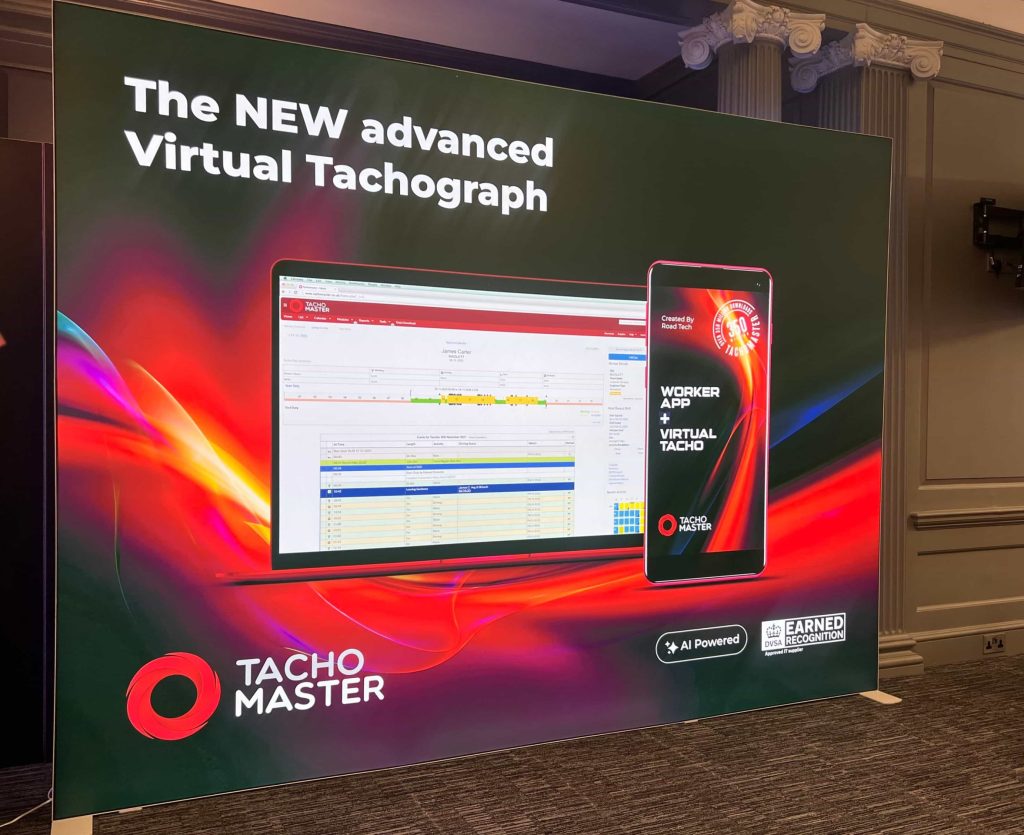
Virtual tachograph
Built into the Tachomaster Worker app and paired through Bluetooth with a DOT device, Virtual Tachograph is designed to show when a named driver starts work and moves a vehicle that may not carry a statutory tachograph. The activity then flows into Tachomaster alongside conventional data.
Road Tech says that this is intended to fill non-tacho gaps, unite light goods vehicle, PSV, van and minibus activity in one record, improve Working Time Directive calculations and give managers live visibility of smaller vehicles.
The product is not a new legal tachograph. Its introduction is in response to the Department for Transport’s Road Safety Strategy, published in January. The strategy does not mandate virtual tachographs or change existing drivers’ hours rules. But Adrian argues the policy direction makes a fuller record of work-related driving more pertinent.
Against that backdrop, a system that joins a driver’s tacho record to other working time, or captures a journey that would otherwise be separate, has appeal. Adrian’s phrase during the launch was that the eventual question would not simply be whether an operator had a tachograph, but whether it had “control”. The immediate benefit is a single, time-stamped record to support management scrutiny, training and audit preparation.
A PSV proposition?
Road Tech’s software suite covers a broad spectrum of regulated transport, but for coach and bus readers, Adrian is keen to challenge the impression that Road Tech is aimed principally at freight.
The wider suite maps readily to passenger-transport risk points. DOT tracking and geofencing support route oversight; Checkmaster verifies licences, CPC status and entitlement; PreDrive evidences completed walk-round checks and flags defects; and Tachomaster’s reporting, driver profiling and training modules help managers identify patterns before they become repeat infringements or incidents. The pitch is the ability to connect evidence that a coach or bus business already generates.
That connection is also Adrian’s answer to artificial intelligence (AI). At 40, Road Tech’s message is that fleet technology is moving beyond the collection of records towards the harder task of joining them up.
“AI is making a massive difference. We can’t ignore it,” he says, though warns that its outputs still depend on reliable information and should be fact-checked. The company’s roadmap includes AI-powered Tachomaster summaries and a central database, Orbit, intended to let its products communicate “in a more imaginative way”.
Adrian also believes the sector still leaves value on the table by treating data as a proprietary island. “Could the industry be more collaborative? I think that is probably more the point,” he notes. Better sharing requires safeguards on customer ownership and data protection, but would in the long term make information from fleet, compliance, maintenance and operations more useful. “Integration,” says Adrian, “is key.”
The Road Safety Strategy
Calling road deaths and serious injuries preventable, the Road Safety Strategy sets a target to cut those killed or seriously injured by 65% by 2035 against a 2022-24 baseline, and puts technology, data and innovation among its four delivery themes.
It also commits government to pilot a two-year national work-related road safety charter for businesses that require people to drive or ride for them.
The strategy estimates that roughly one in three UK road fatalities involves someone driving or riding for work. It expects employers and engagers to make those journeys as safe as possible and says ‘regulatory measures’ will be considered if voluntary engagement is ‘insufficient’.
Connected vehicle data is touted as a route to more predictive safety interventions, and better planning.