




















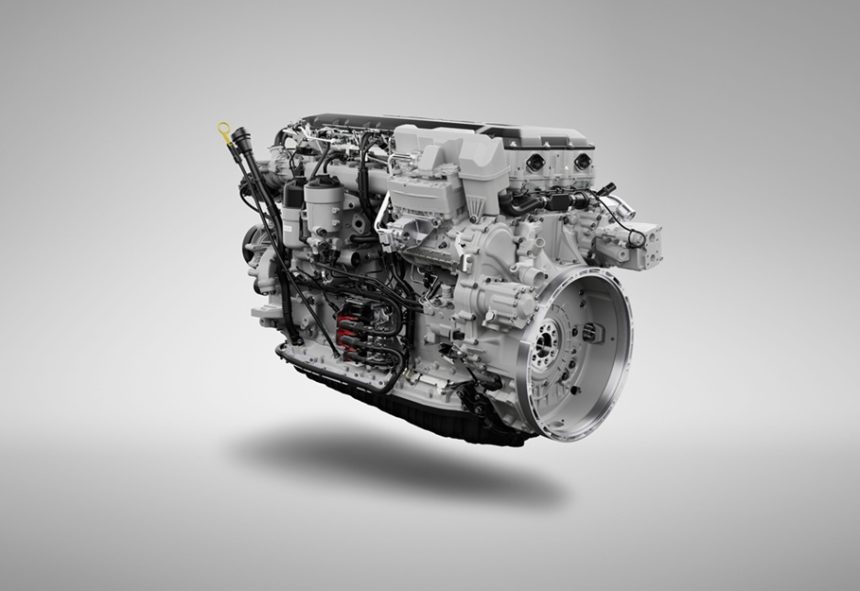
The Scania Super powertrain that is built around a 13-litre engine has come to the coach and long-distance bus segment and includes an optional plug-in hybrid module to give a zero-emission range of up to 80km, the manufacturer has revealed.
Available in trucks for some time, the Super platform delivers what Scania claims is an up to 8% reduction in fuel consumption over the current-generation DC-13 engine when coupled to a new version of the Opticruise automated manual gearbox.
The new engine is designed for a service life of two million km, which is “a massive increase” from its predecessor. Total cost of operation and CO2 emissions are significantly cut, Scania adds.
In addition, the Super powertrain is prepared for Euro 7 emissions legislation and has a new exhaust aftertreatment system to further reduce emissions. Its auxiliary braking capacity is additionally highlighted by the builder.
“Uptime is also boosted because all engine filters are positioned on the ‘cold’, non-turbo side of the engine, which allows for better service access and faster filter replacement,” Scania continues.
In standard configuration the engine within the Super platform will be available at 420, 460 and 500bhp, with the lower of those two ratings also compatible with the plug-in hybrid option.
The manufacturer notes that for long-distance applications, internal combustion remains “the most suitable, or even the only, feasible choice” and that the Scania Super powertrain caters to that reality with “the very latest in combustion technology.”
The plug-in hybrid option is described as a versatile solution that is primarily designed to meet the demands of long-distance operations to allow zero-emission zone compliance and give a reduction in fuel consumption and emissions.
With an integrated 290kW electric machine and a six-speed powershift gearbox, it can run in four modes: electric, hybrid, charge sustain, or forced charging. Its electric range is up to 80km on a single charge, with no compromise on total vehicle range, Scania notes.
To facilitate the transition to and from electric mode, operators may use the Scania Zone automated geofencing technology. That will see an automatic switch to electric power when mandated from “the still very efficient hybrid mode normally used in other types of traffic.”
Selection of the hybrid option gives a claimed fuel and emission saving of up to 40% in what the manufacturer says is typical mixed coach traffic while also futureproofing vehicles and their owners’ businesses against zero-emission zones.
A chassis diagram published in Scania literature on the Super powertrain in coach and bus shows the battery placement for the hybrid driveline to be in the underfloor area.
Speaking about the developments, Scania Head of Product Management for People Transport Solutions Carl-Johan Lööf says: “Our new combustion and plug-in hybrid powertrains are shining examples of Scania’s twin commitment to sustainability and profitability for coach and bus customers.
“With these new powertrains, we will be able to provide long-distance coach and bus operators with incredibly competitive solutions, regardless of their specific needs or which particular challenges they face, meeting both their current and future business needs.”
A Scania spokesperson has confirmed that the Super development for coach and bus has no impact on other powertrains in its portfolio, including the nine-litre DC-09 unit.