
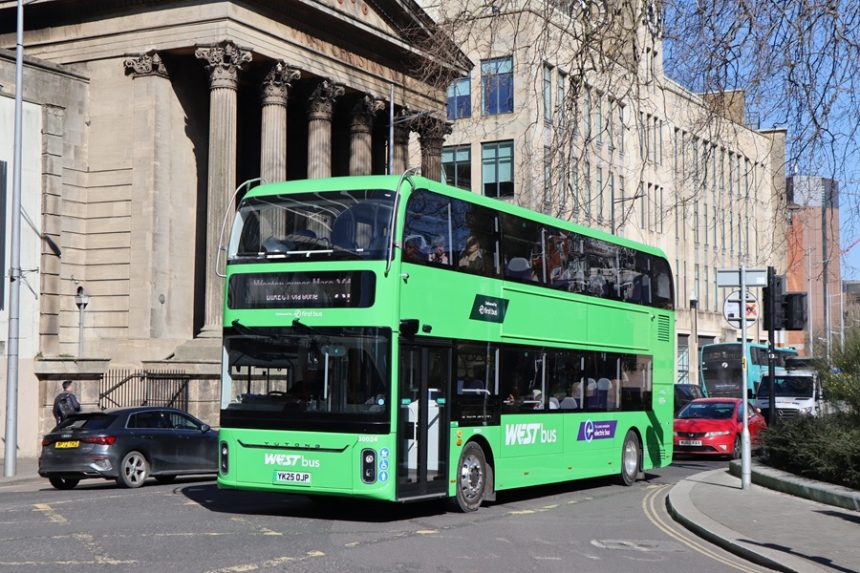
The Bus Services Act in England, which passed into law last month, represents another significant step towards aligning public transport with the UK’s wider decarbonisation ambitions.
While much of the focus is on franchising and local authority powers (with further announcements on local authority funding to come), the Act places a strong emphasis on reducing carbon emissions and accelerating the transition to zero-emission fleets.
It comes into force at a positive time for the bus industry, with passenger numbers on the rise. That should help to give operators the confidence to invest in fleet renewal.
Up to the end of Q2 2025, Society of Motor Manufacturers and Traders figures showed that there were nine consecutive quarters of growth, delivering a significant uplift in registrations of new single- and double-decks and, significantly, impressive uptake of zero-emission models, which comprised one-fifth of all new registrations.
The Bus Services Act includes a requirement that new buses (or bus services) must be zero-emission from “not earlier than 2030.” Decarbonising buses is important, though they contribute a modest share of total transport emissions.
They are relatively easy to decarbonise compared to other vehicles, having fixed routes and, often, the opportunity of depot charging.
As the Transport Committee has commented, increasing bus use is also a vital part of transport emissions reduction since moving people out of cars is one of the more effective levers. (Disappointing, then, that early proposals to pilot free bus travel for under-22s in England are not happening; that could have helped to embed good travel habits early).
While “not earlier than 2030” does provide a clear trajectory, it lacks a hard, clear deadline; it gives operators flexibility but reduces certainty and a sense of urgency.
For local authorities, the Act represents both an opportunity and a responsibility. Enhanced powers over routes and operations come with a mandate to deliver sustainable, low-carbon mobility and promote modal shift.
I have sympathy with the Transport Committee, which earlier said that the government should as soon as practicable reform BSOG to, among other objectives, better align with overarching decarbonisation aims.
The goal of that reform, it says, should be to incentivise growth in ridership, particularly across under-served areas (for example, the grant could be based on passenger journeys).
The Committee also comments that the government must support authorities to grow their bus networks, not merely manage decline. It calls on the Department for Transport to ensure that there is funding to support the provision of socially necessary services.
The Bus Services Act does help to provide a message consistent with the UK’s industrial strategy, which identifies the net-zero transition as the key building block of the country’s industrial future. The Act supports UK manufacturing of zero-emission buses and associated infrastructure, aligning climate goals with future jobs as well as clean growth.
However, the challenge ahead is substantial. Rapid progress is needed in vehicle deployment, supporting infrastructure and grid capacity to ensure that the end of sale deadline for new non-zero-emission buses is achievable in practice.
As the Transport Committee said, the Bus Services Act is a positive and necessary start to the process of revising (and decarbonising) bus services in England, but it cannot be the last word.