



















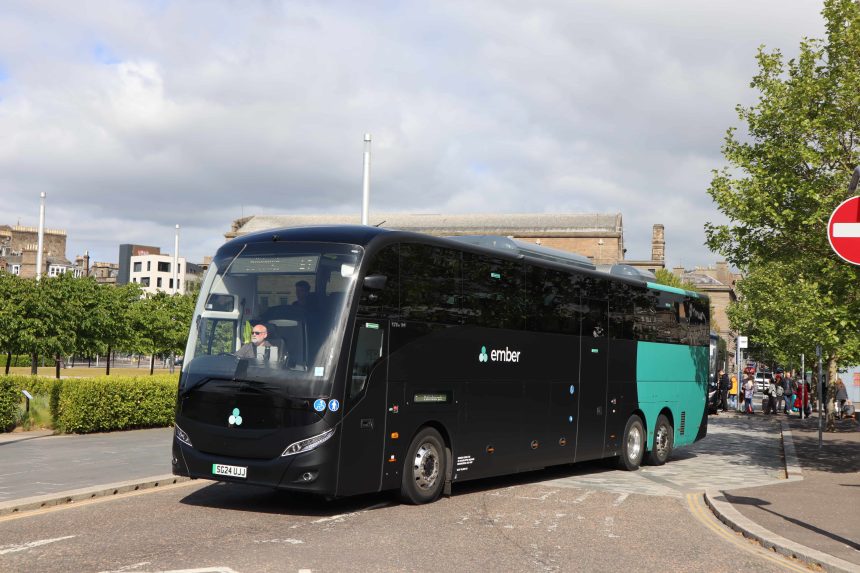
On 24 September, electric intercity coach operator Ember expanded its business beyond scheduled services with the launch of Ember Coach Hire, a new zero-emission private hire offer built off the back of its existing network.
Ember says its entry into coach hire is designed to bring simplicity, transparency and sustainability to that market — all with the added advantage of emitting no harmful tailpipe emissions. The service operates through Ember’s proprietary tech platform, Ember OS, which manages everything from driver allocation to live tracking.
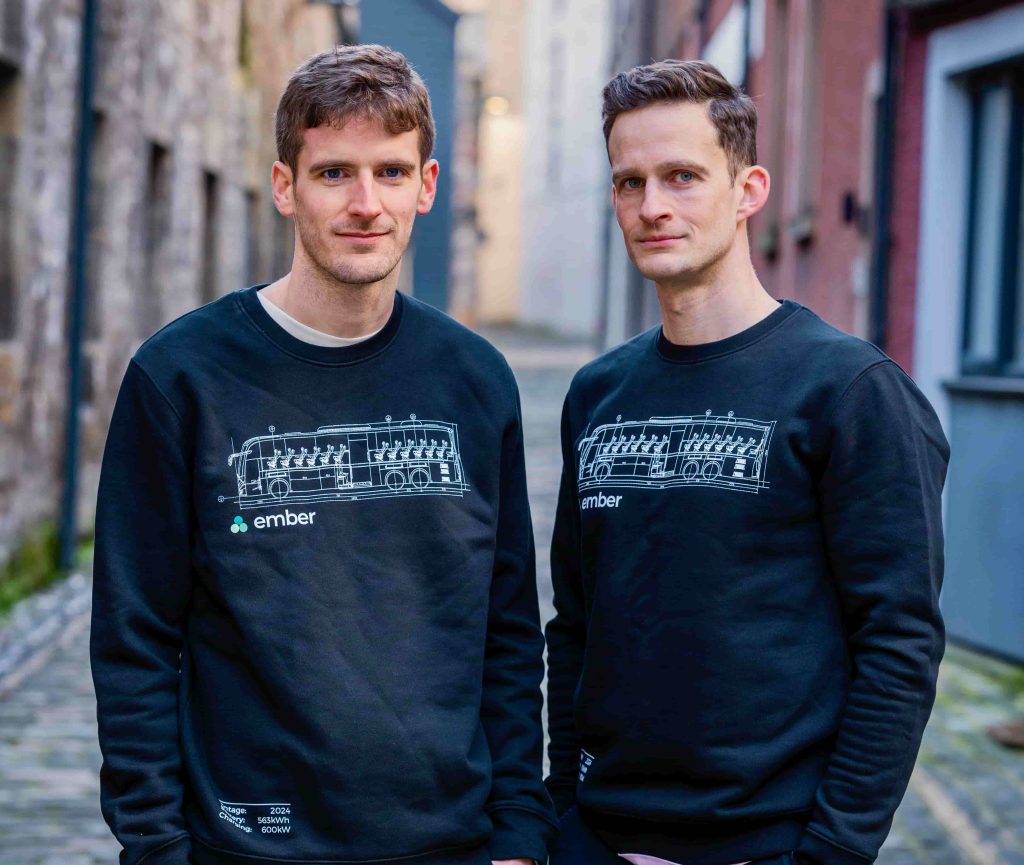
Not something that has come out of the blue, the company says it always had ambitions to run a private hire zero-emission coach product, even before launching Ember scheduled services. But co-founders Keith Bradbury and Pierce Glennie kept quiet until the plan could be actioned.
“It would seem somewhat crazy to shout about it when we had only two coaches on a single route in Scotland!” Keith says. “So, we focused on the short- to medium-term. We told ourselves we would get [Ember scheduled services] working well, and in a way, private hire is similar to that. It was in the back of our minds early on, but we couldn’t make steps towards it until we reached a certain scale. 2025 was when we reached that scale.”

Ember’s expanding network
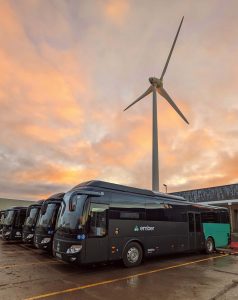
Ember coach hire is being facilitated by the company’s ever-growing network of charging hubs, and the expanding fleet they support.
At time of writing, Ember has 78 vehicles in its fully zero-emission fleet, with more on order. The first batch of the remainder of its ScotZEB2-funded vehicles, due to go into production this year, will take the fleet to 138 in Scotland by the end of Q1 2026.
From its original hub in Dundee, it now has sites at Fort William, Thurso, and Inverness, which with 3.5MWh of battery capacity on site now has what Keith believes is the largest battery storage facility of any coach or bus operator in the UK. Sites at Oban and Perth are both being energised, and more hubs are under construction in Livingstone and Glasgow. Progress is already underway on Ember’s ambition to expand its scheduled service model into England, with private hire expected to follow, albeit with the limitations that fewer charging hubs would bring.
“We now have charging hubs effectively across Scotland, and more vehicles,” explains Keith. “More vehicles means more vehicles allocated to spare capacity. It felt like a good time to launch Ember Coach Hire version 1.0, to test our thinking and put a product into the market. And it is very much a version 1.0 — there is cool stuff, such as live tracking, but this is by no means a final version.”
The project is being overseen by Founder’s Associate Elianna Payne (pictured), a University of Cambridge graduate and former corporate analyst at JP Morgan. Elianna has worked on the project since she joined earlier in the year, and says Ember’s first principles approach is what attracted her to the business. “I think that’s really exciting; a lot of people do want to take things back to basics and I wanted to work in that environment,” she says. “Keith and Pierce are really inspiring as leaders. The aim of Ember is to provide a great coach service. That’s something I’d love as a customer, and I love being part of a team delivering it.”
Mass market approach
Ember says it did not look for any niche with Ember Coach Hire, but rather targeted a mass market solution. In the same way it talks about its scheduled services “for everyone”, it wants to build a coach hire service anyone of any background can use and get value from — something Keith is conscious of at a time when zero-emission coach products can attract a premium image for some operators. Ember still firmly believes in promoting the cost savings associated with electric vehicles; that it remains a logical, affordable alternative to diesel.
“We have always said it’s cheaper to operate electric on scheduled services, on intercity services, because the cost of fuel is effectively lower. And it’s similar in coach hire, in that we priced at the level that we think will be at parity — or even less — than diesel.”
 Ember Coach Hire therefore targets a mix of work — short duration or one-off type events such as weddings, single day corporate events and school trips, and longer term corporate work, such as shuttles intended to move staff. Right now, Ember’s team still responds individually to inbound enquiries, meaning its proposition caters better to the former, but its technology has been built to support the latter for larger contract wins.
“We are trying to get people out of cars and we want to build a service everybody can use and get value from,” Keith says. “Edinburgh has a lot of private schools, for example. Rather than going out with a tailored solution for private schools that are willing to pay extra for a zero-emission school service, we took this to the mass market and built a proposition we think everyone can use.”
That explains Ember’s pricing model — a straightforward, simple structure that makes hourly rates transparent for quick cost calculations. The upfront pricing starts with a £300 fixed fee, plus £60 per driving hour and £20 per waiting hour. “So far, that’s been working well for us in terms of where our pricing has been coming in,” Keith adds. “I think in some ways there’s a bit of stigma on a coach hire, some people expect a second or third life of a coach. When a coach turns up and is a new or nearly new high-specification electric coach, people are impressed. That’s when our customers start to feel good value for money when booking with us.”
Another conscious decision has been to avoid referring to Ember Coach Hire as “private” hire. “We decided that was too much like industry lingo,” Keith explains. “We don’t think people looking to hire a coach would call it private hire. All our language fits a mass market perception.”
Hands-off experience
Customers can currently request bookings through Ember’s website, but a fully automated instant booking system is in development. That may seem unusual in a sector where, traditionally, a great deal of operator-customer dialogue takes place. But Ember’s philosophy is to smooth out that journey through making a simplified, easy-to-use platform. “Where people do want to have some extra assistance, we are happy to provide that to them,” Keith explains. “But we have a strong belief in a good product and what that means. To us, a good product is easy to use. Where people do need additional hand holding, we ask what it is that the person is not sure about — and we design for that.
“We had this in the early days of Ember: people told us that concessionary pass holders would not want to use our website. Turns out, they are more than happy to use it, because it is super simple and easy to use. We have tens of thousands of concessions that book with us every week online. It’s no problem. We were focused on making the ticket booking process really simple.”
When asked what coach hire done right looks like in 2025, Elianna says it all comes down to that ease of booking; also considered is ease of payment; the removal of the expectation for a customer to chase details of the journey; confidence from the customer that the coach will turn up; that the coach will be comfortable and an excellent experience; and that the process will be slick and simple.
Much of the experience comes down to clear communication. Drivers’ names, tracking links, and contact details for the hire in advance are sent to customers. “Getting the booking process and the passenger journey right are important to us,” says Elianna. “Having a tracking link is helpful from a customer perspective. If their event finishes early for whatever reason, they can see where their coach is — this is all better for planning.”
Ember’s philosophy is informed by developments in parallel sectors. It is not the first time Ember notes the ease of use of companies like Uber or Airbnb. “If I think about other experiences people have on an annual basis — if you want to book somewhere to stay — you have easy filters, the discovery process is slick and easy to use,” Keith notes. “You can find the thing you want, book it, and get notifications prior to check-in. Then you have the stay, and a slick process at the end for feedback and the wrap-up. To me, there’s no magic or rocket science to that process. That applies completely to coach hire.
“There will be somebody right now, in the UK, looking for coach hire, and my expectation is to deliver them a service — they should be able to see a booking calendar, they would be able to plot in the trip they want to do, and it would say how long and how much it would cost. They would pay a deposit then and there, and continue with that transaction as effortlessly as an Airbnb. If they want support, they should be able to have that. Equally, they should be able to have as hands-off an experience as possible, and know that their coach will turn up on time at the location they requested, know who the driver is, and see all of that on a booking portal.
“To be clear — we don’t have all of that today. We have the foundation for it on our internal systems. We just need to build the front end for it for coach hire, and that’s what we are moving towards, and what we want to do.
“The reason we launched with our current proposition is that we don’t feel like we need to wait. We can take bookings right now with a slightly more manual process, but we’ve had loads of people book with us already and we’re getting feedback and delivering a service people are enjoying using.”
A dedicated landing page for Ember Coach Hire will be built out as time goes by to support the instant booking process described, but for now, that page holds information with an email address for customers to contact, which Ember will respond to within 24 hours.
An extra benefit to a good product
Is the zero-emission angle itself a selling point for Ember Coach Hire, and does Ember’s entry into private hire demonstrate that the coach sector is ready for zero-emission private hire in a broader sense?
“We can acknowledge that different customers have different priorities when they’re booking,” Elianna says. “Some of them want reliability, some care about ticket price, some do like the sustainability angle. I would not say the latter is the primary reason people book with us. I think it’s because we have a good, all-round product. Some tour operators are interested in the zero-emission angle for selling their tours.”
That makes Ember Coach Hire similar to its core business, where customers enjoy zero-emission as a benefit to a good overall product. Whether other operators could replicate Ember’s model is less certain — Keith notes that Ember’s approach is not necessarily something the wider coach industry can easily adopt. While the company has built its zero-emission coach hire network on a price parity with diesel, a caveat is that Ember is noteworthy for establishing an electric-first business, optimised a stack of vehicles, its own technology, and its use.
“It can be much more expensive to run an electric vehicle if you don’t do all of that,” Keith points out. “I view it like Tesla building its supercharger network.
“Tesla went hard early on building charging capacity in different places to support sales of the cars. Car owners were not confident in buying electric vehicles with nowhere to charge. Tesla solved that itself, and now has the biggest network of chargers, and had it earlier than everybody else.
“In a way, we’ve built our own charging network in Scotland. It’s still small — but we do have a network across Scotland which can support basically any coach hire trip now. In a way it does demonstrate that it’s possible, but it also requires you to have faith that it is possible from the beginning, and build for that. You can’t wait and see. The technology is already there, but you need to build it and put it in to demonstrate the viability.
“Having said that, there is still little incentive for people to change. Even with our launch of Ember Coach Hire, and even with our ambition to scale, I don’t necessarily think this will spur others on to do the same. This is possible from a first principles perspective — but you need to leave behind what you know, and go on a journey of discovery to understand what is possible.”