Including coach services prominently within the Integrated National Transport Strategy (INTS) for England has been advocated by several parties, including Local Transport Minister Simon Lightwood, although how that feeds into the final document remains to be seen.
General consensus is that with a bit of help, coaches can play a bigger part in the transport landscape. Lessons can be taken from Scotland in that respect, where the scheduled coach network is arguably more extensive when considered against population density. Northern Ireland also offers learnings, as does early work in Wales.
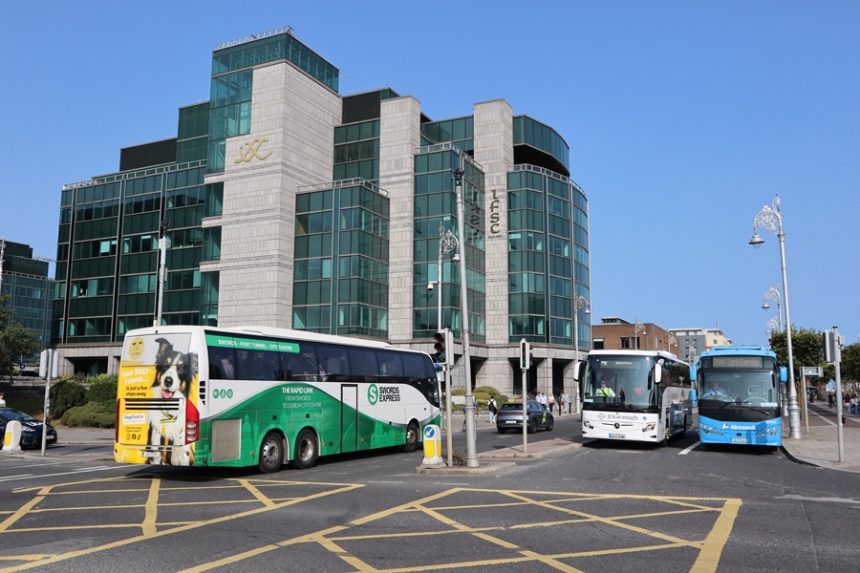
So does the Republic of Ireland. Any visitor to Dublin will notice the depth of coach activity there, particularly in the summer. Coaches are everywhere, and they are highly noticeable thanks to some strong marketing machines and a highly competitive market.
Coach in Ireland is no doubt assisted by modest railway coverage and the lack of a rail link to Dublin airport, and the general lack of the congestion that is seen too often in the UK, but the impression is clear: The mode is doing big business across tourism, private hire, and scheduled service fields.
A competitive market to Dublin airport sustains multiple operators and some high frequencies, but the ‘bus full’ sign is still not an unusual flag on those services.
The amount of new and nearly new metal working hard is impressive, and at least one more local commuter service looks to leverage later-life coaches and occupy them on work that is built around peak hour utilisation.
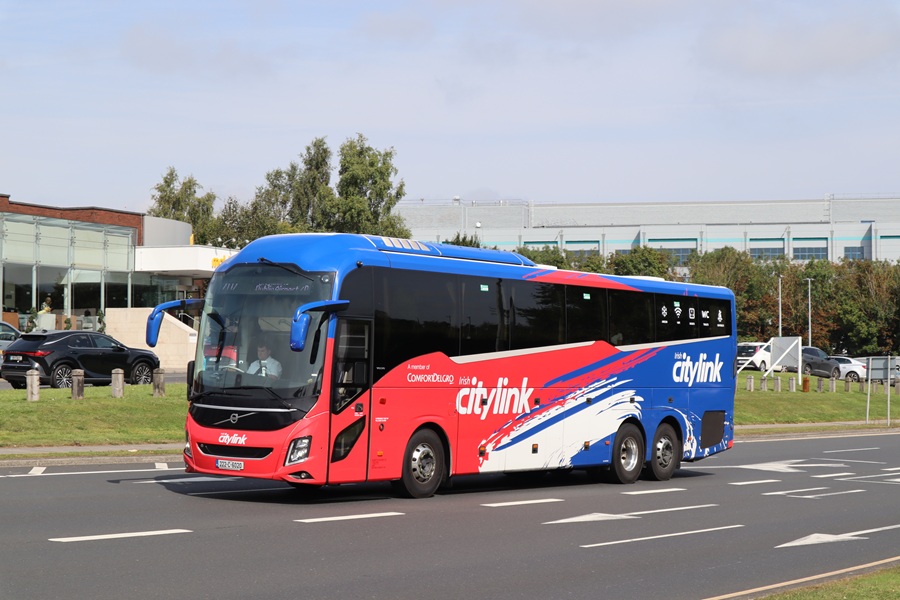
Any idea of coaches competing on the kind of frequencies seen in Ireland between UK city pairings such as London and Manchester, Birmingham or Bristol may sound fanciful given the rail provision on those axes, but the scope for coach here is already shown on connections to airports such as Luton and Stansted and the Edinburgh to Glasgow link.
Appetite from the government to foster development of coach services in England that compete with what is an ever more state-controlled rail network is unclear. Sinking or swimming with those will be left to the private sector.
Filling rail gaps between cities and larger towns might not be helped by bus franchising and the likely need for service permits, but the Falcon service operated by Stagecoach between Plymouth and Bristol and the scheduled coach market in Scotland both show how business is there to be done in the right conditions, preexisting rail link or not.
What is clear in Ireland is how a competitive market has driven innovation and growth in the coach industry. That applies to state-owned Bus Éireann on its long-distance routes as well as private sector operators. If coach is to deliver its promise via the INTS for England, scope to do similar must be prominent.