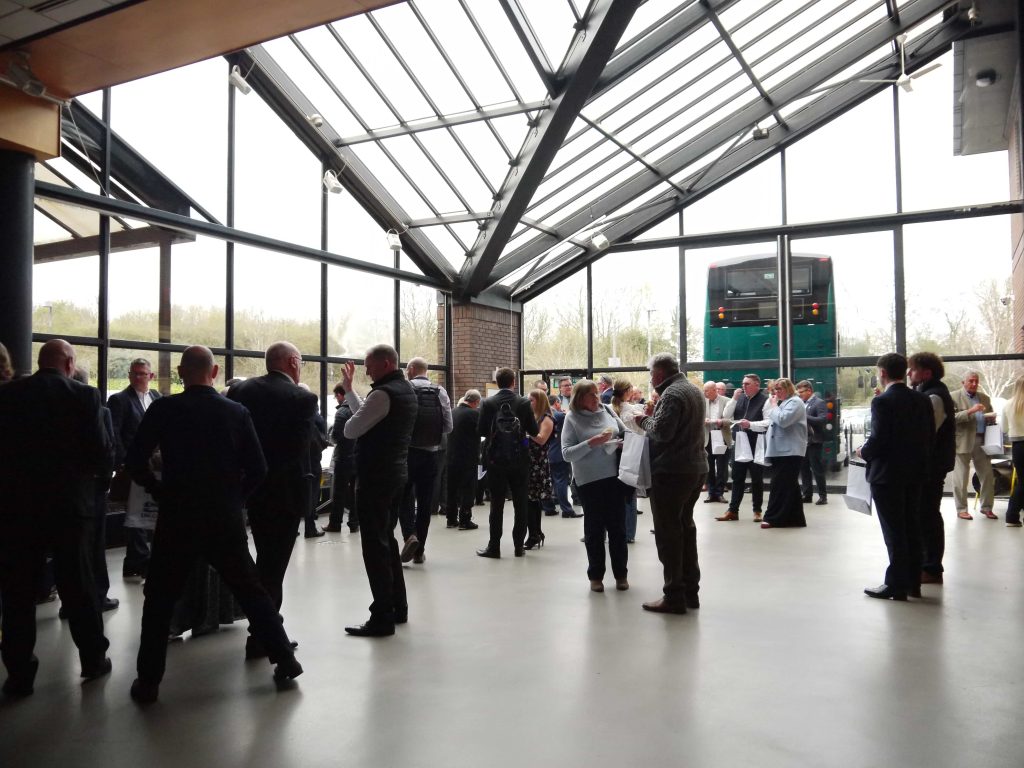




















Presentations at this year’s UK Coach Operators Association (UKCOA) annual conference comprised a diverse lineup from faces both fresh and familiar at an event that drew a record number of guests and speakers. A range of issues were explored, with prescient warnings about changes soon to affect the coach sector.
Compliance was arguably the day’s headline theme and a new approach this year explored the topic via a mock Public Inquiry (PI), performed by guest speaker Senior Traffic Commissioner (TC) Kevin Rooney, alongside James and William Backhouse representing legal counsel and operator, respectively.
The next bridge strike issue?
The mock PI was based on a true story in which a passenger had booked a coach online through a third-party booking provider and required a wheelchair space. When the vehicle arrived, the driver was not aware of the booking and was uncooperative. The passenger was unable to board the coach and was denied access.
TC Rooney noted that the Office of the Traffic Commissioner is seeing more of these issues around PSVAR.
It was learned that onward travel was arranged for the passenger via an alternate operator. Compensation was offered, and the driver underwent a disciplinary procedure.
Two key points were raised from this case: a lack of awareness around the rights of disabled travellers, and a lack of training among the company’s drivers.
In particular, the role of the driver was highlighted in this case. Questions were asked about their personal circumstances. The operator was also asked what processes were in place in terms of driver wellbeing, to enquire whether the company had safeguards in place. It was also confirmed that this approach was documented in a policy. Crucial was to ensure there was no financial disincentive to a driver telling their employer if they are in distress.
The error on the operator’s part had been to rely on advance notice that a passenger required a wheelchair space. Senior TC Rooney noted that there is no obligation from wheelchair users to notify a third party of that need. There had also been little training on Article 16 of Regulation (EU) No 181/2011, in which “carriers… shall establish disability-related training procedures” including instructions and ensuring that drivers and personnel are trained.
Describing this as a common issue, Senior TC Rooney noted that many times, “drivers understand how equipment works but use it so infrequently in practice that they panic. You have to make drivers regularly use it.”
James Backhouse said he expects PSVAR training to become a much more common feature of PIs. Senior TC Rooney even anticipates it may become “the next bridge strike issue,” hence the emphasis on driver welfare. “We’re putting a lot of effort now into driver wellbeing,” he says. “More generally, RHA has produced its Guide to Maintaining Driver Health. It’s a good document and has come as a result of the efforts and mock PIs we have been doing around this work. It’s really key.”
Presentation on PSVAIR
Generating the most discussion of the day was the topic of the PSV Accessible Information Regulations (PSVAIR), following a presentation from Paul O’Bentley, representing lobby organisation the Rail Delivery Group (RDG).
Re-engagement by RDG comes ahead of the end of the technical exemption for AIR in July. In that presentation Paul noted that 85% of rail replacement work is currently in scope and clarified where the rules apply. Four mobile solutions that meet the legislative requirements were teased, and the full competition results from the Innovation UK contest should break cover this month.
RDG did note how it has calculated that approximately 1% of coaches in the market are currently compliant with PSVAIR requirements but would not be drawn on what it believes is an adequate compliance figure. Rural compliance was cited as a particular challenge.
More key issues
Cyber liability is becoming a hot topic for coach operators according to Callum Cooke, Cyber and Technology Practice, Midlands Lead at Gallagher. The insurance broker offered delegates an overview of cyber risk and how insurance fits into that, noting that government involvement has followed several high-profile attacks on businesses.
Claim costs are reducing but trends reveal an increase in frequency. Callum says now is the best time to take out cyber insurance, as prices are “still low.” He adds that it is also likely that local authorities will be looking at cyber insurance as a tender requirement in the coming years.
Rob Munday visited as guest speaker from the National Counter Terrorism Security Office (NaCTSO) branch of the Metropolitan Police, to discuss how coaches can safeguard against terrorism. The plan is to build consistency across what venues and transport providers do, and to ensure they have resource available to keep areas of impact safe. NaCTSO is working with the Department for Transport to develop a toolkit for road transport users and drivers are encouraged to take part. With the introduction of Martyn’s Law, or the Terrorism
(Protection of Premises) Act 2025, venues now have obligations to reduce the risk of attacks, and there will be procedures drivers need to be aware of.
UKCOA Director of Operations Stephen Spendley concluded by noting that UKCOA continues to grow its voice among ministers and government, but also highlighted many of the ongoing challenges for the coach sector. They include recruitment and retention and the need to promote coach driving as a professional career to young talent (with optimism around the removal of the 50km restriction on young drivers) and the need for clearer coordination on how decarbonisation will apply to coaches. He further called for implementation timelines and technical requirements for PSVAIR to “reflect how the coach sector actually works”.
Lobbying efforts continue with the Port of Dover and government to ensure challenges for coaches are understood as the EU Entry/Exit System develops, and UKCOA is now engaging nationally with regions exploring tourism taxes to see as much reinvestment into coach infrastructure as possible. Real world insight from operators is encouraged to help make the case for coaches before decisions are finalised.