


















Scope 3 emissions comprise all indirect greenhouse gas (GHG) across a company’s value chain not directly produced by the company itself or by its purchased energy. They include emissions associated with suppliers, transportation, product use and disposal, and business travel.
According to the Science Based Targets initiative (SBTi), Scope 3 makes up the majority of emissions for most companies, commonly accounting for 70% or more of total emissions and sometimes over 90% in high footprint sectors.
Government and reporting frameworks increasingly acknowledge Scope 3’s role in emissions reporting. Last year, following a call for evidence, the Department for Energy Security and Net Zero published its analysis report on Scope 3 Emissions, citing complex data requirements associated with emissions reporting, challenges in relation to data access, consistency and quality, data estimation, and expertise.
But respondents to the survey agreed that the value of Scope 3 emissions is “crucial for investors to assess climate-related risks and opportunities”.
Scope 3 data also helps companies better understand their supply chain and deliver improvements.
And yet, such emissions remain less visible in general media than direct emissions. In some survey data, only 15% of companies currently disclose Scope 3. A reliance on estimates and the limits of individual corporate action make disclosure narratively harder than purchasing new vehicles, or switching to renewable energy.
One organisation leaning into supplier expectations on Scope 3 emissions is Volvo Buses. The business started its base for sustainability training around five years ago and now has a summit alongside a yearly programme to engage its supply partners, with a focus on cascading requirements from its climate strategy. This year has seen a specific focus on Scope 3.1 emissions, decarbonisation within the supply chain.
“The beginning of the focus from our team on decarbonisation started three years ago, when we set a target to our supply chain,” says Hadja Seydi, Global Sustainability Manager at Volvo Buses. “Each year we always had in those summits a focus on the climate pillar, but this year was fully focused on decarbonisation.”
Kitty Muffolini, Senior Vice President of Global Bus Purchasing at Volvo Buses, says the company is now in “action mode” when it comes to supply partner carbon reduction. “We want to hit our targets,” she says.
Cascading requirements
Despite the challenges of reporting Scope 3 and 3.1, doing so is a “competitive edge” for Volvo Buses — and the company says sourcing in a responsible way and taking the measure to implement sustainability through the value chain is an exciting area of development.
Volvo Group is vocal about the role of sustainability in material selection, product design, circularity, human rights, and the choice of supply partners, and its roughly 50,000 supply partners are expected to take the same responsibilities as those promoted within the Group. To achieve this, they follow the Volvo Group supply partner code of conduct. Volvo Buses actively works with them to understand its value chain backwards.
In addition to its summits, supply partners meet with Volvo Buses through regular business meetings and business review meetings. As part of these gatherings, partners are required to provide roadmaps demonstrating how they will decarbonise their value chains. Engagement has been good, with many such roadmaps achieved. That has “increased the velocity” of Volvo Buses’ broader net zero ambitions.
“By having supply partners present their plans, it made it real,” says Marina Chin, Director, Sustainability and Business Development at Volvo Buses. “We are seeing concrete examples of supply partners in action. It has created a peer pressure and given incentive for other supply partners to show us that they too are on this journey. This has been exciting to see.”
Toolkits and assistance
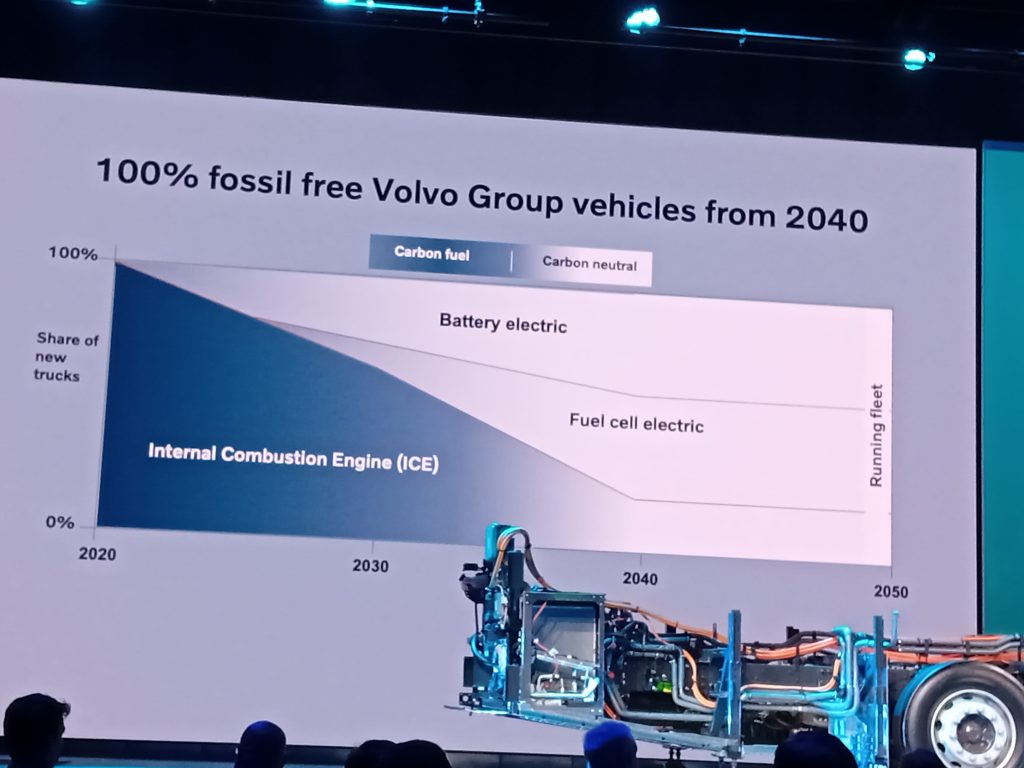
Volvo Buses is keen to show that suppliers have a hand to hold throughout the journey. The company has mapped over 100 potential CO2 reduction levers which have been grouped into seven families: material and process efficiency, renewable heat, fuel switch, circularity and recycling, renewable power, new process, and carbon capture. Volvo Buses says supply partners can already apply these levers at their own operations with low-hanging fruit being efficiency and renewable power.
“We have suppliers at different stages and levels of maturity on the decarbonisation journey,” explains Marina. “Some are very advanced, some we need to support and guide. The message we want to share is that yes, we want all our supply partners with us — this is our expectation. But we don’t expect them to do it alone. We want to do this in good collaboration. This is why we share different tools and resources. This is something nobody has really done before. What’s great about Volvo Buses is we have this collaborative, partnership mindset and we’re there on the journey together.”
The supplier portal includes a decarbonisation toolbox that supports partners to accelerate their decarbonisation journey. There is information such as scopes definition, electromobility strategy, targets and supply partners’ decarbonisation processes. Volvo Buses encourages its partners to review this content. It also requires suppliers to share data such as product carbon footprint, allowing Volvo Buses to track progress towards its goals. In the same toolbox are guidelines on carbon footprint calculation, and best practices.
This culture of collaboration is making innovation scalable, and allows for creative solutions — for example, in Volvo Buses’ subsidiary company Prevost’s Canadian plant, soil dug up from construction was given back to farmers. Those gestures add up to a complete whole. “The path to net zero isn’t about doing everything at once, it’s about continuous improvement,” Hadja says. “Every action matters. When we combine ambition, collaboration and innovation, we can achieve more together than we ever could alone.”
It is also easing the complexity of the process, according to Kitty. “This is something that in order for us to be successful we need to have all our supplier partners along,” she says. “We need to make sure we are engaging the whole value chain and that everyone understands the benefit of doing so… that will let us chop down the elephant into smaller pieces.”
Bringing buyers along
Volvo Buses is firm in its belief that efforts to decarbonise within its business and supply chain translate into profitability, and as the end users of its products — such as public transport operators (PTOs) and authorities — come to scrutinise value chains more closely, it will give the business an extra edge.
“Only a few years ago, questions we got from our customers were immature from a knowledge perspective,” Kitty says. “It is a big, complex thing, and we are learning every day. But our customers have advanced a lot and they too see the benefits when it comes to sustainability. Many PTOs hire sustainability managers within their organisation.
“When we meet with our customers, there are a lot of questions in the specification where we need to answer with what we are doing, how we are doing [it], and we have to prove what we are doing. What we hear from customers is that Volvo Buses can, indeed, prove what it is doing. This is what we have implemented and is one of our strengths.
“The other strength is our close collaboration with supply partners. As we have implemented this sustainability strategy within Volvo Buses, not simply purchasing or engineering, but through the entire value chain when we design and develop parts, components and systems, we have to take into consideration that we want to do it together with our partners.
“They have knowledge and expertise, and that is an obvious benefit when we talk with our customers — we show them how we work, and how we want to collaborate.”