




















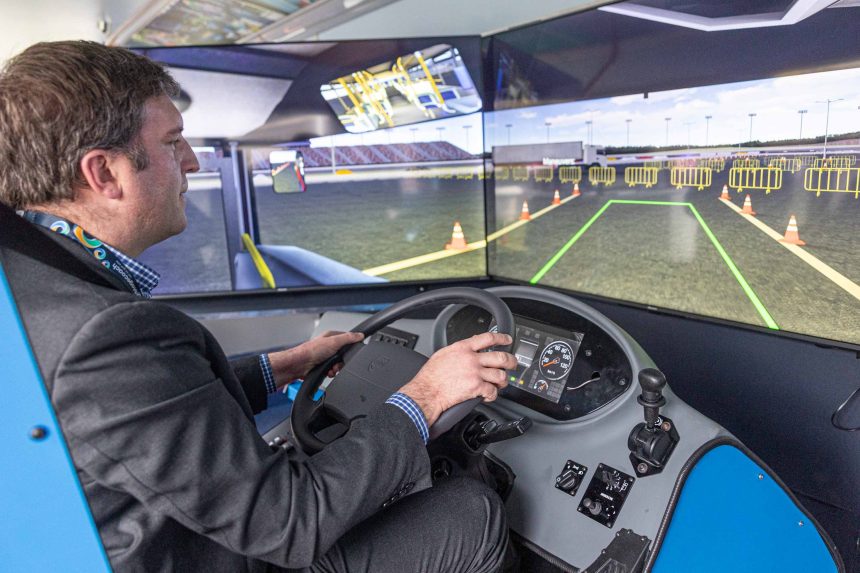
In November, Stagecoach announced the introduction of two full-size bus driving simulators to a pair of of its depots — Taff’s Well, in South Wales, and Kilmarnock, West Scotland.
Both of the machines are serving under a pilot scheme that aims to understand to what extent such simulators can be rolled out more widely across the Stagecoach business, and how they can improve training.
routeone was invited to visit Taff’s Well depot, near Cardiff, to discuss how the simulators fit into the business’ training regime and the role they have to play — both in supplementing driver training at the early stage, and as a tool for continuous development.
A portable product by Simfor
Bus driving simulators are not a new concept in the sector, but Stagecoach’s new models — supplied by Madrid-based manufacturer Simfor — are of a unique type in that they are fully portable, having been transversely mounted inside two of the operator’s single-deck buses. That means they can be driven to different sites within the Stagecoach operating companies using them.
Each simulator represents an investment of over £70,000. Inside is a hydraulically actuated driver’s cab that gives the impression of realistic vehicle physics (braking suddenly will see the entire cab setup lurch forward, for example), enclosed on three sides by moveable screens that act as the view out onto the road ahead and into the mirrors.
Nearby, a training instructor is given a three-dimensional view of the vehicle with their own screens, where they can watch the vehicle’s position in the road, how drivers turn the wheel, and capture data on speed and collisions.
The simulator already features bespoke customisations catered to Stagecoach’s requirements. Correspondence between the operator and Simfor during a feedback gathering phase has seen the addition of accurate road signs and markings, the Stagecoach livery, and double-deck models for low bridge scenarios. The programme can be updated over-the-air remotely, and the plan is to add more scenarios, such a reversing manoeuvre and more mapping capability, in the coming weeks.
Flexible use forms part of appeal
routeone undertook a series of scenarios given to new driver candidates: a cornering test using traffic cones; two straight-line braking tests, one at 35mph, then at 30mph, to demonstrate the difference in stopping distance between the two speeds; and an on-road driving scenario with two low bridges.
These tests act as a familiarisation tool, introducing the basic aspects of the driver role within a safe environment. Stagecoach has its own driver training programme, and many of its new starters are moving directly from a small car to a double-decker bus for the first time as part of their training: the intention is for the simulator familiarisation to translate to improved confidence when those drivers first take to the wheel of a large vehicle.
Use of the simulator may also form part of an interview stage; if a new recruit is willing to take the simulator seriously, it gives an impression of the type of candidate recruiters are working with.
For more advanced drivers, the simulator acts as a tool for remedial training; this could be useful when correcting bad habits such as crossing hands when steering, driving one handed, late indicating, neglecting mirrors, and so on.
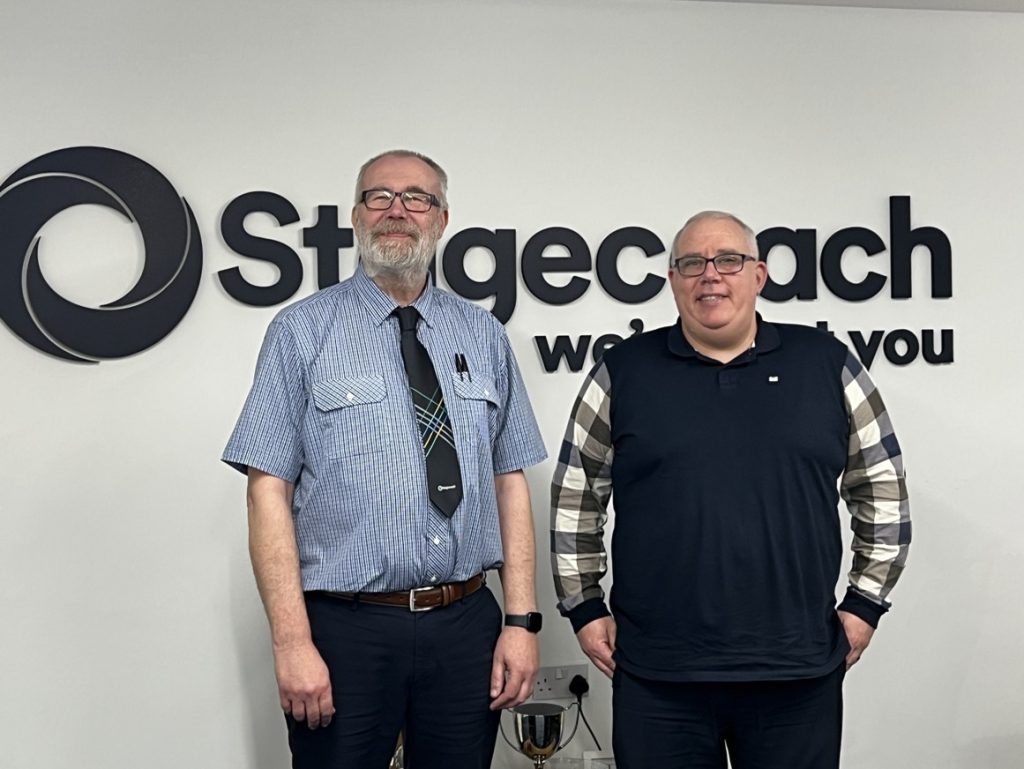
For Taff’s Well Operations Manager Phillip Morgan, the simulator thereby serves a dual-purpose, improving training while helping to reduce avoidable accidents. “It also boosts driver confidence and engagement,” he points out. “We have seen an enthusiastic response from staff wanting to come and use the simulator.”
Shaun Arthur, Relief Driving Instructor at Taff’s Well, supervises the simulator training; he has already noted a reduction in anxiety for new drivers after they have spent one to two hours on the simulator.
“I have been doing training for 10 years and one of the key issues we see is nervousness,” he explains. “When new starters first get in and are not yet sure of everything, we can see anxiety — around the size of the vehicle, around the controls. We are trying to eliminate as much of that as possible.”
Besides being a way to familiarise new starters and correct bad habits, one of the simulator’s biggest advantages is also the option to replicate risky scenarios in a safe environment, or recreate situations drivers may face, or have faced, in the real world. One visit from the Stagecoach Driving Excellence team mimicked distractions, such as bell ringing, to demonstrate to the driver of the simulator how easily focus can be diverted from the road.
Feedback gathering may also form part of the ongoing training, as the simulators allow the operator to capture reaction times. That can help see where drivers may have additional training requirements. For Stagecoach, which is audited as part of the GreenRoad initiative, the comparison of driver-on-driver data through the simulator could potentially be used when improving road scores. It also helps foster a sense of friendly competition between drivers — encouraging rewards for safer driving. Shaun says the drivers already see the simulator as an excellent tool for beginners.
“We haven’t extracted that data yet,” Phillip says, “but what we can do is look at a driver who has had no interaction with the simulator, and compare their data with a driver who is part of the simulator programme, and compare GreenRoad scores. We are very much still in the pilot stage, but going forward, there is a lot of data we can gather from this.”
Equally, if GreenRoad scores dip in one particular depot, the company has the capacity to deploy the simulator to address any training requirements that may be needed. Plans are for the Taff’s Well simulator to visit other sites operating under the Stagecoach South Wales operating company: Aberdare, Cwmbran, Bristol, Porth, and Merthyr Tydfil, as and when it is needed.
Future rollout
The use of such simulators may soon become a more common sight in training schools across the UK. Stagecoach is looking at the potential of rolling out the Simfor models to all 17 of its operating companies.
The decision follows recommendations from the Occupational Psychology Centre (OPC), which has worked with a number of operators of public transport across the UK, including Arriva, Edinburgh Trams, and Avanti West Coast Trains. One of the OPC report’s recommendations, in line with efforts to reduce avoidable road traffic collisions and address driver shortages, is the rollout of more driving simulators. Stagecoach has adopted its recommendations as part of its revamped Driver Excellence Programme, which sees more emphasis on driver support over the first two years.
When asked what the perfect bus driving simulator looks like, both Phillip and Shaun share their ideas.
Shaun notes one of the biggest drawbacks reported by drivers is the graphics. “We understand Simfor is in the process of improving that,” he says. “The more realistic we can make the scenarios, that will give whoever is using the simulator a better sense of conception.”
Phillip, meanwhile, sees an ideal simulator as offering some kind of live mapping option. “Something such as Street View, where we could drive routes and difficult areas, such as known congestion spots, or areas where we know drivers would benefit from remedial training in the interest of accident prevention,” he explains. “If we could identify areas in the real world, and be able to take our drivers back to those places in the simulator, it would be a huge benefit.”
But both are also quick to emphasise that the simulators are not seen as a replacement for real, on-the-road training.
“We want to get across that this doesn’t replace training — it’s an additional aid,” says Phil. “Anything we can do to improve safety is key to Stagecoach. We’re at the start of a very exciting project, which has the potential to grow with the use of artificial intelligence. But we are not looking to take away the experience of on-bus training; that will always be more critical than anything a simulator can offer.”