





















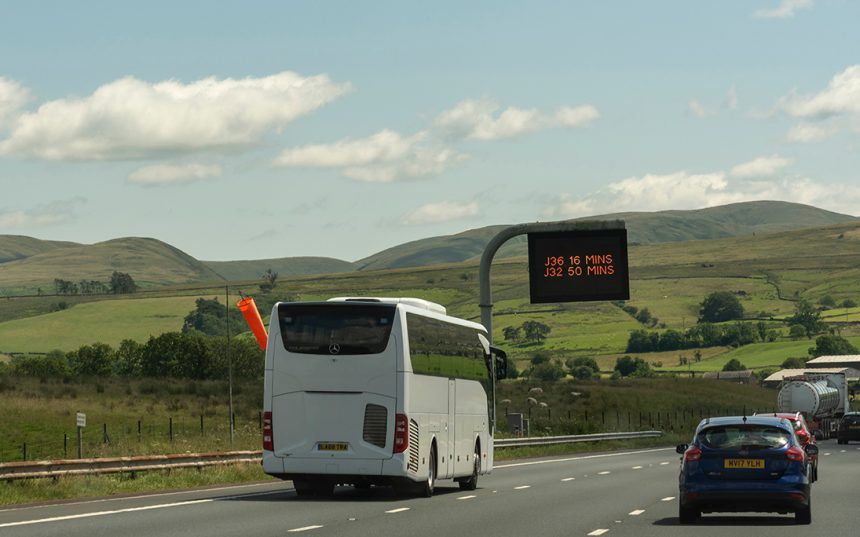
The coach sector has repeated calls for the government to revisit the assimilated drivers’ hours rules, arguing for the 12-day rule to be extended to domestic touring.
The calls come after Dave Parry, owner of Parrys International Tours, noted last month that the requirement for rest days on domestic touring is causing a “crisis” when it comes to staffing.
As the rules stand, drivers on non-regular services must take weekly rest after six consecutive 24-hour periods of working, starting from the end of the last weekly rest period taken. However, coach drivers on an international trip can take weekly rest after 12 consecutive 24-hour periods.
Operators have long argued that the rules are illogical, and do not consider realities of domestic touring — which can see coach tour drivers working fewer hours than regular service drivers and hauliers, as well as additional stops and downtime.
Adding to the frustration was a change to EU drivers’ hours rules in 2024, which extended the 12-day rule to national tours within European countries.
‘Lack of understanding’ at government level to blame?
Shortly after the publication of Mr Parry’s letter, Mark Purchase, former Operations Manager at the Confederation of Passenger Transport (CPT), reached out to note that the UK has put itself in the “worst possible situation” with regards to drivers’ hours rules.
He points out that Regulation (EC) No 561/2006 being written directly across into retained UK law after 31 January 2020 made sense “as a short term measure… we had already been following these rules for many years,” but that there was no need to include amendments made in 2020 by Regulation (EU) 2020/1054 — which included the requirement for tour drivers to have their work scheduled to allow a return to base every four weeks to undertake a 45-hour weekly rest, and changes to how part-time drivers record non driving time.
More ridiculous, he says, is that changes to drivers’ hours rules in Europe aimed at occasional services have not been adopted by the Department for Transport (DfT).
When asked why DfT did not adopt the changes made in Europe in 2024, Mr Purchase blames a lack of understanding at a government level, and a culture in which drivers’ hours rules cater more to the haulage industry than passenger transport.
“The problem is a lack of understanding at DfT about EU regulations and EU directives, as highlighted by the fact it initially refused to accept that AETR rules would apply to British drivers under the Interbus agreement,” he says.

Costs rack up for operators
Sergio Alves, owner of Bella Road Services in Pontyclun, says the UK’s six-day domestic drivers’ hours limit brings serious operational and financial impacts, particularly for seven- to nine-day UK tours.
He argues the rule is “illogical” and counterproductive as international tours typically involve longer distances, more fatigue, and more demanding driving than UK-only tours. Mid-tour driver changes in the UK bring the problem of finding relief drivers in peak locations such as Edinburgh, particularly during the summer season.
Costs then rack up when flying drivers from Cardiff or Bristol, paying for hotels and transfers, and even replacement coaches at short notices when drivers are not available.
Compounding these challenges are a lack of flexibility from some group organisers when it comes to extra costs. That means the operator must either absorb the extra costs, or refuse work.
“It’s been a ridiculous rule since day one,” Mr Alves says. “We have the power to make this simple with one rule: three days of rest for 12 days of consecutive driving. That doesn’t create any argument from our drivers. I am very glad Europe has updated its rules, and I can’t understand why the UK government is not engaging with us.”
Also calling for adoption of the 12-day rule is Director at MacPhails Coaches Martin MacPhail, who notes that Scottish domestic tours in his region are often less arduous than European touring, with shorter driving hours and more downtime — yet are subject to much tighter regulation.
For Mr MacPhail, mid-tour driver changes are a particular challenge in Scotland thanks to relief changes taking place in remote locations. Touring is therefore favoured in Ireland thanks to the application of international rules if vehicles enter the Republic.
In his work with CPT Scotland, multiple consultations with CPT UK explored how a domestic 12-day rule could be introduced. Mr MacPhail says proposals had been developed and escalated through CPT leadership, but momentum stalled due to the change in government in 2024.
“It has been versed at CPT level and batted away [by government],” he says. “Nobody has taken it on board and run with it. This goes back to a lack of understanding among office bearers about what is involved. I have yet to come across anyone who has given a pertinent reason as to why we have not changed the rule.”

Engagement with DfT
Mr Purchase fails to see why there is not more engagement from DfT on the issue. But he argues more energy can be directed to it if industry trade bodies unite their voices. “Really, the three main trade bodies of the industry need to come together and decide among themselves what to ask for,” he says. “It should be harder for them to be pushed away if they all go together.”
Last month, DfT was due to meet with RHA in one of its regular quarterly meetings — but the former postponed. Coach sector Operations Manager Andy Warrender says drivers’ hours was one of the topics he wished to broach.
“I can’t shed any light as to why a change hasn’t happened,” he says. “We have advocated for considerable time before it became EU policy, let alone when it came to play within the EU.
“We recognise it as a significant issue for operators and the intensity of those discussions has grown since the change to the legislation in Europe. There is a will within the industry to pursue it; but our understanding is it is not an easy process to amend.”